




Why does FCP’s $14.6 billion real estate investment strategy view South Florida as a high-conviction rental market?
FCP, the Chevy Chase, Maryland-based real estate investment company, has acquired District West Gables, a 427-unit apartment community in West Miami, Florida. Announced on August 26, 2025, the transaction highlights the firm’s momentum in one of the country’s most resilient rental housing markets. While the financial terms were not disclosed, the acquisition marks FCP’s third multifamily deal in South Florida in just nine months, a pace that underscores institutional confidence in Miami’s housing and employment fundamentals.
FCP has steadily grown its investment portfolio since its founding in 1999, amassing more than $14.6 billion in gross asset value across the United States. The firm is known for equity and structured investments in income-producing and development properties. In recent years, its strategy has increasingly leaned toward high-growth metropolitan markets such as Miami, where strong population inflows and economic diversification support rental demand.
Analysts following institutional real estate capital flows note that private firms like FCP are taking advantage of market volatility to secure assets in regions with long-term growth prospects. In Miami-Dade County, where demographic shifts, job creation, and constrained supply converge, such acquisitions are seen as positioning ahead of an expected recovery cycle.
What makes District West Gables a strategic acquisition for FCP in Miami-Dade County’s housing landscape?
District West Gables is strategically located just a few miles from Coral Gables’ downtown retail corridor and within easy reach of Miami’s most important employment clusters. Built in two phases between 2015 and 2017, the development offers a range of studio, one-, two-, and three-bedroom units housed in mid-rise structures with structured parking.
The property’s amenity mix is tailored to modern renter preferences, including two resort-style swimming pools, dual fitness centers, electric vehicle charging stations, a private movie theater, cabana-lined sundecks, and spacious resident lounges. Such features position it competitively in Miami’s increasingly amenity-driven rental market, where lifestyle and community offerings often determine tenant retention.
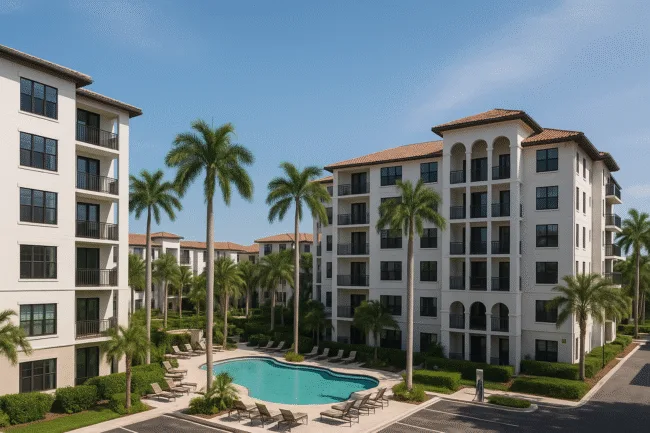
Perhaps more importantly, the community’s connectivity to Miami International Airport, the University of Miami, Florida International University, and the Brickell financial district enhances its appeal to working professionals and students alike. This locational advantage is central to FCP’s bet that District West Gables can sustain strong occupancy rates and above-average rent growth.
Bruce Gago, Senior Vice President at FCP and head of the firm’s Florida investments, remarked that executing transactions in today’s capital markets requires both conviction and capital. He said Miami-Dade’s demographic and economic tailwinds align closely with the company’s strategy, signaling confidence that rental demand in the submarket will remain resilient even amid tighter financial conditions.
How is FCP positioning District West Gables for long-term growth through property enhancements and operational strategy?
FCP plans to implement a value-enhancement program at District West Gables, targeting renovations in both unit interiors and shared community spaces. The initiative will focus on modernizing amenities and aligning them with the expectations of a younger, more mobile tenant demographic. With residents in Miami increasingly seeking high-quality, technology-enabled living spaces, such upgrades are seen as critical to sustaining competitive rent premiums.
The firm has appointed Greystar, one of the world’s largest multifamily property management companies, to oversee operations. The move is designed to ensure best-in-class leasing performance, operational efficiencies, and tenant services. Greystar’s involvement also adds institutional credibility, which is often viewed positively by lenders and investors monitoring performance benchmarks.
Industry observers describe this approach as consistent with a “core-plus” investment strategy—acquiring stabilized, well-located assets with potential for incremental value creation through upgrades and management improvements. By adopting this strategy, FCP positions the property to deliver both steady cash flows and capital appreciation over time.
Why are institutional investors continuing to deploy capital into Miami real estate despite market volatility?
FCP’s deal comes against a backdrop of elevated financing costs, cautious lending, and uneven rental growth across the United States. Yet Miami remains an outlier, with demand drivers that distinguish it from other large U.S. metro areas. Population growth continues to outpace national averages, driven by domestic migration from high-cost states and international inflows from Latin America and Europe. Employment growth in finance, technology, and healthcare adds another layer of resilience, broadening the tenant base beyond tourism and hospitality.
Analysts emphasize that Miami’s limited land availability and regulatory constraints on new construction further reinforce the investment thesis. Even as multifamily completions have increased in parts of the Sun Belt, Miami’s supply remains constrained relative to demand. This dynamic supports continued rent growth, albeit at a more moderate pace than the double-digit surges recorded during the post-pandemic housing boom.
Institutional investors view these fundamentals as a hedge against national volatility. By acquiring assets in Miami, firms like FCP seek stable occupancy, pricing power, and long-term appreciation. The District West Gables acquisition, therefore, fits neatly into a broader strategy of concentrating capital in resilient, supply-constrained markets.
How does this deal fit into FCP’s broader U.S. investment portfolio and Florida expansion strategy?
Nationally, FCP has invested across multiple asset classes, including multifamily housing, commercial properties, and development projects. Its approach blends direct acquisitions with partnerships alongside experienced operating groups. Over the past several years, the firm has accelerated its presence in Sun Belt markets where migration and job creation underpin long-term demand.
Florida, in particular, has emerged as a focal point for the firm. The District West Gables transaction marks FCP’s third South Florida acquisition in under a year, signaling an aggressive build-out of its regional portfolio. Analysts see this as part of a wider trend: mid-sized institutional investors reallocating capital away from mature, slower-growth markets like New York and San Francisco toward high-growth metros such as Miami, Tampa, Austin, and Dallas.
This regional focus reflects both opportunity and necessity. With national transaction volumes down due to interest rate pressures, capital is chasing markets where fundamentals remain strongest. By deepening its Florida footprint, FCP strengthens its positioning in a state that continues to draw significant institutional attention.
What are the broader implications of FCP’s Miami acquisition for institutional sentiment and the U.S. multifamily sector?
Investor sentiment around U.S. multifamily housing remains mixed. While long-term fundamentals are viewed as strong, near-term challenges include higher borrowing costs, moderation in rental growth, and valuation adjustments. However, South Florida has emerged as one of the few markets consistently attracting institutional capital, often commanding lower cap rates than peer metros due to its perceived resilience.
For FCP, the District West Gables deal not only expands its asset base but also signals to the market that private real estate firms remain willing to transact at scale, even in uncertain conditions. Institutional investors interpret such moves as evidence of selective conviction—that capital is being deployed into markets where fundamentals justify the risk.
Longer-term, the deal reinforces Miami’s reputation as a global real estate hub. With international investors also active in the market, U.S. firms like FCP are positioning to compete for assets that can serve as both income-generating properties and long-term capital preservation plays.
What do market experts expect for Miami’s rental housing outlook following this acquisition?
Looking ahead, analysts expect Miami’s multifamily market to remain undersupplied relative to demand, supporting rent growth and high occupancy. However, they caution that affordability pressures could limit the pace of increases, particularly as wages lag behind housing costs. Developers face rising construction costs, regulatory hurdles, and limited land availability, which are likely to constrain new supply.
For District West Gables, the value-enhancement program and Greystar’s management expertise are expected to position the property to outperform the market average. With access to major employment hubs and a comprehensive amenity package, the community is well placed to attract a diverse tenant base.
Institutional sentiment is that Miami will continue to rank among the top U.S. markets for multifamily investment in the coming years. FCP’s acquisition adds further evidence that private capital remains bullish on the city’s long-term trajectory, even as the broader market recalibrates.
Discover more from Business-News-Today.com
Subscribe to get the latest posts sent to your email.
