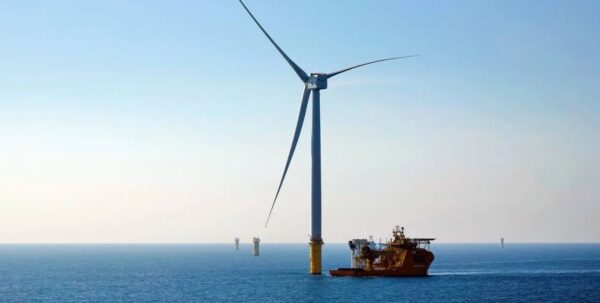



Equinor is reshaping the floating wind industry with its next-generation digital twin at Hywind Tampen, the world’s largest floating offshore wind farm. Fully commissioned in late 2022 and fully integrated into Norway’s offshore grid by May 2023, the project supplies approximately 35% of the electricity consumed by the Gullfaks and Snorre oil platforms. With an installed capacity of 88 MW across eleven 8.6 MW turbines, Hywind Tampen accounts for nearly 47% of global floating wind capacity, underscoring its importance in Equinor’s long-term offshore strategy.
The farm is not only a milestone in offshore renewable generation but also a showcase for how digitalization is transforming deep-water wind economics. Equinor’s decision to integrate predictive maintenance into floating wind operations demonstrates a shift from reactive to proactive asset management. Early operational data from Q1 2025 already places Hywind Tampen ahead of most conventional offshore wind farms, making it a crucial case study for energy transition analysts and institutional investors tracking operational efficiency improvements in renewable infrastructure.
How is Equinor’s digital twin technology improving efficiency and predictive maintenance at Hywind Tampen’s floating offshore wind farm?
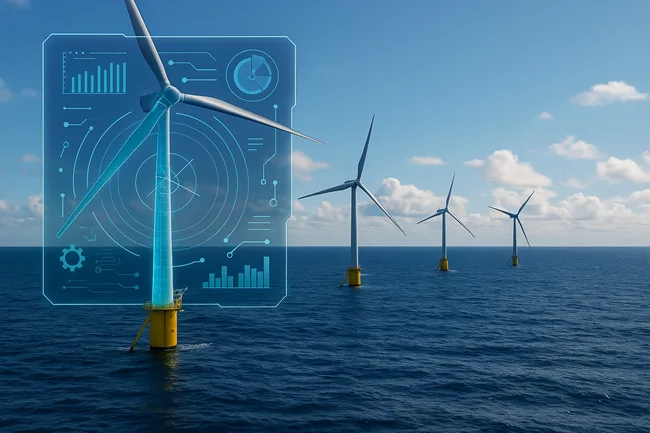
The Hywind Tampen digital twin is a virtual replica of the physical turbines, built in collaboration with the Norwegian University of Science and Technology (NTNU). Developed using Unity 3D for advanced visualization and OPC‑UA protocols for real-time data transfer, the system continuously streams mechanical, thermal, and weather data. Machine learning models, including Prophet time-series prediction, analyze this data to forecast component stress patterns days before they escalate into critical faults.
This predictive capability is particularly valuable for floating wind, where harsh environmental conditions often lead to expensive unplanned maintenance. Bearing stress and gearbox issues—problems that plagued early floating wind projects such as Hywind Scotland—are now detected early enough to schedule maintenance windows without disrupting output. Engineers use augmented-reality overlays to view these stress points in real time, allowing for targeted interventions rather than broad, time-consuming inspections.
Performance data reinforces the value of this approach. Hywind Tampen recorded a 58.4% capacity factor and 95.2% production-based availability in Q1 2025, according to Equinor’s updates. The farm produced approximately 115.7 GWh during the same quarter, placing it among the best-performing offshore wind farms globally. By replacing gas-turbine-generated electricity on nearby platforms, Equinor estimates annual CO₂ reductions of roughly 200,000 t and NOₓ reductions of around 1,000 t. Such emissions savings are critical for oil and gas operators under increasing pressure to meet ESG commitments.
The digital twin also optimizes power delivery by modeling how turbines respond to varying wave heights and wind shear in deep-water conditions. By simulating different operational scenarios, the system helps operators adjust blade angles and rotation speeds for optimal efficiency. This kind of granular control is key to achieving consistent output in water depths of 260–300 m, where Hywind Tampen’s concrete spar structures are anchored.
Equinor’s approach extends beyond Hywind Tampen. The same Echo digital twin platform supports over fifty Equinor-operated installations, including subsea carbon storage initiatives such as Northern Lights. Analysts believe that this interoperability will eventually allow cross-project data sharing, where lessons learned in floating wind can optimize offshore carbon capture and other low-carbon infrastructure.
From an industry perspective, Hywind Tampen is helping set the standard for Industry 4.0 compliance in offshore energy. Its edge-to-cloud data integration, machine-learning diagnostics, and AR-assisted maintenance are aligned with emerging international standards for asset administration shells, making future cross-platform interoperability possible. For deep-water wind developers, this means lower lifecycle costs and reduced reliance on human inspection teams—a significant factor for projects being planned in South Korea, Japan, and Australia.
Equinor’s expansion plans indicate that Hywind Tampen’s twin-driven model will likely influence new floating wind projects. In South Korea, for instance, regulatory approvals for deep-water wind developments are increasingly tied to demonstrated predictive maintenance capabilities and proven digitalization strategies. By adopting this model early, Equinor strengthens its competitive positioning against rivals such as Ørsted and RWE, which are also experimenting with AI-driven maintenance systems but have yet to achieve comparable floating wind scale.
The success of Hywind Tampen also carries financial implications. Institutional investors evaluating floating wind as a long-term asset class are particularly sensitive to operational expenditure (OPEX) trends. Predictive maintenance not only reduces unplanned downtime but also extends turbine lifespans, improving return on investment for high-capital projects. This is crucial as the industry shifts from subsidy-supported models to merchant power pricing.
As international forums such as COP‑Renewables continue to highlight the role of digitalization in the energy transition, Hywind Tampen’s performance is likely to attract further PR and investor attention. If similar systems are deployed across new Equinor projects, they could help floating wind achieve cost parity with fixed-bottom offshore wind sooner than previously forecast.
Discover more from Business-News-Today.com
Subscribe to get the latest posts sent to your email.