




Ingenia Communities Group (ASX: INA), a Sydney-based owner and developer of land-lease communities, seniors accommodation and holiday parks, has rejected an improved A$2.06 billion takeover proposal from Warburg Pincus, arguing that the revised A$5.05-per-security cash offer still substantially undervalues the company. The September 21 rejection marks the second time Ingenia’s board has turned down the United States private equity group and intensifies a contest that is becoming inseparable from Ingenia’s own planned acquisition of residential developer Peet Limited.
Warburg Pincus increased its indicative proposal from A$4.75 to A$5.05 per Ingenia stapled security, lifting the implied equity value by roughly 6.3% from its first approach. Reuters calculated the revised proposal at approximately A$2.06 billion, equivalent to about $1.47 billion, while the offer represents a 16.9% premium to Ingenia’s latest closing price before the revised bid became public. Ingenia’s board, after taking advice from Greenhill and external legal advisers, again concluded that the price did not adequately reflect the value of the business or its growth prospects.
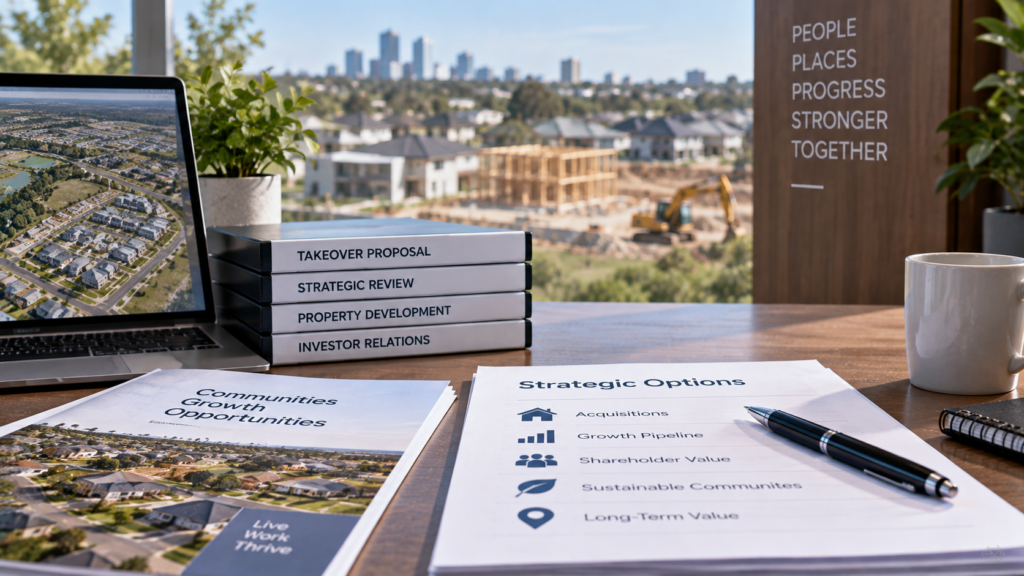
The takeover contest has an unusual strategic condition attached to it. Warburg Pincus wants Ingenia to abandon its proposed acquisition of Peet Limited before proceeding with a recommended takeover, while Ingenia continues to argue that buying Peet is central to its plan to create a larger Australian living-sector platform. That leaves shareholders weighing two very different paths: a fully funded cash exit to private equity or continued exposure to a more ambitious and substantially larger property-development strategy.
Why did Ingenia Communities reject Warburg Pincus’s A$5.05 takeover offer?
The board’s central argument is that the improvement from A$4.75 to A$5.05 per security is not large enough to compensate shareholders for surrendering the long-term value of Ingenia’s existing portfolio and development pipeline. The revised proposal remains non-binding and conditional, including on due diligence, regulatory approvals, definitive documentation and unanimous board support. Ingenia has said it remains open to proposals that represent compelling value, signalling that it is not rejecting a sale in principle but is unwilling to recommend the current price.
Warburg Pincus views the situation differently. The private equity firm has pointed to the cash certainty embedded in its proposal and the premium available to investors compared with where Ingenia traded before takeover speculation intensified. The bid is also backed by committed equity and debt financing, reducing the risk that a future binding proposal would depend on Warburg arranging funding after securing board support.
The disagreement therefore centres less on whether A$5.05 represents a premium and more on which valuation reference point should matter. Warburg is emphasising certainty and the current public-market price, while Ingenia is effectively asking shareholders to value the business according to its land-lease growth strategy, operating portfolio and the additional development pipeline it expects to obtain through Peet.
Why has the Peet acquisition become central to the Warburg Pincus takeover battle?
Ingenia agreed in August to acquire Peet Limited (ASX: PPC), one of Australia’s established master-planned community developers, in a transaction valuing Peet at approximately A$992.5 million. Under the proposed scheme, Peet shareholders would receive A$0.68 in cash plus 0.3367 Ingenia stapled securities for each Peet share, implying approximately A$2.12 per share when the transaction was announced.
The acquisition would give Ingenia a much larger residential development pipeline and extend the company beyond its traditional land-lease communities, holiday parks and seniors accommodation businesses. Ingenia says the combination would secure approximately 5,000 to 7,000 potential land-lease conversion lots with an estimated end value of around A$1 billion while creating a broader national living-sector platform.
Warburg Pincus sees that same transaction as a reason for caution. Its revised takeover proposal remains conditional on Ingenia abandoning the Peet acquisition, effectively offering shareholders an alternative to the strategy management is pursuing. The private equity group is asking investors to accept cash today rather than assume the development, integration and housing-market risks associated with adding a traditional residential development business to Ingenia’s existing platform.
This creates a highly unusual M&A dynamic because Ingenia is simultaneously an acquisition target and an acquirer. The value of Warburg Pincus’s takeover cannot be considered independently of Peet because cancelling the Peet deal is one of the bidder’s central conditions, while completing it could materially change Ingenia’s future earnings mix, capital requirements and risk profile.
What would Peet add to Ingenia Communities if the deal proceeds?
Peet gives Ingenia exposure to master-planned residential communities at a scale it does not currently possess. Founded in 1895, the Perth-based developer controls projects across multiple Australian states and has built a large pipeline of residential lots, including its significant Flagstone City development in Queensland.
Ingenia’s strategic argument is that Peet can provide a long-term supply of sites capable of being converted into land-lease communities. Land-lease housing has become an important part of Ingenia’s growth model because residents generally own their homes while leasing the underlying land, allowing the operator to generate recurring rental income while reducing some of the capital intensity associated with conventional residential ownership.
The transaction would nevertheless push Ingenia deeper into traditional property development, where earnings can be more cyclical and exposed to housing demand, financing conditions and settlement timing. That explains some of the scepticism around the Peet acquisition and helps clarify why Warburg Pincus is using cancellation of the deal as a condition of its own takeover proposal. Reuters noted that the Peet transaction was announced against a backdrop of softer residential property conditions in Australia, adding another layer of execution risk.
How has the market reacted to the revised Warburg Pincus bid?
Ingenia shares moved higher after the board disclosed the improved proposal and its rejection. Reuters reported a gain of about 2.6% during September 21 trading, while market data later showed the securities around A$4.42 to A$4.43, still below Warburg Pincus’s A$5.05 indicative price.
That discount is important. If investors were certain a transaction at A$5.05 would proceed, the market price would normally move much closer to the offer, adjusted for time and execution risk. Instead, the gap reflects uncertainty over whether Warburg will improve its terms, whether Ingenia will eventually engage, whether the Peet acquisition proceeds first or whether the takeover process ends without a binding transaction.
Ingenia shares have also been volatile around the Peet strategy itself. The stock fell sharply when the Peet acquisition was announced in August, while Peet shares rose as investors responded to the takeover premium. That reaction demonstrated that some Ingenia shareholders initially questioned the strategic and financial consequences of the proposed combination even before Warburg Pincus entered the picture.
Why does Warburg Pincus want Ingenia Communities?
Ingenia gives Warburg Pincus access to a portfolio concentrated in sectors supported by demographic and housing trends rather than conventional office or retail property. The company operates lifestyle communities, long-term rental accommodation, seniors housing and holiday parks, with exposure to residents seeking lower-maintenance housing and retirees looking for accommodation outside traditional aged-care structures.
Land-lease communities can appeal to long-duration investors because they combine property exposure with recurring rental income and a development pipeline. Residents typically purchase their home while the operator retains ownership of the land, creating a different capital and earnings profile from traditional homebuilding.
Warburg Pincus also has substantial experience investing in real estate across Asia-Pacific. The firm has deployed more than $9 billion across the region’s property sector, according to reporting around the latest Ingenia proposal, giving it familiarity with residential and living-sector investment models.
The current disagreement therefore appears to be about price and strategy rather than whether Ingenia is an attractive asset. Warburg has returned quickly with a higher proposal after its first rejection, which demonstrates continued interest, while Ingenia has repeatedly left the door open to a more compelling valuation.
Could Warburg Pincus increase its Ingenia bid again?
A third proposal is possible, particularly because Ingenia has not categorically ruled out discussions at a higher valuation. Reuters cited Citi analysts as suggesting that a price in the A$5.25 to A$5.50 range could become more compelling to shareholders given current market conditions, although that is an external analyst assessment rather than guidance from Ingenia’s board.
Warburg Pincus also faces a timing challenge. The Peet acquisition is progressing through its own transaction timetable, meaning the opportunity to derail that deal becomes more complicated as shareholder and court processes advance. Warburg has emphasised that there is a limited window for further engagement before the Peet transaction reaches later implementation stages.
Ingenia, meanwhile, has appointed Greenhill, a Mizuho affiliate, as an independent adviser in addition to its existing financial and legal advisers. That strengthens the board’s ability to assess whether any future Warburg proposal provides enough incremental value to justify abandoning the Peet strategy.
What does the Ingenia battle say about Australian M&A in 2026?
The takeover is unfolding during an unusually active period for Australian corporate transactions, particularly involving foreign private equity and infrastructure capital. Recent approaches and transactions have involved companies across infrastructure, property, financial services, industrials and utilities, with overseas buyers attracted by Australian assets that combine mature cash flows, scarce infrastructure and comparatively transparent regulatory frameworks.
The Ingenia situation adds another characteristic increasingly visible in these deals: boards are resisting headline premiums when they believe public markets are undervaluing long-term development assets. A bid can look generous relative to a depressed share price while still appear inadequate against management’s assessment of future project value, creating prolonged contests between cash certainty and strategic optionality.
For Ingenia shareholders, that tension is particularly pronounced because the company is not simply deciding whether to remain independent. Rejecting Warburg also means continuing toward the Peet acquisition, which would materially enlarge the business and increase its exposure to master-planned residential development.
The next move therefore matters on both sides of the transaction. Warburg Pincus must decide whether A$5.05 is its final economic limit or merely another step in negotiations, while Ingenia must demonstrate that pursuing Peet can create more value than accepting a cash takeover at a substantial premium to where the securities traded before the private equity interest emerged.
Discover more from Business-News-Today.com
Subscribe to get the latest posts sent to your email.