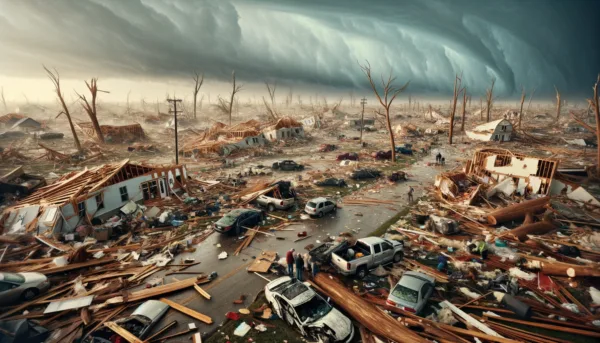
A major search-and-rescue operation is under way in Indonesia after the passenger ship Virgo Transport 8 overturned in the Java Sea with 243 people onboard, leaving 130 people unaccounted for as of September 13. Indonesian authorities said 113 people had been evacuated, including 107 survivors, while six people had died following one of the country’s most serious recent maritime emergencies.
The vessel had departed Surabaya in East Java on Saturday for Banjarmasin in South Kalimantan with 213 passengers and 30 crew members. It lost contact with authorities during deteriorating weather early Sunday, initially prompting reports that it had sunk. Transport Minister Dudy Purwagandhi later clarified that aerial observations indicated the vessel had overturned rather than completely sunk beneath the surface, while investigators had not yet determined what caused the accident.
What happened to Virgo Transport 8 on the Surabaya-Banjarmasin route?
Virgo Transport 8 was travelling across the Java Sea, one of Indonesia’s important domestic maritime corridors, when authorities lost communication with the vessel amid rough conditions. Search teams subsequently located the overturned ship and began coordinating evacuations and searches across a wide maritime area.
The difference between a vessel overturning and sinking is operationally significant. An overturned hull can potentially provide temporary flotation or shelter for passengers who remain trapped in air pockets, while floating debris and survivors may remain concentrated relatively close to the accident site depending on currents and weather.
Authorities deployed ships and aerial resources to the vessel’s last known position, while survivors were transported toward ports in East Java and South Kalimantan. Search teams face a rapidly changing environment because wind, waves and currents can expand the potential search area substantially within hours.
Why are 130 people still missing despite more than 100 successful evacuations?
Passenger accounting after a major maritime accident is rarely straightforward. Authorities must reconcile the official passenger manifest with survivors picked up by multiple rescue vessels, people potentially rescued by commercial ships and those who may have reached land without immediately reporting to the central command post.
The number of missing people can therefore change rapidly during the first phase of an operation. The current figures indicate 243 people were believed to be aboard, with 113 evacuated and six of those subsequently confirmed dead, leaving approximately 130 still being sought.
Rescuers must simultaneously inspect the overturned vessel and search open water. If passengers entered the sea without flotation equipment, the combination of exposure, waves and distance from shore becomes increasingly dangerous as time passes, making the first 24 to 48 hours particularly important.
Did bad weather cause the Java Sea ship accident?
Bad weather was reported when the vessel lost contact, but Indonesian authorities have not established that weather alone caused the ship to overturn. Investigators will need to examine sea conditions alongside vessel stability, cargo distribution, loading practices, mechanical systems and decisions made by the crew before the incident.
Ships can become vulnerable when weight shifts unexpectedly during severe rolling, particularly when vehicles or cargo are carried aboard. Investigators may therefore examine whether loads were correctly secured and whether water entered areas that could have affected stability.
It would be premature to identify a specific technical failure before the vessel is inspected. Indonesia’s transport minister has said the cause remains under investigation, making the weather an important circumstance rather than a confirmed explanation.
Why does Indonesia experience repeated passenger ferry and ship accidents?
Indonesia’s geography makes maritime transportation unavoidable. The country consists of more than 17,000 islands, and millions of residents depend on ferries and passenger ships for journeys that would be handled by roads or railways in more geographically concentrated economies.
That enormous network creates a regulatory challenge involving thousands of vessels, ports and routes operating in widely differing weather and infrastructure conditions. Indonesia has strengthened maritime regulation after previous high-profile disasters, yet accidents involving overcrowding, weather, maintenance and safety compliance have continued to occur. Reuters noted that the country remains heavily dependent on ferries and has a relatively high maritime accident rate.
Rapid expansion of inter-island commerce adds additional complexity. Passenger vessels often operate alongside roll-on/roll-off traffic and commercial cargo, requiring regulators to monitor not only passenger capacity but also vessel stability and cargo-loading practices.
What will investigators examine once Virgo Transport 8 is stabilised or recovered?
The first technical priority will be establishing how the vessel lost stability. Investigators can examine loading records, vessel maintenance, navigation systems, weather information available to the captain, communications before contact was lost and the physical condition of the hull.
Passenger records will also matter. Accurate manifests are critical in maritime disasters because rescue authorities need to know exactly how many people should be accounted for, particularly when several vessels participate in evacuations.
Indonesia could face renewed scrutiny over enforcement if investigators identify preventable failures. However, the immediate priority remains finding the missing rather than assigning responsibility before technical evidence becomes available.
Could the death toll rise as the Java Sea search continues?
The risk is substantial while 130 people remain missing, although a missing designation does not mean all have died. Previous maritime emergencies have produced survivors after extended periods, particularly where overturned vessels provided flotation or individuals were picked up away from the main accident site.
Weather will be one of the decisive factors. Calm conditions make aerial observation and small-boat searches easier, while heavy seas reduce visibility and accelerate the movement of people and debris away from the original location.
The next major developments will therefore be the number of additional survivors located, whether rescuers can gain access to the vessel and whether investigators can confirm how the ship overturned. Until the passenger count is reconciled, the Virgo Transport 8 disaster remains both a rescue operation and an unresolved maritime safety investigation.
Discover more from Business-News-Today.com
Subscribe to get the latest posts sent to your email.