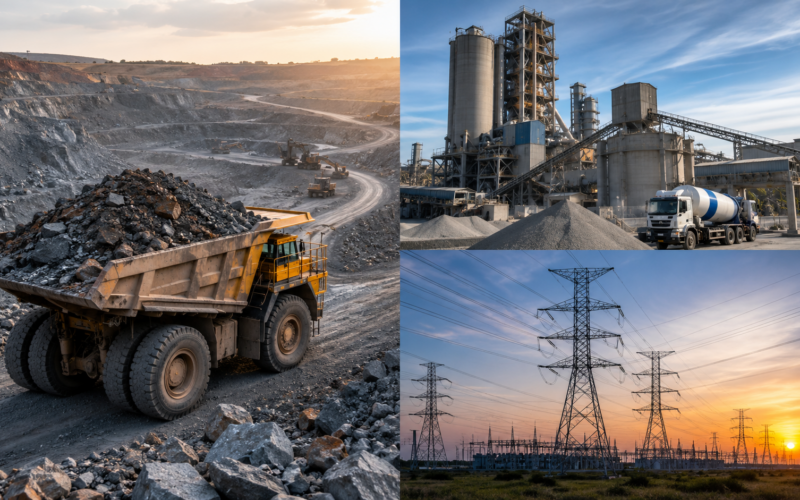
India’s nine core industries expanded 5.4% year on year in July 2026, maintaining relatively strong infrastructure-linked momentum even as growth moderated from the revised 6% recorded in June. Iron ore production increased 29.5%, cement output rose 13.1% and electricity generation climbed 9%, making the three sectors the principal drivers of the latest Index of Core Industries reading.
The provisional data also showed a broader improvement over the opening four months of the previous financial year. Core-sector output increased 4.3% during April-July 2026 compared with growth of 1.5% in the corresponding period a year earlier, suggesting that stronger construction, mining and power activity is providing support to India’s industrial economy despite continued weakness in domestic hydrocarbon production.
The July reading comes shortly after the government overhauled the Index of Core Industries by shifting the base year to 2022-23 and adding iron ore as a ninth core industry. The revised framework gives electricity the largest weight at 30.932%, followed by refinery products at 22.572% and steel at 17.584%, meaning movements in these sectors can have a substantial influence on the overall index.
Which industries drove India’s 5.4% core-sector growth in July 2026?
Iron ore was the fastest-growing component in July, with production up 29.5% from a year earlier. The sector has also been exceptionally strong on a cumulative basis, with output rising 25.2% during April-July compared with the same period of 2025-26.
Cement provided another important growth signal, increasing 13.1% in July and 9.9% during the first four months of the financial year. That performance is particularly relevant to the broader economy because cement demand is closely connected with housing, roads, urban infrastructure, industrial construction and government capital expenditure.
Electricity generation increased 9% year on year in July, while cumulative growth during April-July reached 9.3%. Given electricity’s nearly 31% weight in the revised core-industries index, sustained power-generation growth provides a significant numerical contribution to the headline figure and can also indicate higher economic activity across industrial and commercial consumers.
Coal output increased 7.6% in July following weaker performance earlier in the financial year. Despite the monthly improvement, cumulative coal production remained 3.1% lower during April-July, showing that the sector has not yet fully recovered the output lost during the opening months.
Steel production increased 2.9% year on year in July and 4.5% cumulatively during April-July. The growth rate is considerably more moderate than cement, but continued expansion in both materials is broadly consistent with ongoing construction and infrastructure activity.

Why does the new nine-industry index change how India’s infrastructure data should be read?
India introduced a revised Index of Core Industries with 2022-23 as the base year in July, replacing the older 2011-12 series. The most visible change was the inclusion of iron ore as a ninth core industry because of its importance to steel production, infrastructure and the broader industrial economy.
The methodology for steel was also changed to use gross production rather than net production, bringing the measure closer to the approach used in the Index of Industrial Production. Coal coverage was narrowed to raw coal by excluding washed coal and coal middlings to reduce the risk of double counting products derived from the same underlying coal output.
These changes matter when readers compare current growth rates with older headline numbers because the composition and weights of the index are now different. The government has produced a back series to allow historical comparisons under the revised methodology, but the new structure gives iron ore an explicit 4.905% weight while altering the relative importance of several existing industries.
The July data are therefore among the first monthly readings under a framework designed to reflect more closely the structure of India’s contemporary industrial economy. Iron ore’s strong performance also demonstrates why its inclusion can materially affect interpretations of infrastructure momentum, particularly during periods when mining production grows much faster than traditional energy sectors.
Which parts of India’s core economy are still contracting?
The July figures were not uniformly positive. Crude oil production declined 5.3% year on year and was down 4.3% cumulatively during April-July, extending a persistent challenge for India’s domestic upstream energy sector.
Natural gas production fell 3.7% in July and 4.4% during the first four months of the financial year. Continued declines in oil and gas output can increase India’s dependence on imported energy when domestic demand remains strong, making upstream production trends relevant not only to industrial output but also to the trade balance and energy security.
Fertiliser production declined 8% in July and 5.2% cumulatively, representing the sharpest contraction among the nine industries during the month. The weakness deserves attention because fertiliser availability and imports can influence agricultural input costs and government subsidy requirements, particularly ahead of important crop cycles.
Refinery products offered a more mixed picture. Production increased 2.7% year on year in July, but cumulative output remained 2.5% lower during April-July, indicating that the monthly recovery has not yet erased weakness from earlier in the financial year.
The result is therefore a two-speed core-sector picture. Construction-linked materials, electricity and iron ore are expanding relatively strongly, while domestic hydrocarbons and fertilisers remain under pressure.
What does stronger April-July growth indicate for India’s wider industrial economy?
The acceleration in cumulative core-sector growth from 1.5% a year earlier to 4.3% in April-July 2026 provides a constructive signal ahead of subsequent industrial-production and economic-growth data. Core industries represent important upstream inputs for manufacturing, infrastructure and utilities, so sustained increases can feed into activity across multiple sectors.
The composition of growth is arguably as significant as the headline 5.4% figure. Strong cement, electricity and iron ore output points towards continued investment and construction activity, areas that have been central to India’s recent capital-expenditure cycle, while the recovery in coal during July suggests some improvement in domestic energy supply after a weak start to the year.
At the same time, crude oil and natural gas contractions remain a structural counterweight. India can sustain industrial growth while importing more energy, but doing so leaves the economy more exposed to global commodity prices, shipping disruptions and exchange-rate movements, particularly when international oil markets are volatile.
July’s data therefore suggest that India’s infrastructure-facing economy retains momentum even as the headline growth rate eased from June. Whether that strength broadens will depend on manufacturing demand, private investment, construction activity and the ability of weaker energy and fertiliser sectors to stabilise during the remaining months of 2026-27.
Discover more from Business-News-Today.com
Subscribe to get the latest posts sent to your email.