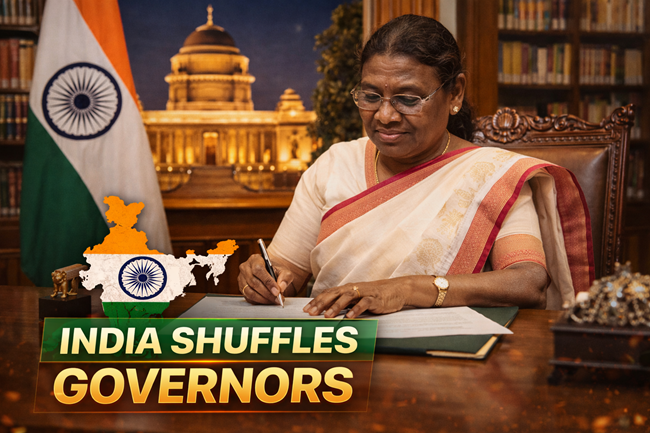
President of India Droupadi Murmu approved a major reshuffle of Governors and Lieutenant Governors across nine states and Union Territories on the night of 5 March 2026, triggering a significant reconfiguration of Raj Bhavans from West Bengal to Ladakh. The appointments were announced through an official communique issued by Rashtrapati Bhavan and will take effect from the dates on which the respective appointees assume charge of their offices.
The reshuffle was announced on the same day that President Murmu accepted the resignation of Dr C.V. Ananda Bose as Governor of West Bengal. Tamil Nadu Governor R.N. Ravi has been appointed the new Governor of West Bengal, succeeding Bose. Kerala Governor Rajendra Vishwanath Arlekar will discharge the additional functions of the Governor of Tamil Nadu until a permanent appointment is made to that office.
In the Union Territory of Delhi, former Indian Foreign Service officer and retired diplomat Taranjit Singh Sandhu has been appointed Lieutenant Governor, replacing Vinai Kumar Saxena, who has been transferred to Ladakh as Lieutenant Governor. Sandhu served as India’s Ambassador to the United States from 2020 to 2024 and contested the 2024 Lok Sabha election from the Amritsar constituency as a Bharatiya Janata Party candidate after retiring from diplomatic service. He is the first Sikh Lieutenant Governor of Delhi.
Kavinder Gupta, who was serving as Lieutenant Governor of Ladakh since July 2025, has been appointed Governor of Himachal Pradesh. Gupta, a senior Bharatiya Janata Party leader from Jammu, previously served as Speaker of the Jammu and Kashmir Legislative Assembly and briefly as Deputy Chief Minister of the erstwhile state of Jammu and Kashmir in 2018. Saxena’s transfer to Ladakh follows Gupta’s redeployment to Himachal Pradesh.
Himachal Pradesh Governor Shiv Pratap Shukla has been appointed the new Governor of Telangana. Shukla, who is originally from Gorakhpur in Uttar Pradesh, is a senior Bharatiya Janata Party leader who has been elected four times as a Member of the Legislative Assembly, served three terms as a Union Minister, and has been a member of the Rajya Sabha. He began his political career through the Akhil Bharatiya Vidyarthi Parishad.
Telangana Governor Jishnu Dev Varma has been transferred to Maharashtra as Governor. Dev Varma is a senior Bharatiya Janata Party leader from Tripura who served as the Deputy Chief Minister of Tripura from 2018 to 2023 and was appointed Governor of Telangana by President Murmu in July 2024.
Lieutenant General (Retired) Syed Ata Hasnain has been appointed Governor of Bihar, taking over from Arif Mohammed Khan, who had held the position since January 2025. Hasnain is a decorated former Indian Army officer widely recognised for his service in counterinsurgency and security operations. Former Bihar Legislative Assembly Speaker Nand Kishore Yadav has been appointed Governor of Nagaland. The Nagaland Raj Bhavan had been functioning under the additional charge of Manipur Governor Ajay Kumar Bhalla since August 2025.
West Bengal Chief Minister Mamata Banerjee responded to the announcement by stating that Union Home Minister Amit Shah had informed her of Ravi’s appointment by telephone but had not consulted her beforehand, which she described as a departure from convention. Banerjee stated on social media that she would not be surprised if former Governor Bose had been subjected to pressure to serve particular political interests ahead of forthcoming state assembly elections. Banerjee described herself as shocked and deeply concerned by the circumstances surrounding Bose’s resignation.
Why has West Bengal received a new governor just before the state assembly elections?
West Bengal’s assembly is among those whose terms are set to expire in the near term, placing the state at the centre of national political attention. The resignation of C.V. Ananda Bose and his replacement with R.N. Ravi, who had a contentious relationship with the Tamil Nadu government during his tenure there, has intensified scrutiny of the Centre’s intentions. Ravi was transferred out of Tamil Nadu in 2023 following a series of disputes with the Dravida Munnetra Kazhagam administration led by Chief Minister M.K. Stalin over the constitutional boundaries of the gubernatorial office. His appointment to West Bengal, where the ruling Trinamool Congress government is in sustained political conflict with the Bharatiya Janata Party-led central government, has drawn immediate commentary from political observers across the country.
Under the Constitution of India, Governors are appointed by the President on the advice of the Council of Ministers headed by the Prime Minister. Governors serve at the pleasure of the President and may be transferred or removed without a fixed term. While the role is defined as largely ceremonial, Governors hold significant discretionary powers in situations involving the formation of government, the summoning and prorogation of legislative assemblies, and the grant of assent to state legislation. In opposition-governed states, the relationship between Raj Bhavans and elected governments has frequently been a source of constitutional dispute in recent years.
What is the significance of appointing a former diplomat as Lieutenant Governor of Delhi?
The appointment of Taranjit Singh Sandhu as Lieutenant Governor of Delhi is notable given the specific character of governance in the national capital. Delhi operates under a unique constitutional arrangement in which the Lieutenant Governor holds executive powers that exist in tension with those of the elected Delhi government. The Supreme Court of India has issued multiple judgments clarifying the distribution of authority between the two offices, most recently reinforcing the primacy of the elected government over the civil services. Sandhu’s background in high-level diplomacy, including four years managing India’s most strategically important bilateral relationship with the United States, distinguishes him from many previous occupants of the post.
Sandhu studied at The Lawrence School, Sanawar, and holds a master’s degree in International Relations from Jawaharlal Nehru University. He is widely regarded within India’s foreign policy establishment as one of the country’s most experienced hands on United States affairs. His transition from diplomacy to the Bharatiya Janata Party and then to a constitutional post follows a pattern seen with other recently retired senior officials.
How does the reshuffle affect Telangana, Maharashtra, Bihar, Nagaland, and Himachal Pradesh?
The chain of transfers across Telangana, Maharashtra, Bihar, Nagaland, and Himachal Pradesh reflects a broader rationalisation of gubernatorial positions. Telangana receives Shiv Pratap Shukla from Himachal Pradesh, while Maharashtra receives Jishnu Dev Varma from Telangana. Both states have significant assembly elections in their political calendars. In Bihar, the appointment of a decorated military officer, Lieutenant General (Retired) Syed Ata Hasnain, brings administrative and security experience to the role at a time when the state’s ruling coalition is navigating complex caste and alliance politics ahead of the 2025 Bihar assembly cycle.
In Nagaland, the appointment of Nand Kishore Yadav fills a vacancy that had been managed under additional charge since August 2025. Nagaland’s governance has longstanding complexities rooted in the decades-old peace process with various Naga insurgent groups, and the position of Governor carries particular significance as a channel of communication between the central government and the state’s political and civil society leadership. In Himachal Pradesh, where the Indian National Congress government under Chief Minister Sukhvinder Singh Sukhu has been engaged in a protracted battle with the central government over fiscal transfers and political defections, Kavinder Gupta’s appointment replaces Shiv Pratap Shukla.
What does Ladakh’s ongoing demand for statehood mean for Vinai Kumar Saxena’s appointment as Lieutenant Governor?
Ladakh was carved out of the erstwhile state of Jammu and Kashmir and reorganised as a Union Territory without a legislature under the Jammu and Kashmir Reorganisation Act of 2019. Since then, political and civic groups in Leh and Kargil have consistently demanded full statehood and constitutional protections for land rights and employment reservations for domicile residents. Protests in Leh in September 2025 resulted in casualties, and the demand for Sixth Schedule status under the Constitution of India has been a recurring point of negotiation with the central government.
Saxena arrives in Ladakh following nearly four years as Lieutenant Governor of Delhi, a tenure marked by persistent institutional friction with the Aam Aadmi Party government. His transfer to a Union Territory with a different political context and active civil demands for constitutional change represents a substantive shift in his administrative role. Kavinder Gupta, who served as Ladakh’s Lieutenant Governor for approximately seven and a half months before his transfer to Himachal Pradesh, had himself been managing the fallout from those 2025 protests.
What does India’s nine-state governors reshuffle mean for federal governance and upcoming elections?
- President Droupadi Murmu approved the transfer and appointment of Governors and Lieutenant Governors across nine states and Union Territories on 5 March 2026, with the changes taking effect from the dates of assumption of charge.
- Tamil Nadu Governor R.N. Ravi has been appointed Governor of West Bengal following the resignation of C.V. Ananda Bose, while Kerala Governor Rajendra Vishwanath Arlekar assumes additional charge of Tamil Nadu pending a permanent appointment.
- Retired diplomat Taranjit Singh Sandhu has been named Lieutenant Governor of Delhi, making him the first Sikh to hold the post, while former Delhi Lieutenant Governor Vinai Kumar Saxena has been transferred to Ladakh.
- Lieutenant General (Retired) Syed Ata Hasnain has been appointed Governor of Bihar, and Nand Kishore Yadav has been named Governor of Nagaland, filling a vacancy managed under additional charge since August 2025.
- West Bengal Chief Minister Mamata Banerjee publicly objected to the process surrounding the appointments, stating that Union Home Minister Amit Shah informed her by telephone without prior consultation, which she described as contrary to convention.