


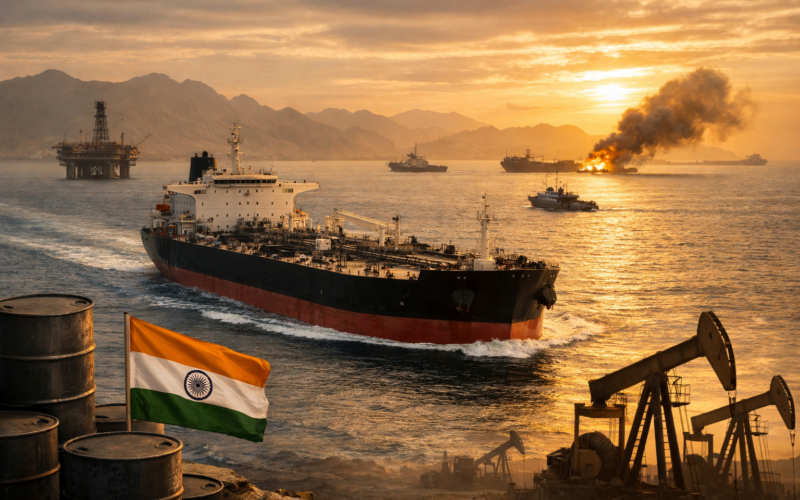
Indian refiners have purchased Iranian crude oil for the first time since May 2019, the Ministry of Petroleum and Natural Gas confirmed on 4 April 2026, marking a significant shift in the country’s energy procurement posture after seven years of compliance with United States sanctions on Iranian oil. The purchases were confirmed amid an acute energy supply crisis triggered by the effective closure of the Strait of Hormuz, the world’s most critical oil and gas transit corridor, as a direct consequence of the United States-Israel war against Iran.
The Ministry of Petroleum and Natural Gas stated in a post on its official account on X that Indian refiners had secured their crude oil requirements from multiple sources, including Iran, and confirmed there was no payment difficulty associated with Iranian crude imports. The ministry added that India had secured its full crude oil requirements for the coming months and reiterated that India sources crude from more than 40 countries, with companies retaining full flexibility to source oil from different geographies.
The ministry also rejected circulating reports that an Iranian crude cargo had been diverted from the western port of Vadinar, India, to China because of payment complications. It stated that vessel destinations recorded in shipping data are often only indicative and do not necessarily reflect final cargo delivery points.
Why did India stop purchasing Iranian crude oil in 2019 and what has changed in 2026?
India was among Iran’s largest crude oil customers before the United States withdrew from the Joint Comprehensive Plan of Action in 2018 and reimposed comprehensive sanctions on Iran’s energy sector. New Delhi initially received a temporary sanctions waiver from Washington allowing continued Iranian crude purchases, but that waiver expired in May 2019 and was not renewed. Faced with the risk of exclusion from the United States financial system, Indian state-run refiners discontinued Iranian crude purchases entirely.
The resumption of purchases in 2026 reflects a direct consequence of the ongoing United States-Israel war with Iran, which has disrupted global oil supply and blocked the Strait of Hormuz to large volumes of commercial shipping. The United States Treasury issued a targeted sanctions waiver the previous month, designed to stabilise global oil markets while preserving financial pressure on Tehran. That waiver framework, as it evolved, continued in practice to serve Indian refiners, redirecting sanctioned Iranian crude away from China and toward South Asia.
The Ministry of Petroleum and Natural Gas described its 4 April statement as a public confirmation of energy arrangements that India had largely abandoned under United States sanctions but has begun to revive in response to the current geopolitical and supply crisis. The Indian refining industry has been managing trading, shipping, and banking arrangements in parallel, as Iran remains subject to a broad architecture of United States and international sanctions.
How has the Strait of Hormuz closure affected India’s domestic energy supply chain?
India is the world’s third-largest oil importer and consumer. The Strait of Hormuz is critical to the country’s energy supply chain because approximately 90 per cent of India’s liquefied petroleum gas imports, which account for around 60 per cent of total domestic consumption, pass through this corridor. India holds approximately 25 days of crude oil reserves and a further 25 days of petroleum product stocks, giving it the smallest strategic buffer of any large oil-importing nation.
Liquefied petroleum gas deliveries across India have faced widespread delays of seven to fourteen days since the disruption began. Commercial allocations of liquefied petroleum gas were initially reduced by up to 80 per cent, forcing closures or shifts to firewood and coal in restaurants, hotels, and commercial establishments across major Indian cities. The energy crisis also triggered force majeure declarations from Petronet LNG, India’s largest liquefied natural gas importer, which notified supplier QatarEnergy and domestic buyers that contracted cargoes could not be fulfilled. Qatar had accounted for between 41 and 46 per cent of India’s liquefied natural gas imports before the Strait of Hormuz shutdown.
Residents in some Indian localities reported that domestic liquefied petroleum gas refill cylinders, which normally retail at approximately 900 to 1,000 Indian rupees, were being sold illegally for between 1,800 and 2,500 Indian rupees on parallel markets. Delivery times in many cities stretched from the same-day or next-day service that urban households typically received before the crisis to delays of up to two weeks.
What domestic enforcement measures has the Indian government invoked to manage the energy crisis?
The Central Government directed all states and Union Territories to take strict action against hoarding and black marketing of petroleum products and liquefied petroleum gas. Invoking provisions under the Essential Commodities Act and the Liquefied Petroleum Gas Control Order, the Ministry of Petroleum and Natural Gas asked state authorities to intensify enforcement, conduct daily raids and inspections in coordination with oil marketing companies, and maintain strict vigilance against diversion and misinformation.
States and Union Territories were instructed to set up control rooms and helplines, hold daily press briefings, and actively counter what the government described as misinformation circulating about fuel availability. More than 4,000 raids had been conducted across states and Union Territories, with over 1,300 liquefied petroleum gas cylinders seized. Public sector oil marketing companies had also issued more than 670 show-cause notices to liquefied petroleum gas distributors. Twenty-one states and Union Territories were holding regular press briefings to keep citizens informed.
The petroleum ministry reported at a broader level that more than 12,000 raids had been conducted since the start of the energy crisis and more than 15,000 liquefied petroleum gas cylinders had been seized. Refineries were directed to maximise liquefied petroleum gas output by redirecting hydrocarbon streams, reportedly boosting domestic production by between 25 and 40 per cent. The Government of India also notified the Natural Gas and Petroleum Products Distribution Order, 2026 under the Essential Commodities Act, 1955, through the official Gazette on 24 March 2026, establishing a streamlined and time-bound framework for expanding pipeline infrastructure across the country.
LPG booking intervals were extended to 25 days in urban areas and up to 45 days in rural areas to curb panic demand. Citizens were encouraged to adopt alternative cooking options including piped natural gas connections, induction stoves, and electric cooktops. The government also reissued guidance discouraging panic purchases of petrol and diesel.
What is the status of Iranian liquefied petroleum gas shipments and vessel movements at Indian ports?
India purchased 44,000 metric tons of Iranian liquefied petroleum gas loaded on a sanctioned vessel. The Ministry of Petroleum and Natural Gas confirmed that the vessel berthed at the western port of Mangalore on 2 April 2026 and was in the process of discharging its cargo. The Iranian liquefied petroleum gas cargo was shared among three state-run fuel retailers: Indian Oil Corporation, Bharat Petroleum Corporation, and Hindustan Petroleum Corporation. The cargo was purchased from a trader with payment to be made in Indian rupees. Sources indicated that India was exploring the purchase of additional Iranian liquefied petroleum gas cargoes.
India-flagged very large gas carrier Green Sanvi, carrying approximately 44,000 to 46,000 metric tonnes of liquefied petroleum gas, crossed the Strait of Hormuz on 4 April 2026 and was expected to arrive at Mumbai by 6 April 2026. Bharat Petroleum Corporation Limited was listed as the buyer, according to ship-tracking firm Kpler. Green Sanvi was the seventh India-flagged liquefied petroleum gas tanker to cross the Strait of Hormuz since the outbreak of hostilities in West Asia. Two additional liquefied petroleum gas carriers, Green Asha and Jag Vikram, were expected to follow, though both remained on the western side of the strait at the time of reporting.
Iran stated that ships not involved in hostilities could transit the Strait of Hormuz safely if they followed established protocols. United States intelligence assessments indicated, however, that Iran was unlikely to reopen the strait in the near term, as Tehran’s ability to restrict this maritime corridor represents its most significant source of leverage in the current conflict.
What are the broader implications for India’s energy diplomacy and sanctions compliance?
India’s decision to resume Iranian crude purchases, made public on 4 April 2026, represents the most significant shift in New Delhi’s Iran energy policy since 2019. The purchase was made possible directly by the United States Treasury’s temporary removal of sanctions on Iranian oil and refined products, framing India’s re-engagement with Iranian crude as a sanctioned and limited exception rather than a unilateral departure from the broader international sanctions regime.
The transactions were structured to address known financial compliance concerns, with payment in Indian rupees and purchases routed through traders rather than direct state-to-state arrangements, consistent with the approach Indian refiners previously used before 2019. Banking institutions in Asia have remained cautious about financing direct dealings with Iranian entities, even under temporary waivers, given the risk of exposure to United States secondary sanctions.
The scale of India’s energy vulnerability exposed by the Strait of Hormuz closure has accelerated a reassessment of the country’s supply diversification strategy. Before the current crisis, India sourced approximately half of its crude imports from the Middle East and had become a large buyer of seaborne Russian crude after the invasion of Ukraine in 2022. The simultaneous disruption of Middle Eastern supply routes has forced Indian refiners to source crude across a wider range of geographies and, for the first time in seven years, from Iran itself.
Key takeaways on what this development means for India, Iran, the United States, and global energy markets
- Indian refiners confirmed purchases of Iranian crude oil for the first time since May 2019, with the Ministry of Petroleum and Natural Gas stating that no payment difficulties were encountered and that India’s crude oil requirements for the coming months are fully secured.
- The resumption of Iranian crude purchases was made possible by a United States decision the previous month to temporarily remove sanctions on Iranian oil and refined products, a measure taken to ease global supply shortages caused by the effective closure of the Strait of Hormuz following the United States-Israel war against Iran.
- India separately purchased 44,000 metric tons of Iranian liquefied petroleum gas on a sanctioned vessel, with the cargo shared among Indian Oil Corporation, Bharat Petroleum Corporation, and Hindustan Petroleum Corporation, and payment arranged in Indian rupees.
- The Indian government invoked the Essential Commodities Act and the Liquefied Petroleum Gas Control Order to combat domestic hoarding and black marketing, conducting more than 12,000 raids and seizing more than 15,000 cylinders as supply delays created parallel markets with illegal prices rising to more than double regulated rates.
- United States intelligence assessments indicated that Iran was unlikely to reopen the Strait of Hormuz in the near term, as control of the strait represents Tehran’s primary source of strategic leverage in the current conflict, raising the prospect of continued supply disruption for India and other major energy importers dependent on the corridor.
Discover more from Business-News-Today.com
Subscribe to get the latest posts sent to your email.