


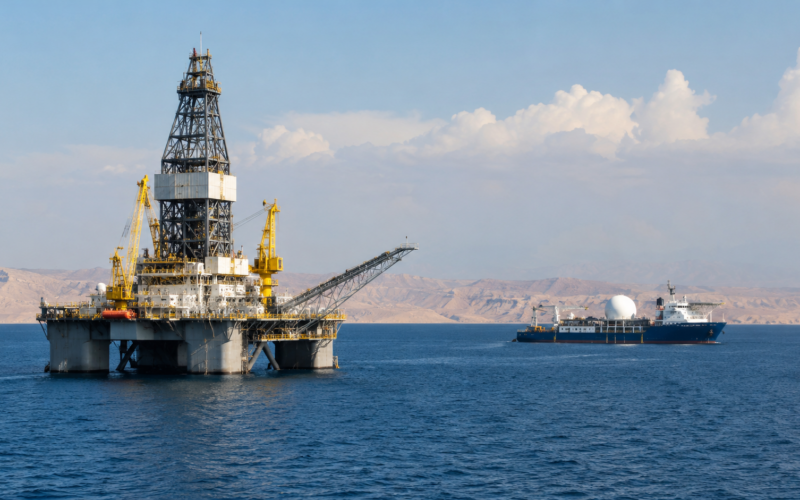
The Union Cabinet, chaired by Prime Minister Narendra Modi, has approved Samudra Manthan, the National Offshore Exploration Scheme, a Central Sector Scheme of the Ministry of Petroleum and Natural Gas carrying an approved Phase-I outlay of ₹84,084 crore (approximately US$8.81 billion) for implementation through the 2030-31 fiscal year. The scheme is India’s most concentrated offshore hydrocarbon push in a generation and sits at the centre of the government’s response to a US$144 billion annual crude oil import bill and repeated geopolitical shocks along Middle East supply routes. It underwrites 60 deepwater exploration wells with government support of up to 50% of eligible drilling cost or ₹675 crore per well, funds a large-scale seismic survey programme worth ₹28,534 crore, and lays the foundation for common offshore infrastructure hubs and a domestic Oil and Gas Manufacturing and Services Zone. The immediate strategic significance is that the state has now put subsidy money behind the deepwater ambitions that Oil and Natural Gas Corporation Limited (NSE: ONGC) and Oil India Limited (NSE: OIL) have been signalling for two years. The central tension is that India’s deepwater track record so far, most visibly in the Krishna Godavari basin, has repeatedly disappointed relative to headline reserve estimates, and the scheme’s success ultimately depends on whether subsidised drilling can convert acreage into commercial production rather than into another set of announcements.
What did India’s cabinet actually approve when it cleared the Samudra Manthan National Offshore Exploration Scheme
Union Minister Ashwini Vaishnaw announced the decision after the cabinet meeting on 31 July 2026, describing Samudra Manthan as an ambitious programme aimed at unlocking hydrocarbons in India’s Exclusive Economic Zone. According to the Ministry of Petroleum and Natural Gas, subject to exploration success the scheme is designed to lift India’s domestic oil and gas production from around 62 million metric tonnes of oil equivalent (MMTOE) to 80 MMTOE annually, expand the country’s hydrocarbon resource base, and catalyse reserve accretion of more than 600 MMTOE. Officials framed the scheme as the transition from a decade of policy reforms, including the removal of more than 99% of earlier “No-Go” areas which has opened over one million square kilometres of the Exclusive Economic Zone for exploration, into mission-mode implementation.
The scheme is comprehensive in scope. It provides for large-scale acquisition, processing and interpretation of high-quality seismic data, accelerated deepwater and ultra-deepwater exploratory drilling, scientific drilling in frontier basins, development of common offshore production and evacuation infrastructure, and establishment of an integrated Oil and Gas Manufacturing and Services Zone. It also includes dedicated allocations for digital programme management, capacity building, technology adoption, stakeholder engagement and international outreach.
How does the ₹84,084 crore outlay break down across seismic, deepwater drilling and offshore infrastructure
The Ministry has disclosed a four-component structure. The largest single line item is deepwater exploratory drilling, with ₹43,200 crore earmarked for 60 wells, including the government cost-share subsidy already noted. The second largest allocation is ₹28,534 crore for modern offshore seismic data acquisition and processing, which is the essential precursor to any credible drilling programme in frontier basins. Common offshore infrastructure hubs receive ₹10,000 crore, intended to accelerate the commercialisation of any discoveries by reducing the standalone infrastructure burden on individual operators. The Oil and Gas Manufacturing and Services Zone carries a ₹2,000 crore outlay aimed at localising critical offshore equipment and services, which have historically depended on imports from a small pool of international specialists.
The subsidy design matters. By capping government support at 50% of eligible drilling cost or ₹675 crore per well, the scheme lowers the geological risk premium that individual operators would otherwise price into deepwater programmes, without absorbing the entire cost of a dry hole. It is also a signal that the government is willing to underwrite exploration risk in a way that its treatment of downstream margins, through windfall taxes and administered pricing on some gas volumes, has not always suggested.
Why does Samudra Manthan matter for ONGC as it launches DeepX and targets 150 deepwater wells over seven years
Oil and Natural Gas Corporation Limited is the primary beneficiary of the scheme in scale terms. The state-owned major, which contributes roughly 70% of India’s domestic crude output, has said it plans to drill about 150 deepwater wells over seven years and to pursue nearly 5,600 MMTOE of deepwater and ultra-deepwater hydrocarbon potential under the Samudra Manthan umbrella. At the operational core is DeepX, a mission-mode team of more than 30 specialists that will work with advanced technologies and international partners, using a “One Company, One Data” approach to consolidate subsurface intelligence and accelerate exploration decisions. The company has indicated that its early campaign will target the Mahanadi Offshore Basin, where the Utkal and Konark discoveries have already provided encouraging subsurface data, before moving into more frontier zones as domestic deepwater drilling capacity matures. ONGC has also pointed to promising indications in the Cauvery and Mahanadi basins alongside established thermogenic gas presence in the Andaman region.
Market data around the announcement was subdued rather than euphoric. ONGC closed at ₹239.10 on 31 July 2026 in a day range of ₹238.17 to ₹241.62, against a previous close of ₹241.59 and a 52-week range of ₹227.65 to ₹307.50. The stock is trading at a price-to-earnings multiple below 8 times and a price-to-book ratio close to 0.85 on Screener data, with a dividend yield in the region of 5%. The company will publish Q1 FY2026-27 results on 4 August 2026, providing the first opportunity for management to formally frame Samudra Manthan in its capital expenditure and reserve-accretion narrative.
How does the scheme reshape the outlook for Oil India as it accelerates its own offshore exploration ambitions
Oil India Limited, the country’s second-largest national exploration and production company, is not the flagship named vehicle for Samudra Manthan but is unavoidably a secondary beneficiary. The Ministry has explicitly stated that the performance parameters of both ONGC and Oil India have been reoriented to place greater emphasis on exploration activity. Oil India has separately indicated a target of 100 wells in the current financial year against 78 in FY26 and 76 in the prior year, and its most recent annual reporting flagged the acquisition of 7,362 line kilometres of 2D seismic data in the Eastern Offshore Extended Continental Shelf as a step towards deepwater capability.
Oil India shares closed at ₹457.60 on the National Stock Exchange on 31 July 2026 in a day range of ₹451.20 to ₹459.00, against a previous close of ₹456.90 and a 52-week range of ₹384.60 to ₹531.00. The company’s Q4 FY26 print, released earlier in the year, showed net profit of ₹2,099.61 crore, and its board is scheduled to consider Q1 FY2026-27 results on 7 August 2026. For a company with a market capitalisation in the ₹74,000 crore range and a P/E multiple around 10 times, incremental subsidised offshore drilling capacity could be more meaningful in relative terms than for ONGC, though it also concentrates execution risk in a company whose reserve base has historically been anchored in mature Assam and Rajasthan onshore fields.
What role do foreign majors such as ExxonMobil and bp now play in India’s deepwater exploration architecture
Samudra Manthan is not designed to be executed entirely by domestic operators. Foreign supermajor involvement has been building in parallel and the scheme is likely to accelerate rather than replace those partnerships. ONGC has previously signed a Heads of Agreement with Exxon Mobil Corporation for deepwater exploration on both the east and west coasts, focused on the Krishna Godavari and Cauvery basins in the eastern offshore and the Kutch-Mumbai region in the western offshore. Separately, ONGC signed a new Technical Services Provider contract with bp on 25 June 2026 for the Western Offshore Basin, following the initial TSP arrangement for the Mumbai High field.
The commercial logic is straightforward: India lacks a domestic base of ultra-deepwater rig operators, subsea engineering specialists and interpretation-grade seismic contractors of the scale required to run 60 subsidised deepwater wells and complementary company-funded programmes over five years. The ₹2,000 crore Oil and Gas Manufacturing and Services Zone is intended to begin closing that gap, but the near-term execution model will remain heavily dependent on international service providers, which in turn ties Samudra Manthan’s delivery timeline to global offshore capital expenditure cycles and rig availability.
Why does execution risk remain the central question despite the government’s 50% deepwater cost subsidy
Indian exploration and production companies trade at a persistent discount to global peers, and broker commentary around the scheme has been supportive but qualified. Recent published analysis has framed the sustained policy push as capable of expediting project timelines, reducing infrastructure bottlenecks and enabling upstream players to drive stronger production growth with better capital efficiency, while also noting that the discount reflects volatility in windfall taxes, historical production disappointments and capped gas realisations rather than the exploration policy framework alone. Cost subsidy addresses the risk of the drill bit, not the risk of the operating regime that follows any discovery.
The historical record is a further reason to keep the analysis measured. Both public-sector exploration and private operators have repeatedly announced high-potential deepwater plays in the Krishna Godavari basin only to see production ramp-ups fall short of headline resource numbers, and Indian deepwater commercial delivery at scale is still substantially unproven. Samudra Manthan sharply reduces the financial cost of testing that assumption; it does not remove the geological or commercial cost of being wrong. For institutional investors, the measurable proof points over the next five years will be the pace at which the 60 subsidised deepwater wells are actually spudded, the discovery rate that follows, and, most importantly, the time from discovery to first commercial production on the common infrastructure hubs the scheme is now funding.
How could the ₹84,084 crore programme change India’s import bill and its exposure to Middle East supply shocks
At the macro level, the scheme is best understood as a strategic hedge rather than an import-substitution silver bullet. India remains the world’s third-largest crude oil consumer, with an annual import bill of nearly US$144 billion, and imports over 85% of the crude it consumes. Moving domestic production from 62 MMTOE to 80 MMTOE by 2030-31 would represent an incremental output uplift of roughly 29% from the current base if achieved on schedule, but even a full delivery of the target would not fundamentally alter India’s structural import dependence over that horizon. What it would do is create some incremental resilience against the kind of Strait of Hormuz supply shocks that have recurred through 2025 and 2026, and it would give Indian refiners a marginally larger indigenous barrel to work with in a market where Brent has traded between roughly US$80 and above US$100 during the past twelve months.
For the broader listed universe, Samudra Manthan is directionally positive for upstream exploration and production names, seismic and drilling service providers, and offshore engineering contractors, while its impact on downstream oil marketing companies is neutral at best. The critical follow-through will be whether the scheme is accompanied by more predictable treatment of upstream cash flows, particularly on windfall levies and gas price ceilings, since exploration incentive without operating certainty tends to produce announcements rather than production.
Key takeaways as India commits ₹84,084 crore to Samudra Manthan offshore exploration through fiscal 2030-31
- The Union Cabinet approved Samudra Manthan, the National Offshore Exploration Scheme, as a Central Sector Scheme of the Ministry of Petroleum and Natural Gas with a Phase-I outlay of ₹84,084 crore (approximately US$8.81 billion) up to 31 March 2031.
- The scheme is structured around four components: ₹28,534 crore for modern offshore seismic data acquisition and processing, ₹43,200 crore for 60 deepwater exploration wells, ₹10,000 crore for common offshore infrastructure hubs, and ₹2,000 crore for an Oil and Gas Manufacturing and Services Zone.
- Government cost support is capped at 50% of eligible drilling cost or ₹675 crore per well, lowering the exploration risk premium for participating operators without fully absorbing the cost of a dry hole.
- Subject to exploration success, the stated production ambition is to move India’s domestic output from around 62 MMTOE to 80 MMTOE annually and to catalyse reserve accretion of more than 600 MMTOE by 2030-31.
- Oil and Natural Gas Corporation Limited (NSE: ONGC) is the primary vehicle, targeting around 150 deepwater wells over seven years and roughly 5,600 MMTOE of deepwater and ultra-deepwater potential through its DeepX mission-mode team, with early campaigns focused on the Mahanadi Offshore Basin around the Utkal and Konark discoveries.
- Oil India Limited (NSE: OIL) is a secondary beneficiary, having already lifted its FY27 well target to 100 versus 78 in FY26 and 76 the year before, with parallel 2D seismic acquisition of 7,362 line kilometres in the Eastern Offshore Extended Continental Shelf.
- Foreign majors remain central to execution: ONGC has a Heads of Agreement with Exxon Mobil Corporation covering deepwater work in the Krishna Godavari, Cauvery and Kutch-Mumbai basins, and a Technical Services Provider contract with bp for the Western Offshore Basin following the earlier Mumbai High mandate.
- The near-term market reaction has been subdued: ONGC closed at ₹239.10 on 31 July 2026 near the lower end of a ₹227.65 to ₹307.50 52-week range, and Oil India closed at ₹457.60 within a ₹384.60 to ₹531.00 range, both still trading at valuation multiples below global upstream peers.
- Broker commentary has framed the scheme as supportive of project timelines, infrastructure bottlenecks and capital efficiency for Indian upstream operators, while noting that the sector’s discount to global peers reflects windfall taxes, historical production disappointments and capped gas realisations rather than exploration policy alone.
- The measurable proof points over the coming five years are the pace at which the 60 subsidised deepwater wells are actually spudded, the resulting discovery rate, and the time to first commercial production on the common offshore infrastructure hubs the scheme is now funding, with the first company milestones anchored around ONGC’s Q1 FY2026-27 results on 4 August 2026 and Oil India’s on 7 August 2026.
Discover more from Business-News-Today.com
Subscribe to get the latest posts sent to your email.