


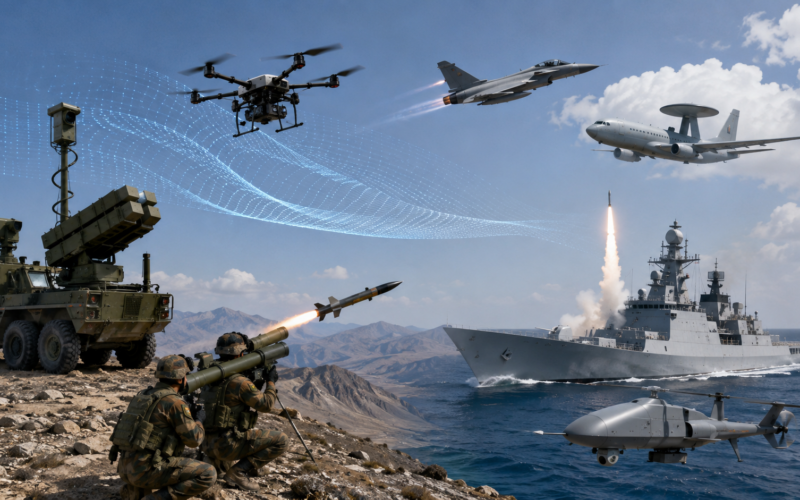
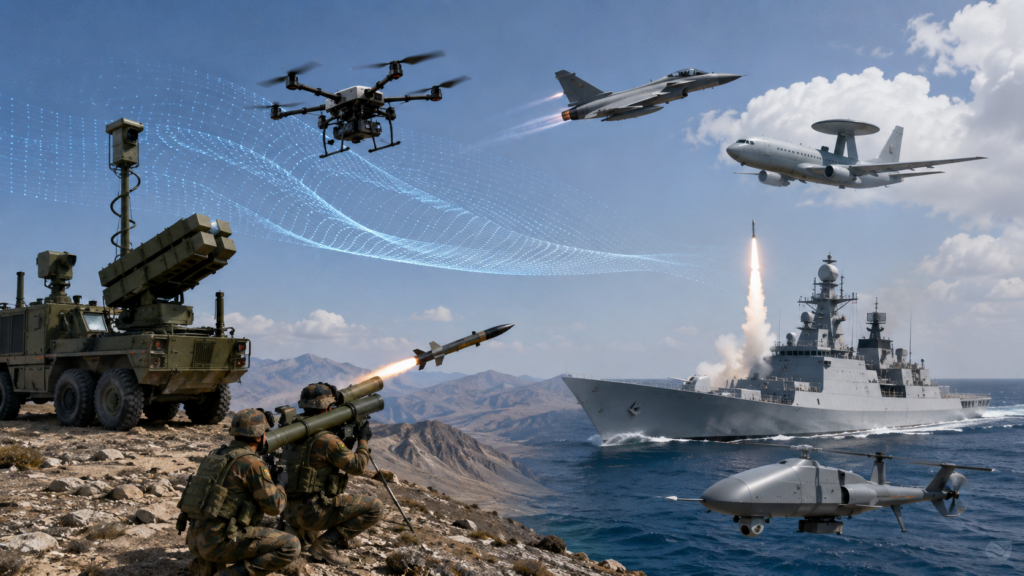
India’s Defence Acquisition Council has granted in-principle approval to military acquisition proposals estimated at about ₹52,000 crore, covering counter-drone electronic warfare, anti-tank missiles, air-defence systems, loitering munitions, naval unmanned aircraft and high-altitude surveillance platforms. The package spans the Indian Army, Indian Navy and Indian Air Force, making it one of the broadest recent procurement signals across India’s land, maritime and aerospace domains. Acceptance of Necessity does not represent a signed contract, funded order book or immediate revenue award for any defence manufacturer. Individual programme values, selected suppliers, procurement categories and delivery schedules have not yet been disclosed. The approval nevertheless creates a substantial future pipeline for Indian missile, electronics, drone, sensor, propulsion and shipbuilding companies as the programmes move through tendering, trials, commercial negotiation and final contracting.
The package is strategically coherent despite covering several apparently different systems. Most of the approvals address one of three military requirements: detecting and defeating unmanned threats, protecting forces against missiles and armoured attacks, or maintaining persistent surveillance across contested terrain and maritime areas.
The industrial opportunity is correspondingly broad. Missile manufacturers could benefit from the MPATGM, MRSAM and V-SHORADS proposals, while defence electronics companies may compete for radars, seekers, command systems and electronic-warfare equipment. Private drone developers, shipyards, power-electronics suppliers and advanced-materials companies could also participate, although the government has not identified successful vendors.
Why is India’s ₹52,000 crore defence approval not the same as a signed procurement contract?
The Defence Acquisition Council has granted Acceptance of Necessity, which is the administrative approval required to begin or advance a capital acquisition programme. It confirms that the military requirement is considered necessary and that an estimated expenditure can form the basis of subsequent procurement activity.
The approval does not mean that ₹52,000 crore will immediately be released to contractors. The armed services must still define specifications, determine procurement categories, issue requests for proposal, evaluate technical submissions, conduct trials where required and negotiate commercial terms.
Some programmes may move more quickly because the technology has already completed development or military testing. Others could require additional validation, localisation commitments or competition between domestic and international suppliers.
Final contract values may also differ from the initial estimate. Competitive bidding, changes in quantities, configuration decisions, inflation, imported content and life-cycle support requirements can all alter the eventual expenditure.
Delivery schedules remain unknown because no contracts have been signed. Large missile and air-defence programmes can require several years of manufacturing after contract award, while commercially mature drones or electronic-warfare systems may be delivered more quickly.
This distinction is particularly important for investors. Listed defence companies cannot add an Acceptance of Necessity estimate to their order books. Revenue visibility begins only after a company receives a contract or funded purchase order.
The ₹52,000 crore headline should therefore be viewed as an addressable procurement pipeline. It indicates where the Indian military intends to deploy capital, but it does not reveal how that capital will be distributed among suppliers.
How large is the ₹52,000 crore package relative to India’s defence capital-acquisition budget?
India allocated approximately ₹1.85 lakh crore for capital acquisition in the 2026 to 2027 financial year. The newly approved proposals are equivalent to about 28% of that annual acquisition allocation.
That comparison demonstrates the strategic scale of the package, but it does not mean the entire ₹52,000 crore will be spent during the current financial year. Capital programmes are normally contracted and paid across several years, with expenditure linked to development, production and delivery milestones.
The wider capital allocation for the armed forces stands at approximately ₹2.19 lakh crore. This includes acquisition expenditure as well as other capital requirements linked to infrastructure and military capability.
Around 75% of the capital acquisition budget has been reserved for domestic defence industries. That policy increases the probability that Indian public-sector undertakings, private manufacturers, startups and component suppliers will participate in the approved programmes.
Domestic reservation does not necessarily mean that every component will be designed and manufactured in India. Advanced seekers, semiconductors, propulsion components, sensors and electronic subsystems may still contain imported technology, depending on the selected procurement category and supplier architecture.
The strategic objective is therefore deeper than replacing imported finished products with local assembly. India must expand domestic capability in design, testing, software, electronic warfare, propulsion, guidance, advanced materials and life-cycle maintenance.
The new package provides potential production volume that can justify such investment. Manufacturers are more likely to build specialised facilities and qualify suppliers when they can see a multi-year procurement pipeline rather than isolated prototype orders.
Why do counter-drone warfare and layered air defence dominate India’s new procurement plans?
The Indian Army received approval for the AKASH TARANG anti-unmanned aerial vehicle electronic-warfare system, the Medium Range Surface-to-Air Missile weapon system and the Very Short Range Air Defence System.
These systems address threats at different ranges and through different defeat mechanisms. Electronic warfare can disrupt drone communications or navigation, V-SHORADS can engage low-flying targets at short range, and MRSAM can provide protection against aircraft, missiles and other stand-off aerial threats at greater distances.
This layered approach reflects the changing economics of air defence. Armed forces may face expensive aircraft and missiles alongside much cheaper reconnaissance drones, loitering munitions and improvised unmanned systems.
Using a costly interceptor against every inexpensive drone creates an unfavourable cost exchange. Electronic attack, guns, lasers and lower-cost missiles therefore need to operate alongside conventional surface-to-air systems.
AKASH TARANG is intended to provide anti-UAV protection to Army formations. The government has not identified the developer, manufacturer or technical configuration, making it premature to connect the programme to a specific listed company.
The system’s electronic-warfare role suggests demand for radio-frequency sensors, signal processing, jamming equipment, command software and secure communications. These technologies can become obsolete quickly as adversaries change frequencies, navigation methods and control links.
V-SHORADS provides a kinetic layer against low-altitude aircraft and unmanned threats. Its multi-spectral sensing is intended to improve resistance against countermeasures, which is important when targets use flares, electronic interference or reduced signatures.
MRSAM adds a medium-range layer capable of protecting formations and infrastructure from a wider range of aerial threats. The programme involves interceptors, launchers, radars, command systems and support vehicles, creating a larger industrial footprint than the missile alone.
The package therefore signals that India is not pursuing one universal air-defence product. It is building an integrated network in which electronic warfare, short-range interceptors, medium-range missiles and command systems work together.
Which companies could benefit from the MPATGM and MRSAM procurement proposals?
Bharat Dynamics Limited and Bharat Electronics Limited are the clearest publicly listed companies with established roles in programmes included in the approval.
Bharat Dynamics Limited, listed on the National Stock Exchange as BDL, is a development and production partner for the indigenous Man Portable Anti-Tank Guided Missile. The company is also an established missile manufacturer and production agency for several Indian guided-weapon programmes.
Bharat Electronics Limited, listed on the National Stock Exchange as BEL, is also a development and production partner for the MPATGM weapon system. Its likely areas of participation include electronics, fire-control equipment, sights and other system components, although the final workshare for a future order has not been announced.
The MPATGM is a third-generation fire-and-forget anti-tank weapon designed for use against modern armoured vehicles. Its imaging infrared seeker, tandem warhead and top-attack capability are intended to allow infantry units to engage tanks from portable launchers.
The January 2026 moving-target test strengthened the programme’s technical maturity. The Defence Acquisition Council approval could move the weapon closer to serial procurement, but quantities and contract timing remain undisclosed.
Bharat Dynamics Limited also has an established role in the MRSAM programme, including missile and weapon-system integration activities. Bharat Electronics Limited participates in MRSAM radar, command, launcher and system-integration work across relevant variants.
These existing roles make both companies plausible industrial beneficiaries. However, neither company should recognise the entire estimated value of the proposals because the ₹52,000 crore package covers numerous unrelated programmes across three services.
The opportunity will be divided among prime contractors, government enterprises, private manufacturers, joint ventures and component suppliers. Imports or foreign technology partnerships may also remain part of selected systems.
Investors should therefore wait for company disclosures identifying contract value, workshare and delivery schedules. Existing programme participation improves probability, but it is not a substitute for a signed order.
How could jet-powered kamikaze drones change India’s loitering-munition strategy?
The Indian Army has received approval for a jet-based kamikaze drone system intended to provide greater lethality, survivability and electronic-warfare capability while remaining cost effective.
Jet propulsion could offer higher speed than conventional propeller-driven loitering munitions. Greater speed can shorten the time between target detection and impact, making it harder for mobile targets to relocate or air-defence systems to respond.
The survivability claim may relate to speed, flight profile, electronic protection or reduced exposure time. The government has not released enough technical detail to determine the planned range, payload, guidance method or launch platform.
Electronic-warfare capability suggests the system may do more than carry an explosive payload. It could potentially support jamming, electronic surveillance or coordinated operations in contested radio-frequency environments.
A jet-powered design will also create different manufacturing requirements. Suppliers may need compact engines, high-temperature materials, guidance electronics, secure data links and aerodynamic structures capable of operating at higher speeds.
Cost will be decisive. Loitering munitions are attractive partly because they can deliver precision effects at lower cost than crewed aircraft or larger missiles. A jet engine and advanced electronic package could erode that advantage if the system becomes excessively complex.
The Army must therefore balance speed and survivability against production volume. A sophisticated weapon available only in small quantities may not provide the battlefield mass required during a sustained conflict.
The proposal could create opportunities for Indian drone startups and established defence manufacturers. No supplier has been identified, meaning the programme may still involve competitive evaluation or an undisclosed development partner.
Export potential could eventually be meaningful because several countries are seeking faster loitering munitions that can operate under electronic attack. Domestic induction and operational validation would be necessary before India could credibly market the system abroad.
Why are active protection systems becoming essential for Indian Army tank survivability?
The Defence Acquisition Council also approved active protection systems for tanks. These systems are intended to detect incoming anti-tank missiles or projectiles and disrupt or destroy them before they strike the vehicle.
The requirement reflects the growing vulnerability of armoured formations. Modern battlefields combine anti-tank guided missiles, drones, loitering munitions and top-attack weapons that can threaten even heavily protected tanks.
Adding more passive armour increases weight, fuel consumption and pressure on engines, suspensions and transport infrastructure. Active protection can improve survivability without relying entirely on thicker armour.
A complete system requires sensors, radar or electro-optical detection, processing software, countermeasures and integration with the tank’s existing electronics. False alarms and accidental engagement risks must be controlled because the system may operate near accompanying infantry.
The programme could therefore benefit Indian radar, electronics, ammunition and armoured-vehicle suppliers. International cooperation may also be considered because several foreign manufacturers already offer mature active protection technology.
Integration will be as important as product selection. Different Indian tank fleets have varying power, space, weight and electronic architectures, meaning one system may not fit every platform without modification.
Delivery timelines could consequently extend beyond the purchase of off-the-shelf equipment. Trials must demonstrate protection effectiveness while ensuring the system does not compromise vehicle mobility, reliability or crew safety.
The wider industrial opportunity includes retrofit kits, spares, training, software upgrades and future integration on new armoured vehicles. Active protection can become a recurring life-cycle business rather than a one-time hardware sale.
What do the Indian Navy’s drone, mine and electric-propulsion approvals reveal?
The Indian Navy received approval for a Multi Influence Ground Mine, a Naval Shipborne Unmanned Aerial System and a land-based testing facility for electric propulsion systems.
The shipborne unmanned aircraft proposal addresses demand for persistent surveillance beyond the visual range of a vessel. A naval drone equipped with advanced sensors can extend situational awareness without requiring a helicopter to be launched for every mission.
Operating from a ship creates specialised engineering requirements. The aircraft must withstand saltwater exposure, wind, limited deck space, electromagnetic interference and the movement of the vessel.
Its control system must also connect securely with shipboard combat-management and communications networks. This creates opportunities for drone manufacturers, sensor suppliers, naval electronics companies and software integrators.
The Multi Influence Ground Mine is intended to restrict an adversary’s maritime manoeuvre. Modern naval mines may respond to combinations of acoustic, magnetic, pressure or other signatures rather than simple physical contact.
Such weapons require underwater sensors, signal processing, explosives, batteries and corrosion-resistant structures. Their value lies partly in deterrence because even the possibility of mines can slow naval movement and force an adversary to allocate resources to clearance.
The land-based electric-propulsion test facility has longer-term industrial significance. It will test motors and associated propulsion systems intended for naval assets, supporting India’s effort to develop and validate more advanced ship-power architectures domestically.
Electric and integrated propulsion can provide efficiency, lower acoustic signatures and greater flexibility in distributing power among propulsion, sensors and weapons. It also creates demanding requirements for motors, generators, converters, control systems and thermal management.
A domestic test facility can reduce reliance on overseas validation and allow Indian ship designers to evaluate propulsion equipment before installation. That capability may become increasingly important as future warships require more electrical power for radar, electronic warfare and directed-energy systems.
How could high-altitude pseudo satellites reshape Indian Air Force surveillance?
The Indian Air Force received approval for a fixed-wing high-altitude pseudo satellite capable of supporting intelligence, surveillance, reconnaissance, telecommunications and remote sensing.
A high-altitude pseudo satellite is an unmanned aircraft designed to remain in the stratosphere for extended periods. It can provide persistent coverage over an area at a lower altitude than a conventional satellite but far above most commercial and military aircraft.
The concept can fill the gap between satellites and tactical drones. Satellites provide wide coverage but may pass over a location only at intervals, while conventional unmanned aircraft require more frequent refuelling, maintenance and crew support.
A stratospheric platform can potentially remain over a region for days or weeks, providing continuous sensor coverage or communications relay. Solar power and lightweight structures are frequently central to such designs.
The industrial challenges are substantial. The platform requires highly efficient aerodynamics, lightweight composites, advanced batteries, solar cells, autonomous flight controls and communications systems capable of operating under extreme temperatures.
Payload weight must be carefully managed because every additional sensor or communications system affects endurance. High-altitude winds and weather patterns can also complicate station keeping.
The programme could support India’s emerging dual-use aerospace ecosystem. Technologies developed for military surveillance could have applications in disaster management, border communications, environmental monitoring and remote connectivity.
No supplier has been disclosed. That uncertainty preserves opportunities for established aerospace manufacturers, private drone companies and research-led startups, but it also means investors should avoid assigning the programme to a particular stock.
How should investors interpret BEL and BDL shares after the procurement approval?
Bharat Electronics Limited closed at ₹418.05 on July 3, rising approximately 0.7% during the session. The stock gained about 1.6% over the five trading sessions beginning June 29 and approximately 1.8% over one month.
Its 52-week range stood at ₹361.20 to ₹473.45. The July 3 close placed Bharat Electronics about 11.7% below its annual high and approximately 15.7% above the low.
Bharat Dynamics Limited closed at ₹1,388.20, up about 0.2% for the session. The stock gained approximately 4% over the same five-session period and about 14.5% over one month.
Bharat Dynamics remained roughly 31% below its 52-week high of ₹2,013.50 but traded about 27.8% above the annual low of ₹1,086.
The Defence Acquisition Council announcement was released at 4:02 p.m., after normal market trading had ended. The July 3 price movements therefore cannot be attributed to the official ₹52,000 crore announcement.
The next trading session will provide a clearer indication of immediate investor reaction. Even then, short-term movement should be treated cautiously because the government has not allocated programme values or confirmed suppliers.
Bharat Electronics has the larger and more diversified defence-electronics portfolio, while Bharat Dynamics offers more concentrated exposure to missile production. That concentration can produce greater upside when large missile contracts arrive, but it also creates more sensitivity to delivery schedules and programme execution.
Both stocks already reflect strong expectations for Indian defence spending. Investors should focus on signed orders, advances, delivery milestones and margin performance rather than assuming the full procurement estimate will flow to established public-sector companies.
What must happen before the ₹52,000 crore pipeline becomes manufacturing revenue?
The armed services must first convert broad operational requirements into detailed technical specifications. These specifications will determine range, payload, sensor, mobility, communications and support requirements for each system.
The Ministry of Defence must then select procurement categories and eligible vendors. Domestic design and manufacturing content will influence which public and private companies can participate.
Technical evaluation and field trials may follow, particularly for drones, active protection systems and electronic-warfare equipment. Systems must perform under realistic weather, terrain, electronic-interference and operational conditions.
Commercial negotiation will determine final prices, quantities, warranty terms and life-cycle support. Large or strategically significant contracts may require additional government approvals before signing.
Manufacturers will then need to establish production schedules and qualify supply chains. Missile seekers, propulsion systems, electronic components and specialised materials can become bottlenecks if domestic capacity is insufficient.
Advance payments and milestone funding will influence working capital. Defence contractors may need to purchase inventory and expand facilities before receiving full payment.
Delivery could extend across several financial years. Revenue recognition will depend on each company’s contract terms and the acceptance of completed systems by the customer.
The ₹52,000 crore decision is therefore the beginning of a capital-allocation process, not the end. Its real industrial impact will emerge only when specific companies receive funded contracts and demonstrate that they can deliver at scale.
Key takeaways on India’s ₹52,000 crore defence procurement approval
- India has granted Acceptance of Necessity for military acquisition proposals estimated at approximately ₹52,000 crore.
- The approval covers counter-drone electronic warfare, anti-tank missiles, air-defence systems, kamikaze drones, naval unmanned systems and high-altitude surveillance.
- Acceptance of Necessity is an in-principle approval and cannot yet be treated as a signed contract or company order book.
- Individual programme values, suppliers, procurement categories, quantities and delivery schedules remain undisclosed.
- The package is equivalent to approximately 28% of India’s ₹1.85 lakh crore capital-acquisition allocation for 2026 to 2027, although spending will likely extend across several years.
- Bharat Dynamics Limited and Bharat Electronics Limited have established programme roles in MPATGM and MRSAM, but no new contracts have been announced.
- Counter-drone warfare and layered air defence are the dominant themes, reflecting the growing battlefield threat from drones, missiles and loitering munitions.
- The naval electric-propulsion testing facility could create a longer-term domestic capability in advanced warship power systems.
- The high-altitude pseudo satellite proposal could support persistent surveillance, communications and dual-use aerospace technologies.
- Investors should monitor requests for proposal, vendor selection, field trials and signed contracts before assigning revenue to defence stocks.
Discover more from Business-News-Today.com
Subscribe to get the latest posts sent to your email.