




How is Imugene positioning azer-cel to become the first off-the-shelf CAR T therapy for blood cancers, and can its capital raise support the pivotal trial pathway in 2026?
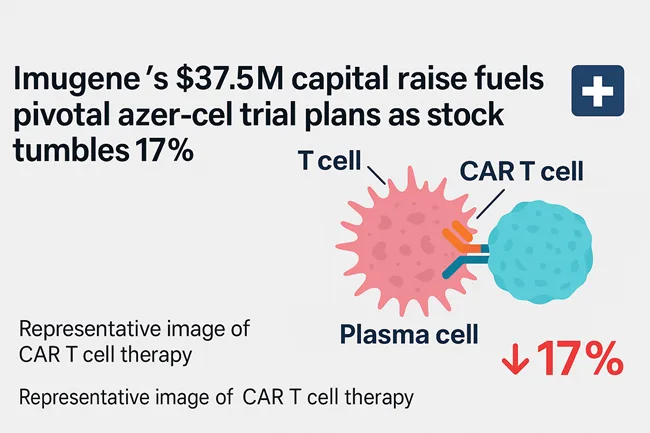
Imugene Limited (ASX: IMU) saw its share price slide 17.65% to A$0.35 on July 16, 2025, following the announcement of a strongly supported A$22.5 million placement and the launch of a A$15 million share purchase plan (SPP). The clinical-stage immuno-oncology company, which is developing a portfolio of cancer immunotherapies including the allogeneic CD19 CAR T therapy azer-cel, is aiming to use the fresh capital to fund its pivotal Phase 2 trial slated for 2026. The stock’s steep decline, which pushed its one-year return to -81.28%, signals investor caution despite promising clinical data and regulatory momentum.
Imugene’s capital raising comes as it pursues accelerated regulatory pathways for azer-cel, with Fast Track Designation already granted for Diffuse Large B-Cell Lymphoma (DLBCL). According to the company’s July investor presentation, the Phase 1b trial has reported a 75% overall response rate and a 55% complete response rate among heavily pre-treated lymphoma patients, including those who failed prior autologous CAR T therapy. Institutional investors reportedly see the therapy’s scalability and lower manufacturing costs—enabled by healthy donor-derived T cells—as a potential differentiator in a US$2 billion market for rare lymphomas with no approved allogeneic CAR T treatments.
What does the capital raising structure reveal about institutional confidence in Imugene’s clinical and commercial roadmap?
The placement priced at A$0.33 per share—representing a 22.4% discount to the previous close—attracted strong interest from Australian and international institutional investors. Eligible retail shareholders will be able to participate via the SPP under identical terms, with applications capped at A$100,000. For every four shares issued, participants will receive three listed options exercisable at A$0.43 until March 30, 2026, and one piggyback option exercisable at A$0.86 until June 30, 2028. Upon completion, Imugene expects to hold a pro-forma cash balance of A$64 million, sufficient to fund operations into the second half of 2026. If all attaching options are exercised, an additional A$36.6 million could extend the funding runway into mid-2027.
Institutional sentiment remains mixed. While some investors are encouraged by the robust early efficacy data and the potential for a single-arm pivotal trial—a pathway typical of niche, high-unmet-need indications—others remain cautious about the clinical and regulatory risks inherent in first-in-class CAR T therapies. Analysts note that comparable early-stage CAR T deals, such as AbbVie’s US$2.1 billion acquisition of Capstan and AstraZeneca’s US$1 billion acquisition of EsoBiotec, highlight big pharma’s appetite for allogeneic platforms. However, these transactions also underscore the long and uncertain development timelines in the CAR T space.
Can azer-cel’s Phase 1b data and regulatory milestones translate into accelerated approval prospects by 2026?
Imugene plans to meet with the U.S. Food and Drug Administration (FDA) in the fourth quarter of 2025 to discuss the design of a pivotal Phase 2 registrational trial in DLBCL and CAR T-naïve rare lymphomas. The company is positioning azer-cel as a “fast-to-market” therapy targeting high-need indications where comparator-free, single-arm trials may be sufficient for accelerated approval. Analysts suggest that the drug’s 55% complete response rate already meets the FDA’s typical benchmark of at least 50% for heavily pre-treated DLBCL, with durability of response exceeding 450 days in some patients.
The scalability of the allogeneic approach could provide a commercial advantage. Unlike autologous CAR T therapies, which are patient-specific and require a four-to-six-week manufacturing process, azer-cel’s donor-derived T cells can be produced in bulk, enabling multiple doses from a single batch. Imugene’s management believes this cost-efficient model could open access to regional cancer centers currently unable to support autologous manufacturing.
What are analysts forecasting for Imugene’s stock and funding outlook in light of the sharp share price drop?
The sharp 17.65% intraday drop reflects short-term dilution concerns and broader risk-off sentiment in small-cap biotech stocks. However, some institutional investors argue that Imugene’s funding position and clinical progress justify a long-term view. The A$0.33 placement price is viewed as attractive for investors willing to take on clinical development risk, particularly given the potential A$2 billion U.S. market for azer-cel.
The company’s strategy to reduce operating costs—including out-licensing its manufacturing facility and trimming headcount—is expected to conserve cash while focusing resources on the azer-cel program. Analysts caution, however, that failure to secure FDA support for the pivotal trial design in late 2025 could significantly delay commercialization and strain the extended funding runway.
What is the broader sector outlook for allogeneic CAR T therapies, and how does Imugene fit into this competitive landscape?
The allogeneic CAR T sector remains an area of intense interest, with major pharmaceutical companies actively acquiring or licensing early-stage assets in multi-billion-dollar transactions, signaling a strong belief in the transformative potential of “off-the-shelf” therapies. Unlike autologous CAR T products, which are inherently constrained by patient-specific manufacturing bottlenecks, allogeneic therapies promise scalable production and faster patient access—key attributes that could dramatically expand the addressable patient population. Industry analysts point to deals such as AbbVie’s US$2.1 billion acquisition of Capstan Therapeutics for its in vivo CAR T platform and AstraZeneca’s US$1 billion acquisition of EsoBiotec as evidence of big pharma’s willingness to pay significant premiums for differentiated allogeneic or in vivo CAR T technologies. Roche’s US$1.5 billion acquisition of Poseida Therapeutics in late 2024 further underscored how allogeneic CAR T is shaping the next wave of immuno-oncology consolidation, with global pharmaceutical companies racing to establish footholds ahead of potential regulatory approvals.
Imugene’s competitive positioning in this crowded field is being closely watched due to several differentiating factors. Its lead asset, azer-cel, has already achieved U.S. Food and Drug Administration Fast Track Designation for relapsed or refractory Diffuse Large B-Cell Lymphoma (DLBCL), allowing for greater engagement with regulators and the potential for priority review. Early Phase 1b data showing a 75% overall response rate and a 55% complete response rate in heavily pre-treated patients positions azer-cel comparably with autologous CD19 CAR T therapies such as Yescarta, which reported a 54% complete response rate in similar settings. Analysts have noted that azer-cel’s durability of response, now exceeding 450 days in some patients, meets or approaches the median durability benchmarks of approved autologous therapies, which typically range between 10 and 17 months.
Equally significant is Imugene’s manufacturing model, which is designed around healthy donor-derived T cells. This “one batch to many” production approach could result in materially lower cost of goods sold (COGS), potentially giving Imugene a pricing advantage in a market where autologous therapies often exceed US$400,000 per treatment. The scalability of this model also opens the door to broader geographical access, including regional cancer centers that lack the specialized infrastructure required for autologous CAR T manufacturing. Institutional investors see this as a key commercial differentiator, particularly in rare lymphoma indications where treatment penetration remains low due to logistical barriers.
However, competition in the allogeneic CAR T landscape is intensifying rapidly. Roche, AstraZeneca, and AbbVie have already committed significant resources to expanding their cell therapy pipelines, with several Phase 1 and Phase 2 programs targeting both hematologic and solid tumor indications. Some of these rival programs are leveraging advanced gene-editing technologies or novel conditioning regimens aimed at improving persistence and reducing graft-versus-host risks—areas where Imugene will need to maintain competitive parity. Analysts caution that while Imugene’s early efficacy and safety data are promising, success will ultimately depend on replicating these results in larger, more diverse patient cohorts. Furthermore, securing timely regulatory milestones—such as the anticipated FDA Type B End-of-Phase meeting in late 2025 and subsequent pivotal Phase 2 trial initiation—will be crucial for retaining investor confidence.
Market observers also note that timing is critical. With multiple competitors racing toward pivotal trials, being among the first to secure accelerated approval could provide significant first-mover advantages in niche indications such as primary central nervous system lymphoma and relapsed DLBCL. Conversely, delays in trial recruitment or regulatory alignment could erode Imugene’s competitive lead, particularly if larger rivals achieve earlier clinical readouts or pursue strategic partnerships that accelerate commercialization.
For now, investor sentiment remains cautiously optimistic, with the recent A$37.5 million capital raise seen as a strong vote of confidence in the company’s ability to fund the pivotal azer-cel program through 2026. Yet, the 17% post-raise share price decline highlights lingering skepticism about dilution risk and the inherent uncertainties in bringing first-in-class allogeneic therapies to market. Analysts agree that maintaining the current efficacy and safety profile, while executing clinical and regulatory milestones on schedule, will determine whether Imugene can secure a leadership position in what is becoming one of the most competitive segments of the immuno-oncology market.
Discover more from Business-News-Today.com
Subscribe to get the latest posts sent to your email.

