

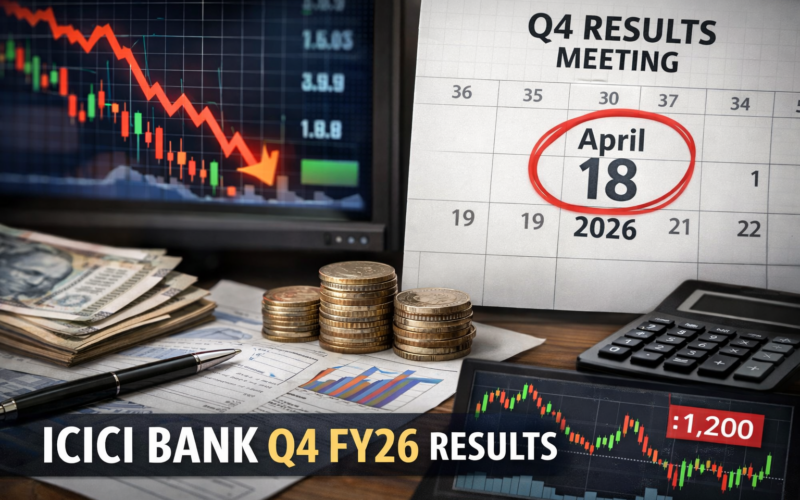
ICICI Bank Limited (NSE: ICICIBANK) is heading into the most consequential date in its near-term calendar — its Q4 FY26 results board meeting on April 18, 2026 — with the stock sitting roughly 13% below its 52-week high and retail investor sentiment split between those buying the dip and those waiting for proof that the Q3 earnings shock is behind it. The bank, India’s largest private sector lender by consolidated assets, saw its Q3 FY26 profit fall 2.68% year-on-year after a Reserve Bank of India-mandated provisioning charge of ₹1,283 crore related to agricultural loan misclassification. That single event sent the stock to near its 52-week low of around ₹1,200, and the April 18 announcement now doubles as both an earnings catalyst and a reputational reset moment. What the bank reports in the next ten days — profit recovery, net interest margin stability, loan growth, and the quantum of any dividend recommendation — will determine whether ICICIBANK at current levels is a value entry point or a value trap.
Why did ICICI Bank’s Q3 FY26 profit fall and is the RBI provisioning issue now resolved?
The Q3 FY26 result was the story that knocked ICICIBANK off its multi-year trajectory. Standalone net profit fell to ₹11,317.86 crore from ₹11,792.42 crore in the same quarter a year earlier, a 4% decline that stood out against the bank’s long record of compounding earnings. The cause was not deteriorating credit quality or a slowdown in the core business. Net interest income actually rose 7.7% to ₹21,932.2 crore in Q3, and the bank’s gross NPA ratio held at a healthy 1.53%.
The damage came from a ₹1,283 crore provision mandated by the RBI following a review of priority sector lending classifications. ICICI Bank, like several peers including Axis Bank, had misclassified a portion of agricultural loans under PSL guidelines over an extended period. The RBI required the bank to take a one-off charge to cover the compliance gap. This is an important distinction for investors: it was a regulatory correction for past accounting, not a sign of worsening loan book quality.
ICICI Bank stated it did not have to declassify its entire affected portfolio from PSL status, unlike some peers who faced a harsher outcome. This creates the prospect of a partial provision reversal in future quarters as the bank achieves compliance on reclassified loans. Whether management signals that reversal path — or quantifies the residual risk — on April 18 will be closely watched. Analysts at Motilal Oswal maintained a Buy rating with a target of ₹1,750 after the Q3 result, viewing the provisioning event as non-recurring.
What are analysts forecasting for ICICI Bank Q4 FY26 PAT, NIM, and loan growth?
Heading into April 18, the analyst community is modelling a return to earnings normalcy. Consensus PAT estimates for Q4 FY26 range from ₹11,500 crore to ₹12,200 crore, a recovery from the Q3 provisioning-depressed number, underpinned by the absence of the one-off RBI charge. Revenue estimates from brokerages including Motilal Oswal, YES Securities, and JM Financial range from ₹48,000 crore to ₹50,000 crore for the quarter, versus ₹47,508 crore in Q3 FY26.
Net interest margin is expected to remain stable at 4.0 to 4.1%, which matters because NIM stability is the key differentiator separating ICICI Bank from peers facing deposit repricing pressure. Return on assets, which the bank has consistently sustained above 2.3%, is forecast to hold in the 2.3 to 2.4% range in Q4. That RoA level is significant: at scale, only ICICI Bank and Kotak Mahindra Bank have maintained it consistently among India’s large private banks.
Loan growth guidance and outlook commentary from managing director Sandeep Bakhshi will carry as much weight as the headline numbers. Retail and MSME loan growth has been running at 15 to 17% year-on-year, well ahead of the system average of 12 to 14%. Whether that trajectory holds into FY27, and how the management frames the macro headwinds from the ongoing West Asia conflict and oil price pressure, will shape how quickly the stock closes the gap to analyst targets.
How does the RBI rate environment and India’s macro backdrop affect the ICICIBANK investment case?
India’s monetary policy cycle has shifted in favour of borrowers and growth over the past 18 months. The RBI’s Monetary Policy Committee cut the policy repo rate in both February and April 2025, taking it to 6.25% and signalling an accommodative stance. Rate easing is directionally positive for banks by stimulating credit demand, though the near-term impact on NIM can cut both ways: lower rates eventually compress lending yields, while liability costs take longer to reprice down through the deposit base.
ICICI Bank’s treasury head B. Prasanna has publicly noted that the tail-end of liability repricing offers stability through the first half of FY27. A meaningful NIM expansion scenario, rather than just stability, depends on whether the RBI proceeds with further cuts in 2026 and how quickly deposit costs follow. The bank is positioning itself to benefit from yield transmission faster than public sector peers, given its higher proportion of floating-rate retail assets.
The macro complication is the ongoing US-Iran conflict and the associated surge in global crude oil prices. India, as a major oil importer, faces a dual pressure of higher import costs and potential inflationary pass-through. Ambit Capital’s research has flagged that prolonged conflict could cap India’s banking sector credit growth at 10 to 12% in FY27, against a base case of 11 to 13%. For ICICI Bank, which earns a meaningful portion of wholesale banking revenue from trade finance and working capital facilities, supply chain disruption can actually increase short-term credit demand from corporate clients even as it clouds the long-term capex outlook.
Crisil Ratings has projected 13% credit growth for the sector in FY27, driven by MSME and retail demand. That environment plays directly to ICICI Bank’s portfolio mix and branch network strengths.
What makes ICICI Bank’s business model different from other large Indian private sector banks?
ICICI Bank is one of three lenders designated by the RBI as a domestic systemically important bank, alongside State Bank of India and HDFC Bank. The D-SIB label is shorthand for a bank that cannot be allowed to fail. It comes with higher regulatory capital requirements but also signals institutional permanence that underpins long-term investor confidence.
What sets ICICI Bank apart operationally is the breadth of its financial services ecosystem. The bank operates through standalone retail, corporate, and international banking divisions, and holds stakes in ICICI Prudential Life Insurance, ICICI Lombard General Insurance, ICICI Securities (now a wholly owned subsidiary following its delisting in March 2025), and ICICI Prudential Asset Management. This conglomerate structure means the bank benefits from cross-sell revenue streams that pure-play lenders cannot replicate. Fee income from insurance distribution, broking, and wealth management provides a cushion when interest margin pressure mounts.
The bank’s branch network spans 7,385 locations across India, complemented by 11,983 ATMs and a presence in 11 countries including the United Kingdom, Canada, the United States, and Singapore. Its Bharat Banking vertical specifically targets tier 2, tier 3, and rural customers, a segment that major private banks underserved for years and one that is now delivering disproportionate deposit growth relative to urban markets.
How has iMobile Pay changed ICICI Bank’s cost structure and competitive positioning in digital banking?
iMobile Pay has become one of the most-watched metrics in Indian retail banking. The app has crossed 30 million registered users and processes over 85% of retail banking transactions for the bank. For investors, the relevance is structural: as digital channels absorb transaction volume, the marginal cost of serving an additional customer falls, protecting profitability even as branch expansion slows.
The app is not limited to ICICI Bank account holders. Since the bank opened iMobile Pay to non-customers, allowing anyone to use its UPI and payments interface, it has functioned as a customer acquisition channel, pulling in deposits and credit card applications from people who entered the ecosystem through a payments experience. UPI volume through iMobile Pay has grown substantially, with the bank reporting over 60% year-on-year UPI growth in recent financial years.
ICICI Bank also operates InstaBIZ for its small business segment, which enables same-day working capital loan approvals for merchants. Digital underwriting at this scale, combining iMobile Pay transaction data, GST filing history, and account behaviour, gives ICICI Bank a meaningful credit decisioning edge over banks still reliant on manual assessment. This is the primary reason the bank’s MSME loan growth has outpaced system averages without a corresponding deterioration in asset quality.
How is ICICIBANK currently priced relative to its fundamental earning power and analyst targets?
At around ₹1,310 as of April 8, 2026, ICICIBANK is trading at approximately 17.9x trailing price-to-earnings and 2.78x book value. The 52-week range spans ₹1,208 to ₹1,500, meaning the stock is sitting in the lower half of its annual range despite the business fundamentals remaining broadly intact.
The consensus analyst price target across 38 Buy-rated analysts sits at a 12-month average of approximately ₹1,678, with the high estimate at ₹2,040 and the low at ₹1,470. That implies roughly 28% upside from current levels at the consensus midpoint, a gap wide enough to attract dip-buyers but not so extreme as to signal distress. BofA Securities has reduced its price target while maintaining a constructive view. PL Capital specifically named ICICI Bank as a preferred pick over public sector banks, citing its private sector advantage in the second half of FY27 when loan-to-deposit dynamics are expected to swing back in favour of deposit-constrained private lenders.
The market cap at current prices sits around ₹9.2 lakh crore (approximately USD 110 billion), making ICICIBANK one of the ten largest listed financial institutions in Asia by market capitalisation. For context, the stock is priced below the level at which many institutional investors first built positions in FY24 and FY25, before the broader Indian market correction.
What are the execution risks ICICIBANK investors need to monitor through FY27?
The most immediate risk heading into Q4 results is whether the ₹1,283 crore PSL provisioning event from Q3 was truly a one-off or whether additional misclassified accounts surface in the audit for the full financial year. Management’s tone on this question on April 18 will matter. Any suggestion of further provisioning requirements would likely extend the stock’s underperformance relative to the Bank Nifty index.
Beyond the near-term, the deposit paradox is a structural challenge the entire sector faces. Household savings in India are shifting incrementally toward capital markets, including mutual funds, equities, and sovereign gold bonds, rather than term deposits. For banks, this tightens the funding base and elevates the cost of bulk deposits. ICICI Bank’s relatively higher CASA ratio acts as a partial buffer, but certificate of deposit rates rose 48 basis points in December 2025 and January 2026, and bulk term deposit rates climbed 25 to 50 basis points in the same window.
Geopolitical risk via the West Asia conflict feeds through oil prices into inflation and the RBI’s room to cut rates further. If oil remains elevated near USD 110 per barrel, the inflation buffer that gave the RBI room to cut in early 2025 narrows significantly. A rate hold or a reversal to tightening would compress the credit demand outlook and pressure ICICIBANK’s margin recovery timeline. Currency risk also applies: a sustained rupee depreciation scenario driven by India’s oil import bill would complicate NIM projections for the bank’s international operations.
What are the key takeaways from ICICI Bank’s Q4 FY26 results outlook and FY27 investment thesis?
- ICICI Bank reports Q4 FY26 results on April 18, 2026, with analyst consensus expecting a PAT recovery to ₹11,500 to 12,200 crore after the Q3 provisioning dip caused by a one-off RBI-mandated agricultural loan charge of ₹1,283 crore.
- The stock is trading at approximately ₹1,310, around 13% below its 52-week high of ₹1,500, with a consensus 12-month analyst price target of roughly ₹1,678, implying approximately 28% upside at the midpoint.
- ICICI Bank is one of three RBI-designated domestic systemically important banks and holds a conglomerate structure spanning insurance, broking, and asset management that generates cross-sell fee income beyond pure lending margins.
- The iMobile Pay platform with over 30 million users is structurally reducing customer acquisition and servicing costs while driving MSME and retail loan growth at 15 to 17% year-on-year, ahead of the sector average.
- The Q3 PSL provisioning issue is considered non-recurring by the majority of covering analysts, but the Q4 audit covering the full financial year remains the key binary risk in the near term.
- Macro headwinds from the West Asia conflict, elevated crude oil prices, and deposit repricing pressure create a ceiling on near-term NIM expansion. The FY27 margin recovery thesis depends on further RBI rate cuts materialising without an oil-driven inflation reversal.
- The April 18 dividend recommendation from the board will also be closely watched. A dividend in line with or exceeding the ₹11 per share paid in FY25 would signal management confidence in the FY26 earnings trajectory.
Discover more from Business-News-Today.com
Subscribe to get the latest posts sent to your email.