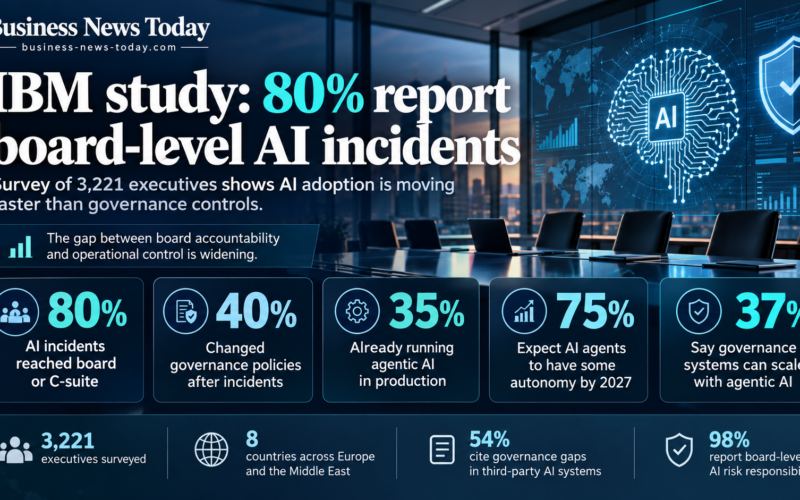
International Business Machines Corporation (NYSE: IBM) has released research showing that 80% of senior executives surveyed across eight European and Middle Eastern countries reported an artificial intelligence-related incident reaching their board or C-suite during the previous year. Yet only 40% of organizations reporting such incidents cited changes to their AI governance policies or frameworks in response, exposing a potential disconnect between executive awareness and corrective action. The findings, announced on October 14, 2026, arrive as businesses increasingly deploy autonomous AI agents capable of executing tasks and influencing decisions with limited human intervention. They also point towards growing demand for enterprise AI governance, cybersecurity, monitoring and compliance technology. The unresolved challenge is whether organizations can establish effective operational controls before agentic AI becomes embedded in more consequential business processes.
Why does IBM’s finding that 80% of executives reported AI incidents expose a wider corporate governance problem?
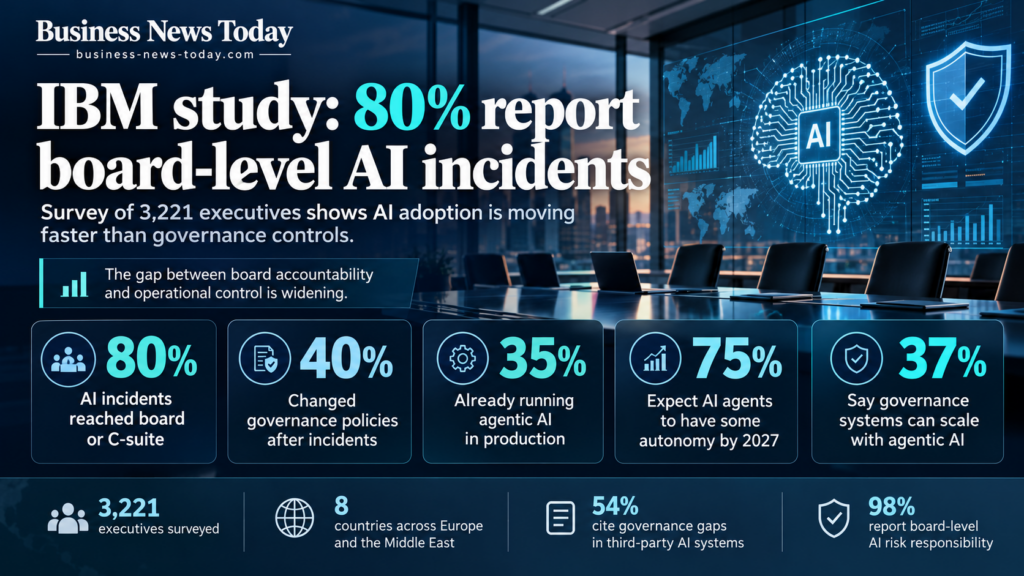
The IBM study identifies a governance problem that cannot be explained simply by a lack of executive involvement. According to the research, 98% of surveyed executives reported that responsibility for AI risk had been formally assigned at board level, while 26% said their organizations had dedicated board-level AI committees. Despite these structures, the relatively limited policy changes following reported incidents suggest that formal accountability does not necessarily produce consistent operational responses. Boards may recognize artificial intelligence as a strategic risk without having sufficient information about the effectiveness of existing safeguards.
The distinction between incident escalation and confirmed organizational damage is essential when interpreting the findings. IBM’s survey covers AI-related events ranging from agent failures and decision errors to data exposure and security breaches, but the announcement does not provide a breakdown of their severity or verified financial consequences. The 80% figure therefore measures what executives reported reaching senior leadership, rather than establishing that four in five enterprises suffered a major AI security breach. Nevertheless, the prevalence of reported escalation suggests that artificial intelligence has become a significant governance concern within the surveyed organizations.
The research was conducted by Censuswide on behalf of IBM between September 14 and September 24, 2026, covering 3,221 executive management respondents at organizations employing at least 1,000 people. Participants were based in the United Kingdom, France, Germany, Italy, Spain, the Netherlands, Saudi Arabia and the United Arab Emirates. Although IBM presents the findings within an EMEA context, the survey does not include African markets and should not be interpreted as statistically representing every enterprise across the wider region. Its findings are particularly relevant to large organizations managing complex technology environments, regulatory obligations and multiple external service providers.
How could the expansion of autonomous AI agents increase operational risk for large enterprises by 2027?
The movement from AI assistants towards autonomous agents introduces a different category of operational exposure. An assistant generally supports a human decision, while an agent can be configured to carry out sequences of actions across connected enterprise systems, sometimes without obtaining separate approval for every step. Such capabilities can accelerate workflows involving customer service, procurement, financial operations and information technology management, but they also create additional points where errors, excessive permissions or compromised instructions may have wider consequences. Governance frameworks designed primarily to review model outputs may be insufficient when AI systems can initiate transactions or modify business records.
IBM found that 35% of respondents said their organizations were already running agentic AI in production, while 75% expected AI agents to possess some decision-making autonomy by 2027. However, only 37% believed their current governance systems were designed to scale alongside agentic AI deployments. The figures describe a substantial difference between anticipated adoption and reported governance readiness, although they do not establish how extensively individual companies intend to deploy autonomous systems. A business using agents for limited internal support faces a different exposure from one permitting automated changes to payments, customer accounts or regulated records.
The survey also reveals uncertainty over who should be accountable when autonomous systems produce adverse outcomes. Chief information officers and chief technology officers were the most frequently identified roles with assigned responsibility for agent-related outcomes, yet they were selected by only 17% of respondents. Opinions about legal liability were similarly fragmented, with 20% favouring proportionate responsibility between deployers and vendors, 19% identifying the need for a regulatory framework they considered insufficiently developed, and 14% favouring responsibility resting with the technology provider. These responses reflect differing views rather than established legal allocations of liability, which depend on the applicable jurisdiction, contractual terms and circumstances of an incident.
Why are enterprises continuing with artificial intelligence deployment when governance frameworks are not ready?
One of the survey’s more commercially consequential findings concerns how executives balance innovation against control requirements. When artificial intelligence deployments move faster than governance and compliance frameworks can accommodate, 56% of respondents said their organizations continue implementation within agreed risk limits while controls evolve. By comparison, 33% reported delaying deployment until governance arrangements become ready. The findings suggest that many enterprises view delayed adoption as a commercial disadvantage, although continuing within defined risk limits is not equivalent to abandoning governance requirements.
The effectiveness of that approach depends heavily on how risk limits are established and enforced. An organization may authorize an AI agent to perform routine purchasing activities while requiring human approval above a defined monetary threshold, or permit automated infrastructure changes only within specified technical boundaries. Such arrangements allow businesses to pursue productivity gains while restricting potentially costly decisions. However, their effectiveness requires reliable permissions, continuous monitoring and the ability to intervene when an agent behaves unexpectedly.
Executives identified several controls they expected to need as AI autonomy increased towards 2027. Contractual or legal frameworks addressing vendor liability were cited by 33%, while 32% identified defined human escalation thresholds, 30% highlighted real-time monitoring and audit trails, and 29% pointed to mechanisms for immediately stopping agent activity across an enterprise. These percentages represent identified future control needs, not confirmation that the capabilities have already been implemented. They nevertheless provide a practical indication of where enterprise technology spending could shift as organizations move beyond experimental AI deployments.
What does IBM’s research reveal about third-party AI supply chain risks and financial accountability?
Artificial intelligence governance becomes more complicated when enterprise applications depend on models, platforms and services developed by outside organizations. IBM found that 54% of surveyed executives acknowledged gaps or limitations in governance coverage for AI systems used by major vendors, technology partners and supply chain participants. Only 21% reported continuously monitoring third-party AI risks, while 13% applied independent assurance or certification requirements. These findings suggest that technology dependencies may expand more rapidly than the mechanisms organizations use to evaluate them.
The commercial exposure extends beyond cybersecurity because vendor-controlled systems can affect business continuity, contractual performance and regulatory compliance. A company integrating an external AI model into an internal workflow may retain responsibility for its operational decisions even when it does not control every technical component supporting those decisions. This creates a need for clearer vendor assessments, contractual safeguards, incident-reporting obligations and evidence about system behaviour. It also makes the ability to trace actions across interconnected platforms increasingly valuable.
IBM’s findings indicate that organizations are beginning to distinguish conventional generative AI from more autonomous systems. Some 54% of respondents said their companies maintained separate governance frameworks for generative and agentic AI, while another 38% applied a common framework with additional controls for agents. However, just 37% reported having a formal, board-reviewed quantification of the financial exposure arising from gaps in AI governance. Without credible estimates of potential losses, companies may struggle to compare the cost of stronger safeguards against the operational and financial risks those safeguards are intended to reduce.
How will the European Union AI Act influence enterprise AI governance investment through 2027?
Regulatory developments are adding another dimension to corporate AI governance decisions, particularly within the European Union. IBM reported that 41% of surveyed executives in European Union countries were accelerating governance investment ahead of high-risk AI obligations scheduled for December 2027, while a further 35% indicated that structured compliance preparations were proceeding according to plan. These responses suggest that regulatory readiness is becoming a factor in technology investment decisions alongside productivity, cybersecurity and operational efficiency. However, compliance requirements depend on how a particular AI system is classified and the role an organization performs under the legislation.
The European Union’s AI Act already has enforceable provisions, while major requirements governing certain high-risk AI systems are scheduled to apply from December 2, 2027. The corresponding requirements for high-risk systems embedded in regulated products are scheduled for August 2, 2028. High-risk obligations include measures addressing risk management, technical documentation, activity logging, human oversight and cybersecurity. These rules do not automatically classify every autonomous AI agent as high-risk, making accurate system classification an important part of enterprise compliance planning.
IBM also identified different regulatory influences outside the European Union. In the United Kingdom, sector regulator expectations were the most frequently cited driver of AI governance investment, selected by 27% of respondents. In Saudi Arabia and the United Arab Emirates, national AI strategy requirements were identified as the leading influence, at 61%. These geographic differences mean multinational enterprises may need governance systems that apply consistent internal safeguards while supporting differing local regulatory and policy requirements.
Can IBM convert rising AI governance concerns into software and consulting growth?
The research is commercially relevant to IBM because enterprise AI management overlaps with several areas of its existing technology portfolio. The company offers hybrid cloud infrastructure, automation, artificial intelligence software and consulting services through products and businesses including watsonx, Red Hat and HashiCorp. Organizations seeking to manage AI permissions, monitor autonomous activity and integrate governance into existing technology environments could create opportunities across these offerings. However, the survey identifies potential customer requirements rather than confirmed contracts, software purchases or incremental revenue for IBM.
IBM’s latest reported quarterly results illustrate both the scale of its enterprise technology business and the need to distinguish opportunity from realized performance. Second-quarter 2026 revenue increased approximately 1% year over year to $17.2 billion, with software revenue rising 5% to $7.8 billion. Consulting revenue remained broadly flat at $5.3 billion, while infrastructure revenue declined 7% to approximately $3.8 billion. The differing segment performances show that exposure to enterprise AI spending does not automatically translate into uniform growth across the portfolio.
IBM generated approximately $2.5 billion in free cash flow during the second quarter, down around $300 million from the prior-year period, while first-half free cash flow remained broadly unchanged at $4.8 billion. Management’s most recent published full-year expectations called for constant-currency revenue growth of 4% to 5% and an approximately $1 billion annual increase in free cash flow. Greater spending on AI governance could support these objectives if customers purchase software, commission consulting projects or expand existing contracts. The magnitude of any contribution cannot be calculated from IBM’s survey because the study does not quantify expected customer budgets, contract values or implementation expenditure.
IBM shares closed at $227.88 on October 14, 2026, declining 1.26% during the session and standing approximately 31.5% below their 52-week high of $332.46 recorded in June. The wider United States equity market also weakened that day, with the S&P 500 declining 1.11%, while IBM’s survey announcement was distributed after the regular market close. The trading movement therefore should not be described as an investor reaction to the study. More meaningful evidence of whether demand for governance-related products is influencing the company’s valuation will come from financial performance, customer adoption and management commentary.
IBM is scheduled to discuss its third-quarter 2026 financial results on October 21. Investors will have an opportunity to assess software growth, consulting demand, operating margins and the company’s progress towards its full-year outlook. Evidence of stronger enterprise spending on AI governance would strengthen the commercial argument surrounding the study, particularly if accompanied by identifiable bookings, deployments or recurring software revenue. Without such evidence, the research primarily supports an industry-wide demand hypothesis rather than a company-specific earnings forecast.
What evidence will demonstrate whether enterprise boards can govern autonomous AI systems effectively?
The next stage of enterprise AI adoption is likely to place greater emphasis on measurable controls rather than governance structures alone. A company may establish a board committee, assign executive responsibility and approve a risk framework while still lacking visibility into the decisions autonomous agents make across its applications. More convincing evidence of governance maturity would include reliable audit records, tested human intervention procedures, systematic vendor assessments and documented improvements following operational incidents. Financial risk quantification would also help boards determine whether spending on new controls is proportionate to potential business exposure.
IBM’s study exposes a tension between the speed at which enterprises want to deploy AI and the operational discipline required to use it safely at scale. For technology providers, this could expand demand for monitoring platforms, security products, compliance services and implementation expertise, although competition and customer purchasing decisions will determine how much revenue materializes. For enterprise boards, the more immediate test is whether organizations can move from recognizing AI incidents to demonstrating that corrective measures reduce their frequency or consequences. The strongest evidence of progress will be visible when accountability assignments, intervention controls and documented financial exposure become routine features of production AI systems rather than responses to individual failures.
What are the key takeaways from IBM’s 2026 enterprise AI governance study?
- IBM surveyed 3,221 senior executives across eight European and Middle Eastern countries in September 2026.
- Some 80% of respondents reported an AI incident reaching their board or C-suite during the previous year.
- Only 40% of affected organizations cited governance policy or framework changes following reported incidents.
- While 98% reported formal board-level AI risk responsibility, accountability for autonomous agent outcomes remained fragmented.
- Around 35% said their organizations already operated agentic AI in production, and 75% anticipated some agent decision-making autonomy by 2027.
- Only 37% believed their governance systems could scale with agentic AI deployment.
- More than half of respondents acknowledged governance limitations involving third-party AI systems.
- European Union high-risk AI requirements scheduled for December 2027 are influencing corporate governance investment.
- IBM could benefit from greater demand for enterprise AI oversight, but the survey does not establish incremental revenue.
- IBM’s October 21 earnings announcement will provide a nearer-term financial checkpoint, while measurable control effectiveness remains the wider industry’s central test.
Discover more from Business-News-Today.com
Subscribe to get the latest posts sent to your email.