




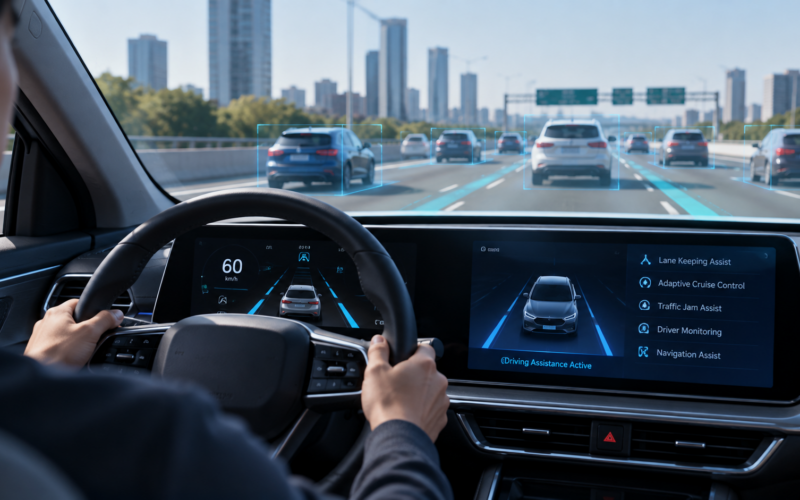
Hyundai Motor Company (KRX: 005380) has delayed the planned launch of its internally developed Level 2++ advanced driver-assistance system by approximately two years, moving the target from late 2027 to late 2029 as it gathers additional driving data and completes further safety validation. Chief Executive José Muñoz said Hyundai will use technology developed with Nvidia Corporation (NASDAQ: NVDA) for Level 2+ and Level 2++ vehicles expected in 2028 while the South Korean automaker continues developing its own long-term system.
The shift is consequential because Hyundai has made vertical integration a central part of its technology strategy. Management wants the group eventually to control critical technologies including batteries and autonomous-driving systems rather than permanently depending on external suppliers, yet the latest timetable shows how difficult that objective becomes when software capability evolves faster than traditional vehicle-development cycles.
Why has Hyundai pushed its Level 2++ driver-assistance system back by two years?
Advanced driver assistance is unusually dependent on data. Engineers need to expose systems to enormous numbers of real-world driving scenarios, including unusual road layouts, weather, construction zones, unpredictable drivers and vulnerable road users, before increasing automation while maintaining acceptable safety performance.
Muñoz said Hyundai requires additional data and validation before introducing its in-house Level 2++ system at scale. The resulting delay moves the expected launch to late 2029 from late 2027, while the planned Nvidia-based solution provides Hyundai with an interim route to more sophisticated driver assistance in 2028.
Level 2 systems remain driver-assistance technologies rather than fully autonomous driving. Drivers are still responsible for supervising operation, which is an important distinction when comparing Hyundai’s roadmap with robotaxi projects designed around Level 4 automation.
The delay nevertheless affects competitive positioning because driver-assistance capability has become a visible selling point in electric and premium vehicles. Chinese manufacturers in particular have been adding software features rapidly, compressing the time established automakers have to perfect proprietary systems before customers expect them.
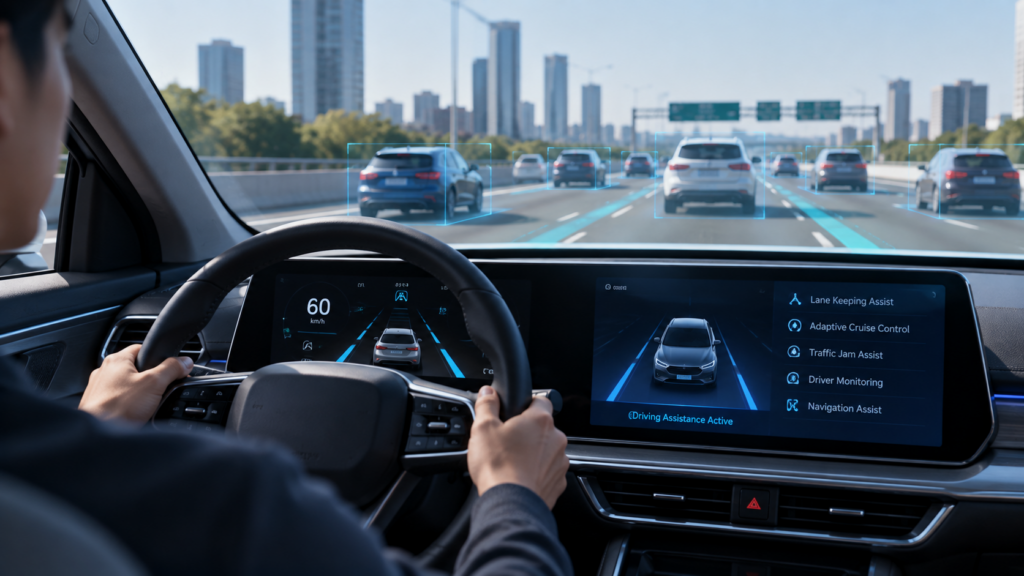
Why is Nvidia strategically useful to Hyundai even if Hyundai ultimately wants its own technology?
Nvidia provides computing platforms and software designed specifically for vehicles, giving automakers access to advanced hardware without creating every semiconductor and software layer independently. For Hyundai, an interim Nvidia solution can reduce the feature gap while internal teams continue developing technology intended to differentiate future vehicles.
That does not necessarily undermine Hyundai’s vertical-integration strategy. Automakers frequently use external technology during transitional periods while building internal capabilities, particularly when missing an entire product cycle could be more damaging than temporarily depending on a partner.
The risk comes if temporary dependence becomes permanent. Nvidia is building relationships across the automotive industry, meaning Hyundai could end up using technology also available to competitors unless its own software, vehicle integration or proprietary systems provide sufficient differentiation.
Hyundai also owns autonomous-driving company Motional, giving the wider group exposure to higher levels of vehicle automation. The challenge is turning research and autonomous-mobility expertise into affordable technology that can be deployed reliably across millions of consumer vehicles.
How does the software delay fit Hyundai’s current financial performance?
Hyundai’s second-quarter results show a company generating record revenue but facing pressure on profitability. Revenue increased 1.9% year over year to a record KRW49.22 trillion, while operating profit fell 20.8% to KRW2.85 trillion and the operating margin declined to 5.8%. Global wholesale sales fell 6.9% to 991,885 vehicles.
Hybrid vehicles remain one of the strongest areas. Hyundai sold a record 187,661 hybrids during the second quarter, while total electrified-vehicle sales reached 266,627 units, up 1.7%. North America also remained relatively resilient, helping offset weakness elsewhere.
These results explain why software investment cannot be considered separately from basic vehicle economics. Hyundai needs to spend heavily on software, autonomy, batteries and electric platforms even while operating profit is falling, making development efficiency increasingly important.
Partnering with Nvidia can therefore be viewed partly as capital and execution management. If Hyundai can buy an interim solution rather than rushing its own system before it is ready, management may reduce technical risk while preserving internal resources for a later proprietary platform.
How serious is Chinese competition for Hyundai in Europe and other global markets?
Muñoz said Chinese manufacturers are offering some vehicles at prices 30% to 40% below competing products in markets including Italy, Spain and France. He also pointed to Chinese brands securing more than 9% of European Union vehicle sales during the first half of 2026 and roughly 15% of registrations in the United Kingdom. Those comments represent Hyundai management’s assessment of the competitive threat, but the underlying market-share gains illustrate how quickly Chinese brands have expanded outside their home market.
Hyundai is not simply competing on sticker price. Chinese manufacturers have combined lower manufacturing costs with rapid software development, advanced in-car technology and short model cycles, forcing established global automakers to compete simultaneously on hardware and digital features.
Muñoz argued that US market safeguards have so far limited similar penetration in the United States, where Chinese electric vehicles face tariffs around 100%. Trade-policy outcomes remain outside Hyundai’s direct control, which increases the strategic importance of competing through products rather than assuming regulatory barriers will always restrict Chinese entry.
For Hyundai, hybrids currently provide an important competitive bridge because consumers can reduce fuel consumption without moving completely to battery-electric vehicles. The company still needs stronger software capability, however, because electrification is increasingly shifting product differentiation away from engines and toward computing.
Could Hyundai’s delay become an advantage if it avoids releasing immature technology?
There is a reasonable commercial argument for patience. Driver-assistance failures can create safety risks, regulatory scrutiny, costly recalls and reputational damage, making premature deployment potentially more expensive than a delayed launch.
The issue is whether Hyundai uses those additional two years productively. If the company gathers enough data to create a robust internal system while customers receive capable Nvidia-based technology in the interim, the delay could become a manageable sequencing decision.
If competitors move substantially further ahead during that period, Hyundai could instead find itself trying to close a larger technological gap in 2029. That is particularly relevant because software capabilities can improve through accumulated fleet data, meaning companies already operating sophisticated systems potentially gain more information with every mile driven.
The measurable milestones are therefore the 2028 Nvidia-supported launch, the performance of that system in consumer vehicles and evidence that Hyundai’s proprietary 2029 platform remains on schedule.
What does Hyundai’s latest stock performance suggest about investor sentiment?
Hyundai Motor shares were trading about 1.5% higher at KRW368,500 in delayed Seoul market data on the morning of September 18, following a KRW363,000 close a day earlier. The movement should not be attributed solely to management’s autonomous-driving comments because the stock responds to currencies, tariffs, vehicle sales and wider Korean market conditions.
The larger investor concern remains the combination of record revenue and declining operating profit. Hyundai is growing in strategically important areas such as hybrids, yet technology investment, cost pressures and weaker overall volumes are making it harder for revenue growth to translate into earnings growth.
That makes the Nvidia bridge strategically important but not sufficient by itself. Hyundai ultimately wants to own more of the technology underlying future vehicles, and the revised 2029 timetable gives management additional time to prove that ambition can become a scalable commercial platform.
Discover more from Business-News-Today.com
Subscribe to get the latest posts sent to your email.


