



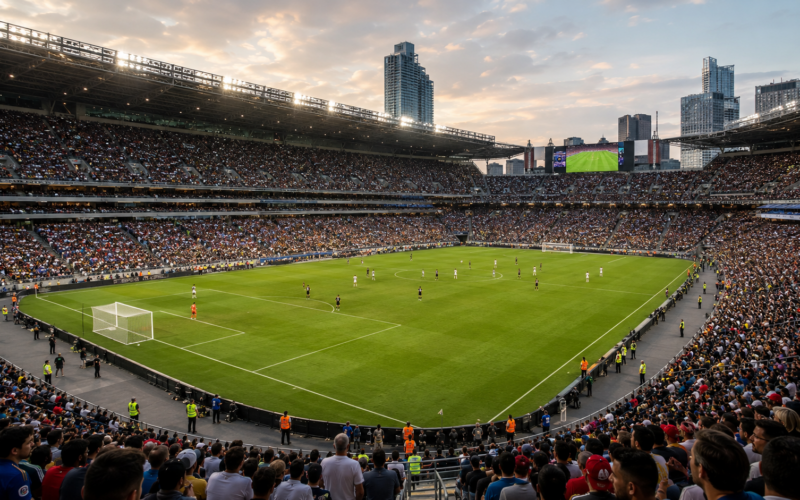
The United States men’s national soccer team opened its 2026 FIFA World Cup campaign on June 12, 2026, with a 4-1 victory over Paraguay at SoFi Stadium in Inglewood, California, delivering the kind of statement result that can change the mood around a tournament almost overnight. Folarin Balogun scored twice, Giovanni Reyna added a late fourth goal, and the United States turned its home-soil opener into one of the most emphatic World Cup performances in the program’s modern history.
The win mattered because it was not simply a positive start. It was a result loaded with symbolism, commercial significance, national sporting pressure and a long-running question about whether the United States can become more than an enthusiastic host of global soccer. For a country staging the tournament alongside Canada and Mexico, the performance gave fans, broadcasters, sponsors and tournament organizers exactly what they needed on opening night: a competitive reason to believe that the home team could stay central to the 2026 World Cup conversation.
The United States defeated Paraguay by three goals, scored four times in a World Cup match for the first time, and saw Balogun become the first American player since 1930 to score multiple goals in a World Cup game. Those milestones gave the result a historical edge, but the larger story is about momentum. The United States entered the tournament with talent, visibility and expectation. After one match, it also has a defining early image: a young, confident team attacking with conviction in front of a home crowd.
Why did the United States’ opening win over Paraguay feel bigger than one group-stage result?
World Cup openers can be deceptive, but they are rarely irrelevant. A poor first match can force teams into tactical panic, media scrutiny and immediate pressure. A strong first match can create breathing room, shape belief inside the squad and increase public attention beyond the core soccer audience. The United States did not just win against Paraguay. It gave the tournament’s American storyline a jolt at the earliest possible moment.
The timing made the result even more powerful. The 2026 FIFA World Cup is the first men’s edition played on United States soil since 1994, and the sport’s domestic rise has been tied for years to the idea that this tournament could accelerate soccer’s mainstream position in the country. That made the Paraguay match more than a football contest. It was also a national showcase, a broadcast product, a fan-culture test and a commercial moment for the sport’s American future.
The United States made that showcase work by scoring early and refusing to play like a team satisfied with survival. Paraguay’s own goal in the opening minutes gave the hosts immediate control, but the real difference came from what followed. The United States pressed forward, looked dangerous in transition and found the kind of attacking rhythm that has not always been associated with American World Cup teams.
Balogun’s first-half goals shifted the match from promising to memorable. His second goal, after a pass from Malik Tillman, gave the performance a star-making quality because it combined timing, composure and technical precision. For a United States team still searching for global credibility, those moments matter. World Cups are not only remembered by results. They are remembered by faces, goals and the sudden emergence of players who turn national expectation into something more emotional.
How did Folarin Balogun become the defining face of the United States’ World Cup start?
Folarin Balogun’s performance instantly became the central narrative because it connected sport, identity and timing. Born in Brooklyn to Nigerian parents and raised in London, Balogun represents the increasingly global nature of American soccer. His decision to represent the United States had already been treated as a significant recruitment win. His two-goal World Cup debut turned that decision into a national talking point.
Balogun’s background gives his rise a wider resonance. He developed in England’s academy system, came through Arsenal’s youth structure and had the option of building his international career elsewhere. By choosing the United States, he became part of a broader effort to attract dual-national talent capable of raising the team’s technical ceiling. Against Paraguay, that recruitment strategy delivered in the brightest possible setting.
The significance of his brace goes beyond the stat sheet. The United States has often been respected for athleticism, organization and resilience, but it has not always produced World Cup forwards who look ruthless in decisive attacking moments. Balogun’s two goals challenged that perception. He played like a striker comfortable with expectation, not burdened by it.
That matters because the United States’ ceiling at this World Cup may depend on whether it can consistently convert possession and pressure into goals. Christian Pulisic has long been the country’s headline attacking player, but a genuine tournament run requires more than one focal point. Balogun’s emergence gives opponents another urgent problem and gives the United States a sharper attacking profile.
His performance also changes the public conversation. Before the tournament, much of the debate around the United States centered on whether the squad had matured enough to handle the pressure of a home World Cup. After Paraguay, the question is more ambitious: can this generation turn a historic opening statement into a deeper run?
What does Christian Pulisic’s fitness concern mean after such a dominant start?
The only immediate concern from the match was Christian Pulisic’s fitness after he was substituted following a calf issue. That development matters because Pulisic remains the United States’ most recognizable player and one of its most influential attackers. Even on a night dominated by Balogun’s goals, Pulisic’s early involvement helped set the tone for the American performance.
The United States can take encouragement from the fact that it continued to control the match and eventually scored again without Pulisic on the field. That is an important sign of squad depth and attacking variety. In past cycles, any injury concern involving the team’s biggest star might have overshadowed the result. This time, the team still had Balogun, Reyna, Tillman and other creative players capable of carrying the performance forward.
Still, the World Cup is a short, unforgiving tournament. Fitness uncertainty around a player of Pulisic’s importance will remain a major talking point until there is more clarity. The United States has upcoming group-stage pressure to manage, and the coaching staff will need to balance ambition with caution. A strong opening win gives the team options. It does not eliminate the risk of overextending a key player too early.
That is why the Paraguay result should be viewed as both a breakthrough and a beginning. The United States has made its first statement, but tournament credibility is built through repetition. One dominant performance can change mood. Multiple controlled performances can change expectations.
Why could the 2026 World Cup become a turning point for American soccer culture?
The United States’ win over Paraguay arrived at a moment when soccer in the country is no longer a niche experiment but still not fully embedded at the level of the National Football League, National Basketball Association or Major League Baseball. A successful home World Cup could narrow that gap by creating casual fans, strengthening youth participation, increasing media demand and giving sponsors a larger reason to invest in the sport’s domestic ecosystem.
This is where the current affairs angle becomes bigger than the scoreboard. Major sporting events often work as cultural accelerators. The 1994 FIFA World Cup helped establish Major League Soccer and laid part of the foundation for soccer’s modern growth in the United States. The 2026 edition arrives in a much more mature sports market, with stronger digital distribution, global player visibility and a generation of younger fans more comfortable following international football.
A United States team that wins convincingly can make the tournament feel less like a visiting global event and more like a national moment. That distinction is important. Host countries often rely on local emotional investment to sustain energy across stadiums, broadcasts and public conversation. The better the home team performs, the more the tournament can spill out of sports pages and into broader culture.
Balogun’s story also fits the modern American identity of the team. The squad is shaped by immigration, dual-national pathways, European development systems and a domestic fan base that is both passionate and still expanding. In that sense, the Paraguay match was not just a soccer win. It was a snapshot of how the United States is trying to build a world-class football identity in its own image.
Can the United States convert one historic World Cup night into a serious run?
The biggest challenge now is managing the emotional spike. A 4-1 opening win can inspire confidence, but it can also inflate expectations quickly. Paraguay was overwhelmed for long stretches, yet tougher tactical tests are likely to come. The United States will need to show that it can handle opponents that deny space, control tempo, or force the Americans into slower possession patterns.
That is where Mauricio Pochettino’s role becomes central. The United States did not look like a team relying only on adrenaline. It looked organized, aggressive and prepared to keep attacking even after building a lead. If that structure holds, the win over Paraguay could become more than a memorable opener. It could become the first sign of a team that has found a tournament identity at exactly the right time.
For now, the result gives the United States three critical assets: points, belief and attention. Points help with group-stage qualification. Belief helps inside the dressing room. Attention helps turn the home World Cup into a national event with commercial and cultural force. That combination is rare, and the United States earned it in one night.
The caution is obvious. World Cups do not reward celebration for long. The next match will test whether the Paraguay win was a peak performance or the start of a pattern. But the opportunity is just as clear. The United States has spent decades trying to convince the world that it belongs on soccer’s biggest stage. On June 12, 2026, it did not ask for validation. It took the field, scored four times and made the tournament listen.
Key takeaways from the United States’ 4-1 World Cup win over Paraguay
- The United States opened its 2026 FIFA World Cup campaign with a 4-1 win over Paraguay on June 12, 2026, giving the host nation an early surge of momentum.
- Folarin Balogun became the defining figure of the match after scoring twice and strengthening his role as a central attacking force for the United States.
- The result was historically significant because the United States scored four goals in a World Cup match for the first time.
- Christian Pulisic’s calf concern remains the biggest immediate issue for the United States despite the comfortable opening victory.
- Giovanni Reyna’s late goal added to the sense that the United States has more attacking depth than in past World Cup cycles.
- The win could help expand mainstream American interest in the 2026 FIFA World Cup by giving casual fans a strong home-team storyline early in the tournament.
- Paraguay’s defensive struggles raised questions about how the team will respond after being overwhelmed in its opening match.
- Mauricio Pochettino’s tactical setup gave the United States a more aggressive and confident identity in front of a home crowd.
- The opening victory improved the United States’ group-stage position, but the next match will show whether this performance was a one-off surge or the start of a deeper run.
- The result gave broadcasters, sponsors and tournament organizers an early boost by keeping the host nation at the center of the World Cup conversation.
Discover more from Business-News-Today.com
Subscribe to get the latest posts sent to your email.