




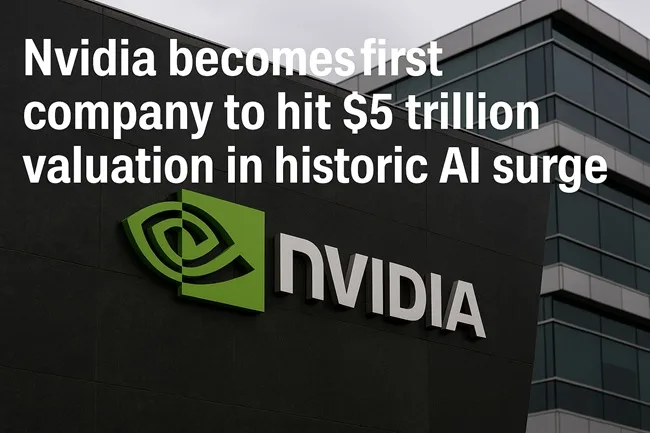
Nvidia Corporation has officially become the first company in history to reach a $5 trillion market capitalization, marking an inflection point not only for the company, but also for the broader technology sector, the artificial intelligence economy, and investor psychology. This historic valuation puts Nvidia in a league of its own, just ahead of a critical moment in U.S.–China relations, as Donald Trump and Xi Jinping prepare for high-stakes diplomatic discussions that could influence the future of global semiconductor policy.
The company’s share price surged more than 4 percent in the past week, buoyed by a combination of strategic announcements, investor momentum, and rising institutional allocations toward AI infrastructure. This growth trajectory has been nothing short of meteoric—only three months ago, Nvidia crossed the $4 trillion threshold. The $5 trillion milestone, achieved on October 29, 2025, demonstrates just how quickly the company’s dominance in AI hardware is translating into investor confidence and market capitalization.
While Microsoft Corporation and Apple Inc. have historically competed for the top spot in terms of valuation, Nvidia’s rise marks the first time a company outside traditional software and consumer tech has claimed this position. It also places a semiconductor firm at the very heart of global financial market dynamics—something almost unthinkable a decade ago.
What triggered the most recent rally and how significant is the $500 billion AI-chip booking pipeline?
The most immediate catalyst behind the valuation surge was Nvidia’s disclosure of nearly $500 billion in advance bookings for its AI chip portfolio. These orders, which span delivery timelines well into 2026 and beyond, include demand from hyperscale cloud providers, sovereign governments, and enterprise customers building large language model infrastructure.
Additionally, Nvidia revealed plans to build and deliver seven AI supercomputers for the United States government, further cementing its role as a national strategic supplier. The scale and scope of these contracts have given institutional investors clear forward visibility on revenue, which is often the missing link in high-momentum tech stocks.
For many investors, this $500 billion figure validates the thesis that Nvidia has moved beyond being a chipmaker into becoming the backbone of the AI economy. These are not speculative opportunities—they are confirmed orders, budgeted by governments and multinationals who now see AI infrastructure as a critical enabler of economic growth, defense, and innovation.
This supply pipeline and backlog play a pivotal role in how markets are justifying such a premium valuation. With many fund managers still underweight on Nvidia relative to its index weight, the rebalancing pressure may continue to fuel further share price upside in the short term.
How did Nvidia shift from a GPU company to an AI infrastructure powerhouse?
The transformation of Nvidia Corporation from a maker of graphics processing units for gaming and visualization to a global AI compute platform has been one of the most compelling narratives in corporate strategy over the past decade.
CEO Jensen Huang has spent the last five years repositioning the company’s value chain—from gaming chips to full-stack AI systems, networking components, and data center scale software platforms. With the rise of generative AI models like GPT and Claude, demand for high-performance computing capacity has exploded. Nvidia’s H100 and Blackwell chips have become the default architecture of choice for training large language models across industries.
Furthermore, the company’s software stack—NVIDIA AI Enterprise, CUDA, and DGX Cloud—has created a tightly integrated ecosystem that keeps customers locked in. Combined with supply chain coordination with Taiwan Semiconductor Manufacturing Company (TSMC) and strategic availability management, Nvidia has created scarcity-driven pricing power for its most advanced offerings.
This vertical integration is why Nvidia continues to outperform rivals such as Advanced Micro Devices Inc. and Intel Corporation. Cloud providers including Microsoft Azure, Amazon Web Services, and Alphabet’s Google Cloud have all chosen Nvidia hardware as the core of their AI offerings, with some hedging their risk by building their own silicon only as a fallback.
What are the geopolitical and regulatory implications of Nvidia’s size and timing?
The timing of Nvidia’s $5 trillion milestone is particularly noteworthy given the backdrop of ongoing trade tensions between the United States and China. Just as markets celebrated Nvidia’s latest achievement, world leaders Donald Trump and Xi Jinping were preparing for their next diplomatic meeting, which includes agenda points on export restrictions for advanced AI chips, data flow controls, and national security implications of semiconductor dependencies.
Nvidia has already seen some of its China-focused product lines restricted under U.S. Department of Commerce guidelines, limiting the company’s ability to sell its most powerful chips in the region. However, the firm has responded by designing downgraded versions specifically for Chinese markets to maintain a presence without breaching export compliance rules.
As geopolitical dynamics evolve, Nvidia is uniquely positioned at the intersection of global technology ambitions and national interest policies. The company’s growing size makes it a subject of policy scrutiny, both in terms of supply chain resilience and antitrust concerns. It also makes Nvidia vulnerable to any shifts in regulatory sentiment—especially as governments begin to examine the power concentration within AI value chains.
From a geopolitical risk lens, Nvidia is now as consequential as any defense contractor or energy giant.
How will Nvidia’s $5 trillion valuation reshape investor exposure and index fund strategies across global markets?
Nvidia’s ascension to the top of global market cap rankings has far-reaching consequences for passive funds, exchange-traded funds, and institutional index managers. The company’s weight in the S&P 500 and Nasdaq indices has increased dramatically, creating asymmetric exposure to its performance.
A single-day move in Nvidia stock now has the power to sway the entire tech-heavy Nasdaq Composite, while its growing representation in exchange-traded funds forces continuous rebalancing. This introduces both volatility and tracking risk for funds benchmarked against broader indices.
Retail investors, meanwhile, face a psychological challenge: many will view the $5 trillion mark as a possible top, triggering profit-taking behavior. But others will see it as confirmation that Nvidia is the next long-term compounder in the same vein as Apple Inc. or Amazon.com Inc. during their growth years.
Analysts are divided. While many have revised price targets upward, citing forward bookings and demand tailwinds, a growing number of voices are warning of valuation risk and the difficulty of sustaining exponential growth beyond 2026. With expectations sky-high, Nvidia must now overdeliver each quarter to justify the premium.
How sustainable is Nvidia’s $5 trillion momentum amid AI competition, valuation pressure, and regulatory headwinds?
Despite the bullish sentiment and the celebratory tone, there are still risks that Nvidia and its shareholders must grapple with. Chief among them is valuation compression if AI infrastructure spending slows down or becomes commoditized. The current price assumes that Nvidia will continue to grow its top line aggressively while maintaining margin dominance.
Another looming risk is the trend of hyperscale customers—such as Amazon, Microsoft, and Google—investing in their own chips to reduce dependence on Nvidia. While current orders are robust, the long-term strategy of these clients involves developing alternatives that could undercut Nvidia’s future pipeline.
Supply chain constraints, especially around the availability of cutting-edge chip fabrication from Taiwan Semiconductor Manufacturing Company, remain another concern. Any disruption in this value chain, whether from geopolitical instability in the Taiwan Strait or component shortages, could stall Nvidia’s ability to meet demand.
Finally, regulatory overhangs—including antitrust scrutiny in the U.S. and Europe, or broader AI policy frameworks—may limit Nvidia’s ability to freely grow or force divestitures in future strategic deals.
What to watch going forward as Nvidia enters uncharted valuation territory?
In the short term, attention will turn to Nvidia’s next earnings report, where investors will be looking for confirmation of order book conversions, gross margin trends, and forward guidance. Any weakness in these metrics could spark a correction.
Geopolitical developments, particularly related to Trump–Xi talks and any new export control announcements, will also be closely monitored. Nvidia’s China exposure and the fate of its downgraded chips will shape regional revenue growth expectations.
Rival moves from Advanced Micro Devices, Intel, and custom-silicon strategies from hyperscalers will also be key to track. If any competitors successfully close the gap on Nvidia’s performance or cost-efficiency edge, sentiment could shift.
Is Nvidia’s $5 trillion valuation a ceiling—or just a milestone?
Nvidia’s entry into the $5 trillion club is a symbol of how AI has become the defining economic force of this era. It reflects not just company performance, but a reallocation of capital toward infrastructure builders of the AI future. In many ways, this milestone will be remembered as the moment Wall Street and Silicon Valley agreed on one thing—Nvidia is the new foundation layer of digital civilization.
Whether this valuation proves to be a high-water mark or merely a launchpad will depend on execution, competitive resilience, and how fast AI becomes embedded into every industry. For now, Nvidia is the company everyone must benchmark against—and the bar just got higher.
Key takeaways from Nvidia’s historic $5 trillion valuation milestone and AI infrastructure dominance
- Nvidia Corporation became the first company in history to surpass a $5 trillion market capitalization, fueled by explosive demand for artificial intelligence chips and infrastructure.
- The company’s valuation jumped just three months after hitting $4 trillion, underscoring rapid investor momentum and confidence in its AI platform strategy.
- Nvidia disclosed $500 billion in AI-chip bookings, including orders from the United States government for seven AI supercomputers.
- The company’s shift from GPU manufacturing to full-stack AI infrastructure leadership has been pivotal in cementing its market dominance.
- Institutional investors are responding with increased exposure, pushing Nvidia’s index weight in ETFs and benchmark funds to unprecedented levels.
- The valuation surge occurs amid geopolitical uncertainty, with upcoming Trump–Xi talks poised to impact chip export policy and China market access.
- Analysts warn of valuation risk and competitive pressure, particularly as cloud giants develop custom silicon and governments scrutinize tech power concentration.
- Nvidia’s stock remains one of the most influential drivers of the Nasdaq and S&P 500, raising concerns about over-dependence on a single tech giant.
- The next 12 to 24 months will test Nvidia’s ability to deliver on growth expectations, navigate regulatory hurdles, and maintain its AI leadership position globally.
Discover more from Business-News-Today.com
Subscribe to get the latest posts sent to your email.