



Why are European photonic computing startups emerging as credible challengers to U.S. semiconductor leaders in AI hardware?
European deep-tech startups are increasingly positioning themselves as viable competitors to U.S. semiconductor giants in the race to build energy-efficient AI hardware. The most recent signal of this shift came from Stuttgart-based Q.ANT GmbH, which in July 2025 raised €62 million in Series A funding to commercialize its photonic processors. The financing, co-led by Cherry Ventures, UVC Partners, and imec.xpand, marks Europe’s largest Series A in photonic computing, highlighting investor confidence that startups in the region can reshape the global AI hardware landscape.
For years, U.S.-based companies like NVIDIA, AMD, and Intel dominated AI accelerators with GPUs and specialized ASICs, while emerging photonic players such as Lightmatter and Lightelligence captured investor attention with optical interconnects and limited matrix-multiplication accelerators. However, these U.S. firms remain heavily focused on hybrid or electronic-first architectures. European startups are instead betting on full photonic co-processing, offering radically different energy and performance metrics tailored for high-performance AI inference and training workloads.
Institutional sentiment suggests Europe’s photonic computing ecosystem is becoming more than a regional curiosity. Analysts point out that breakthroughs in component manufacturing and integrated design have given European players an early advantage in deploying commercially viable photonic processors, while many U.S. competitors remain in pilot or pre-commercial phases.
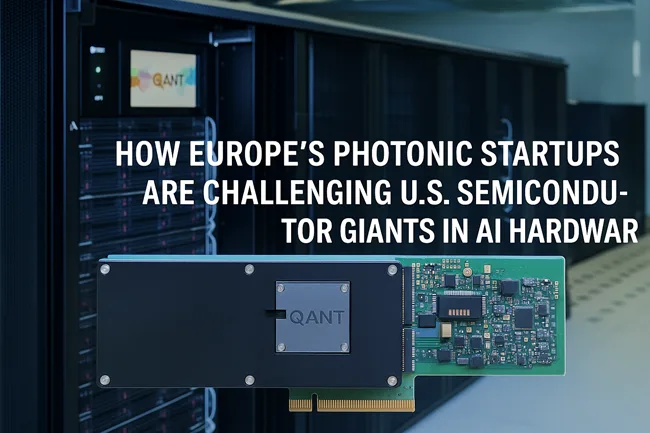
What makes Q.ANT and other European startups competitive against established U.S. semiconductor companies?
Q.ANT’s approach demonstrates why European startups are gaining momentum. Its Native Processing Server (NPS), built on Thin-Film Lithium Niobate (TFLN), promises up to 30 times energy efficiency and 50 times performance improvements compared to CMOS-based chips. Real-world testing suggests that the NPS can increase data-center capacity by as much as 100 times without requiring active cooling systems. Crucially, the system functions as a plug-in co-processor, allowing seamless integration with existing data-center hardware, a key adoption barrier that many photonic technologies have struggled to overcome.
Other European startups are following similar disruptive strategies. PsiQuantum, though headquartered in the U.K. and focused on quantum photonics, has been building critical photonic manufacturing capacity in Europe, aiming to compete in long-term high-performance computing markets. Dutch research institutions, particularly imec in Belgium, have supported integrated silicon-photonics fabrication that startups can leverage for scalable production. This vertically integrated approach contrasts with many U.S. startups, which remain reliant on third-party fabs and lack direct control over key components.
Additionally, Europe’s policy and funding environment favors photonic innovation. Development banks such as L-Bank are actively funding deep-tech initiatives, citing Q.ANT as a prime example of how photonic computing can create high-value jobs and build a next-generation technology cluster. Analysts say this combination of financial backing and regional manufacturing expertise allows European players to move faster from laboratory prototypes to commercial deployment.
How are U.S. semiconductor giants responding to the rise of photonic challengers from Europe?
U.S. incumbents have begun to respond to the photonic threat, but their focus remains primarily on hybrid architectures. NVIDIA and Intel are investing heavily in photonic-electronic interconnects to improve data transfer rates and reduce energy consumption in GPUs and AI accelerators. Lightmatter, valued at several billion dollars, recently unveiled a photonic chip designed to handle matrix multiplications with high precision, though mass adoption is still several years away. AMD is also exploring optical interconnects for high-bandwidth memory integration.
Despite these efforts, analysts note that large U.S. players face structural disadvantages. Their product roadmaps are tightly tied to existing GPU and ASIC ecosystems, making a complete pivot to full photonic co-processing risky in the short term. By contrast, European startups like Q.ANT, unencumbered by legacy architectures, can develop hardware optimized entirely for photonic workflows.
Institutional investors believe this flexibility allows European startups to seize early market share in specific segments, particularly inference-heavy workloads where energy efficiency and cooling reduction are critical. However, analysts caution that U.S. giants could eventually integrate photonic technologies into their GPUs at scale, threatening Europe’s first-mover advantage.
Can European photonic startups secure long-term leadership, or will U.S. players reclaim dominance as photonic technologies mature?
The long-term outlook for European photonic computing leadership will depend on several factors. Manufacturing scalability remains one of the biggest challenges. Thin-Film Lithium Niobate fabrication is still a niche capability, concentrated in a few facilities, and ramping up production to meet hyperscale demand will require significant capital and supply-chain coordination. TRUMPF’s manufacturing expertise is expected to give Q.ANT an edge, but other European startups may need to forge partnerships with global fabs or expand their own production lines.
Software ecosystem integration is another hurdle. Developers and enterprises are deeply invested in CUDA, ROCm, and other U.S.-centric AI libraries. European startups will need to ensure seamless compatibility with popular frameworks such as PyTorch and TensorFlow to drive adoption beyond niche deployments. Analysts say Q.ANT’s early work on plug-in compatibility is a step in the right direction, but wider ecosystem support will be essential to avoid being outpaced by U.S. competitors with entrenched developer communities.
Institutional sentiment remains cautiously optimistic. Europe’s photonic startups are viewed as having a two-to-three-year window to establish themselves as leaders in energy-efficient AI hardware. If they can secure early contracts with hyperscale data-center operators and validate their energy and performance claims at commercial scale, analysts believe they could hold a meaningful share of the AI hardware market by 2030. However, if U.S. giants successfully integrate photonics into their existing product lines during this period, European leadership could quickly erode.
Will Europe’s policy and funding ecosystem sustain photonic computing innovation long enough to compete globally?
Policy-driven funding and public-private partnerships are likely to play a decisive role in Europe’s ability to sustain photonic computing innovation. Regional development banks such as L-Bank and research hubs like imec are already acting as critical enablers, providing not only capital but also technical infrastructure. European governments view photonic computing as strategically important, both for energy security and for reducing reliance on U.S. semiconductor supply chains.
Institutional investors say this policy support gives European startups an advantage in building vertically integrated operations, which are harder for U.S. players to replicate in a market driven primarily by private capital. However, analysts caution that sustaining this edge will require continued government commitment and clear commercialization pathways for funded research.
By 2030, Europe’s photonic computing sector could either become a credible competitor to U.S. semiconductor giants or remain a niche player if scale and ecosystem integration challenges are not solved quickly. Analysts agree that the next two years will be pivotal in determining whether startups like Q.ANT can turn early technological leadership into lasting market power.
Discover more from Business-News-Today.com
Subscribe to get the latest posts sent to your email.



