Antony Waste Handling Cell Limited (NSE: AWHCL, BSE: 543254) shares traded lower in Monday’s session despite the Indian waste management specialist reporting a strong operational start to FY26. As of 11:39 a.m. IST on August 11, 2025, the stock was down 2.66 percent at ₹590.25, compared with a previous close of ₹606.35. Intraday trade saw the counter open at ₹591.55, reach a high of ₹597.40, and slip to a low of ₹576.05, with volume-weighted average price (VWAP) at ₹584.89. The market capitalisation stood at ₹1,675.25 crore, and free float market cap at ₹901.70 crore.
The decline came even as the Thane-based municipal solid waste management leader reported a 13 percent year-on-year increase in total operating revenue to ₹224 crore in the first quarter ended June 30, 2025, supported by record resource recovery sales and the launch of a new Extended Producer Responsibility (EPR) initiative.
What drove Antony Waste Handling Cell Limited’s revenue growth in Q1 FY26 compared to last year?
Antony Waste Handling Cell Limited’s consolidated revenue from operations for the quarter ended June 30, 2025, rose to ₹254.4 crore, representing a 9 percent increase over the ₹232.9 crore recorded in the same period last year. This improvement reflected a balanced contribution from both its core service lines — municipal solid waste collection and transportation (MSW C&T) and municipal solid waste processing — along with incremental gains from ancillary income streams.
Revenue from MSW C&T climbed to ₹151.4 crore, underpinned by a combination of contract renewals with higher tipping fee structures, efficiency gains from route optimisation, and steady throughput from fixed shifts, trips, and household collection charges. The company’s established relationships with municipal corporations allowed it to secure predictable inflows from long-term contracts, while operational fine-tuning helped contain fuel and manpower costs despite inflationary pressures in urban service delivery.
MSW processing revenue reached ₹72.2 crore, benefiting from higher plant utilisation rates and increased volumes of waste diverted to processing rather than landfill. The ramp-up of the CIDCO bio-mining site — a strategic addition to the company’s processing portfolio — provided a notable boost, helping to handle legacy waste while freeing up landfill space. Seasonal tailwinds in the quarter, often linked to pre-monsoon and early monsoon waste generation patterns in urban centres, also supported higher intake at processing facilities.
EBITDA for the quarter rose 12 percent year-on-year to ₹62.1 crore, translating into an EBITDA margin of 24.4 percent — an improvement of approximately 65 basis points compared to Q1 FY25. This margin expansion was driven by better asset utilisation, incremental revenue from value-added waste recovery, and disciplined control over operating expenses. The company’s emphasis on monetising by-products such as refuse-derived fuel (RDF) and compost also contributed to higher per-tonne revenue realisation.
Profit after tax (PAT) came in at ₹23 crore, up 8 percent from ₹21.3 crore in the prior-year quarter. The sequential drop from ₹46 crore in Q4 FY25 was due to the absence of a one-time gain of ₹23.9 crore booked in the preceding quarter. Excluding that exceptional item, net profitability remained stable, supported by consistent operating performance and a relatively unchanged finance cost profile.
From an investor perspective, the growth drivers in Q1 FY26 highlight Antony Waste Handling Cell Limited’s ability to leverage its integrated waste management model to capture both fixed and variable revenue streams. By combining stable contract-based income with higher-margin processing and recovery revenues, the company has positioned itself to generate steady top-line growth even in a competitive and regulatory-sensitive sector.
How did resource recovery and waste-to-energy operations perform in the June 2025 quarter?
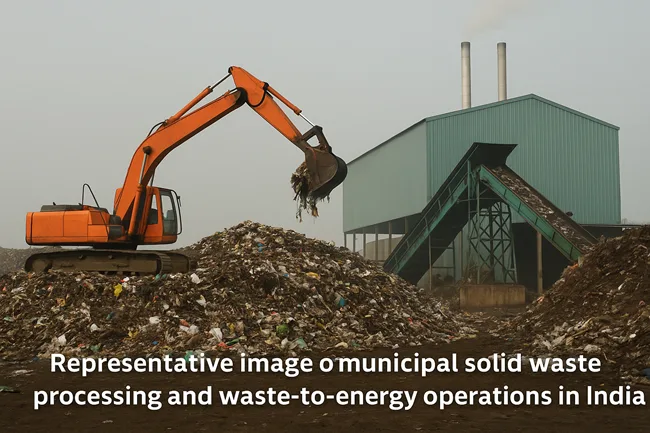
The waste-to-energy (WtE) plant operated at a plant load factor of about 84 percent, which Antony Waste Handling Cell Limited described as setting new benchmarks for industry reliability in converting waste into clean energy. Resource recovery was a highlight of the quarter, with refuse-derived fuel (RDF) sales surging 62 percent year-on-year to approximately 55,500 tonnes, and compost sales up 10 percent to around 6,600 tonnes.
A key strategic milestone was the commercial launch of the EPR initiative within the WtE division. With the Pimpri Chinchwad Municipal Corporation (PCMC) WtE project now registered to qualify for EPR credits, the company has already monetised 20 percent of its first-year allocation of over 94,400 metric tonnes. Management said this provides a sustainable new revenue stream and strengthens the company’s position in India’s push toward a circular economy.
What are market participants focusing on after the Q1 FY26 earnings release?
Institutional investors and traders appear to be weighing the operational gains against broader market sentiment. At the time of reporting, total traded volume stood at 0.56 lakh shares with a traded value of ₹3.29 crore. The buy quantity of 23,227 shares slightly outpaced the sell quantity of 20,472 shares, indicating mixed short-term positioning.
The stock remains 31 percent below its 52-week high of ₹859.40 (November 6, 2024) but above its 52-week low of ₹459.70 (March 7, 2025). Analysts tracking the waste management sector suggested that sustained high load factors at the WtE plant, continued growth in RDF and compost sales, and successful execution of the EPR monetisation plan could provide earnings stability in the coming quarters. However, they also pointed to sectoral challenges such as regulatory changes, input cost pressures, and the pace of municipal contract renewals.
How does Antony Waste Handling Cell Limited position itself for growth in the evolving waste management sector?
Chairman and Managing Director Jose Jacob said the company’s Q1 FY26 performance underscored its resilience, operational efficiency, and commitment to sustainable growth. He highlighted the integration of environmental responsibility with profitable growth through initiatives such as EPR credits and the expansion of material recovery.
With more than two decades of experience, Antony Waste Handling Cell Limited has worked with over 23 municipal corporations across India. Its flagship Kanjurmarg plant in Mumbai is the largest single-location waste processing facility in Asia. The PCMC WtE plant is the first in Maharashtra to sell power under the Green Energy Open Access Rules, positioning the company to benefit from India’s renewable energy policies.
Management reiterated its focus on capturing opportunities in waste-to-energy, landfill management, and emerging waste recovery markets, with an emphasis on optimising throughput and reducing landfill dependency.
What is the outlook for Antony Waste Handling Cell Limited’s shares and financial performance?
While near-term share price movements may be influenced by broader equity market trends, the company’s performance metrics suggest a stable operating base for FY26. Sustained growth in high-margin segments such as RDF sales and EPR credits could help offset variability in municipal contract revenues. Analysts expect that maintaining EBITDA margins above 24 percent, combined with disciplined capital allocation, will be key to delivering shareholder value.
The next quarters will also test the scalability of the EPR initiative and the consistency of WtE plant performance. Institutional sentiment remains cautiously constructive, with a focus on execution and contract pipeline visibility.
Discover more from Business-News-Today.com
Subscribe to get the latest posts sent to your email.