


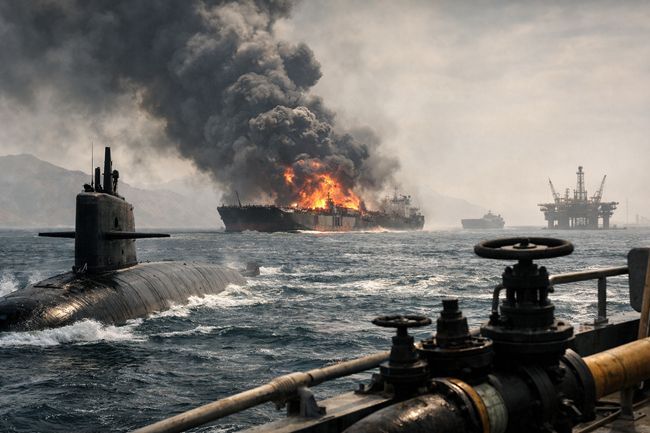
The conflict between the United States and Iran widened significantly on Wednesday, 4 March 2026, after a United States Navy submarine fired a torpedo and sank the Iranian Navy frigate IRIS Dena in the Indian Ocean south of Sri Lanka. The strike deepened a shipping crisis that had paralysed the Strait of Hormuz for a fifth consecutive day, cutting off vital oil and liquefied natural gas flows from the Middle East and triggering a cascade of force majeure declarations across global energy supply chains.
United States Defense Secretary Pete Hegseth confirmed the strike at a Pentagon press briefing alongside Chairman of the Joint Chiefs of Staff General Dan Caine on Wednesday. Hegseth described the action as the first sinking of an enemy ship by torpedo since World War II, stating that the IRIS Dena had been operating in international waters when it was struck. General Caine confirmed the warship was destroyed by a single Mark 48 heavyweight torpedo fired from a United States Navy fast-attack submarine. The Department of Defense released video footage showing the frigate’s hull destroyed in the blast.
The IRIS Dena was a Moudge-class frigate of the Islamic Republic of Iran Navy, commissioned in 2021 and displacing approximately 1,300 to 1,500 tonnes. In February 2026, the vessel had been participating in the multinational naval exercise MILAN 2026 and the International Fleet Review at Visakhapatnam, India, hosted by the Indian Navy, and was returning to Iran at the time of the attack. Sri Lanka’s navy said 87 bodies had been recovered and 32 sailors were rescued after the sinking. The frigate had approximately 180 crew members on board when it issued a distress call between 6am and 7am Sri Lanka local time, approximately 40 nautical miles south of Galle. Search and rescue operations were continuing as of Wednesday afternoon.
What does the sinking of the Iranian frigate IRIS Dena mean for the scope of United States military operations against Iran?
General Caine told reporters that United States forces had destroyed more than 20 Iranian naval vessels as part of Operation Epic Fury, effectively neutralising Iran’s major naval presence in the operational theatre. United States Central Command commander Admiral Brad Cooper stated publicly that there was not a single Iranian ship underway in the Arabian Gulf, Strait of Hormuz, or Gulf of Oman, and that the United States would not stop its campaign against the Iranian Navy.
The sinking of the IRIS Dena in the Indian Ocean carried particular strategic significance beyond the immediate kill. The strike was conducted within the United States 7th Fleet’s Indo-Pacific area of operations, representing the first time the conflict with Iran had reached that theatre. The Mark 48 torpedo is a heavyweight wire-guided weapon designed to detonate beneath a ship’s keel and cause catastrophic structural damage rather than a simple hull penetration. The sinking also marked the first time in nearly 44 years that any nation’s submarine scored a confirmed combat kill, the previous instance being the Royal Navy nuclear-powered attack submarine HMS Conqueror sinking the Argentine Navy cruiser ARA General Belgrano during the Falklands War in 1982, and the first enemy warship sunk by a United States submarine since World War II.
How many ships are stranded in the Strait of Hormuz and what does the maritime shutdown mean for global oil supply?
At least 200 ships, including oil and liquefied natural gas tankers as well as cargo ships, remained at anchor in open waters off the coasts of major Gulf producers including Iraq, Saudi Arabia, and Qatar as of Wednesday, according to Reuters estimates based on ship-tracking data from the MarineTraffic platform. Hundreds of other vessels remained outside the Strait of Hormuz, unable to reach ports. Analysis of vessel activity by MarineTraffic indicated tanker transits through the Strait of Hormuz were approximately 90 percent lower than the prior week. The Strait of Hormuz is the world’s most critical maritime energy chokepoint, handling approximately one fifth of the world’s daily oil supply and a comparable share of global liquefied natural gas trade.
The current crisis originated with joint military strikes by the United States and Israel on Iran beginning 28 February 2026 under Operation Epic Fury, which targeted military facilities, nuclear sites, and senior Iranian leadership. Iran responded by directing its Islamic Revolutionary Guard Corps to issue warnings prohibiting vessel passage through the Strait of Hormuz, triggering an effective halt in shipping traffic through the waterway.
At least eight vessels have sustained damage in the region since the conflict began on Saturday. On Wednesday, the Maltese-flagged container ship Safeen Prestige was damaged by a projectile near the northern end of the Strait of Hormuz, prompting the crew to abandon ship, according to the United Kingdom Maritime Trade Operations agency. The Marshall Islands crude oil tanker Libra Trader and Panama-flagged bulker Gold Oak also sustained minor damage approximately 7 to 10 nautical miles off the United Arab Emirates port of Fujairah on Wednesday. Neither vessel sustained major damage or crew injuries, according to United Kingdom Maritime Trade Operations.
Despite the near-total gridlock, a rare transit took place on Tuesday when the Suezmax tanker Pola sailed through the Strait of Hormuz to the United Arab Emirates to load crude, according to industry sources and London Stock Exchange Group ship-tracking data. The Pola had switched off its automatic identification system transponder on 2 March as it approached the Strait and reappeared the following day off Abu Dhabi. The voyage illustrated the risks vessels face in attempting to navigate the passage under current conditions.
What is the impact of QatarEnergy’s force majeure declaration and the Ras Laffan shutdown on global liquefied natural gas markets?
QatarEnergy formally declared force majeure on liquefied natural gas deliveries on 4 March 2026, following the shutdown of its Ras Laffan Industrial City and Mesaieed Industrial City facilities after Iranian drone strikes two days earlier. Qatar is the world’s largest single exporter of liquefied natural gas, supplying approximately 20 percent of global volumes, with approximately 82 percent of its sales directed to Asian buyers. The contractual cascade spread rapidly: India’s Petronet LNG issued its own reciprocal force majeure, naming three specific tankers, the Disha, Raahi, and Aseem, which were unable to reach Ras Laffan through the closed Strait of Hormuz.
Qatar announced on Wednesday that it would fully shut down gas liquefaction operations and would not return to normal production and exports for at least one month, according to two sources familiar with the matter cited by Reuters. The Dutch Title Transfer Facility futures contract, Europe’s benchmark wholesale gas price, rose 35 percent in the prior session to more than 60 euros per megawatt-hour. The Northeast Asia liquefied natural gas benchmark, the Japan-Korea-Marker, which captures deliveries to Japan, Korea, China, and Taiwan, reached a one-year high. Goldman Sachs estimated the production pause would reduce near-term global liquefied natural gas supply by approximately 19 percent.
Goldman Sachs separately warned that if shipping through the Strait of Hormuz were halted for an entire month, European gas prices could more than double, approaching the threshold that triggered large demand reductions during the 2022 European energy crisis. Even if the United States were to accelerate its own liquefied natural gas production, analysts assessed that it was unlikely to offset Qatari supply in the near term.
How are Saudi Arabia, Iraq, and other Gulf producers responding to the energy infrastructure attacks and the shipping crisis?
Iraq cut its oil production on Wednesday as the country ran out of onshore storage capacity, unable to load oil onto tankers. Saudi Arabia, the United Arab Emirates, and Kuwait were also struggling to load oil onto tankers, though it was not confirmed as of Wednesday whether those countries had formally reduced output. Saudi Aramco’s largest domestic refinery and key crude export terminal, Ras Tanura, which has a processing capacity of approximately 550,000 barrels per day and is regarded as a cornerstone of Saudi Arabia’s energy sector, was struck on Wednesday according to four sources.
Iraq’s production cuts were reported to have reached nearly 1.5 million barrels per day as of Wednesday, with the potential to widen to more than 3 million barrels per day within days if the shipping standstill continued. The cumulative effect of tanker immobility, storage saturation, and attacks on production facilities across multiple Gulf states represented a simultaneous disruption of the supply chain at multiple points.
What steps has United States President Donald Trump taken to stabilise the Gulf shipping and energy crisis?
United States President Donald Trump said he had instructed the United States International Development Finance Corporation to provide political-risk insurance and financial guarantees for maritime trade in the Gulf, and said the United States Navy would escort tankers through the Strait of Hormuz if necessary. Trump stated that the United States would ensure the free flow of energy to the world regardless of circumstances.
Goldman Sachs raised its forecast for Brent crude oil in the second quarter of 2026 by $10 to $76 per barrel and raised its West Texas Intermediate forecast by $9 to $71 per barrel on Wednesday. The bank cited longer-than-expected disruption to exports of oil and gas through the Strait of Hormuz and damage to oil production and refining facilities as the primary risks to its revised forecasts. Oil prices had gained approximately 12 percent since the conflict began on Saturday, though prices pulled back modestly on Wednesday.
Commercial war risk insurance costs had soared at least five-fold in recent days, with brokers reporting rates well above levels that shipowners and charterers typically operate under. Jakob Larsen, chief safety and security officer of the Baltic and International Maritime Council, the shipping industry association, said providing protection for all tankers operating in areas currently threatened by Iran was unrealistic as it would require a very high number of warships and other military assets.
How are Asian refiners and petrochemical companies responding to the Middle East oil and gas supply disruption?
Some Asian refiners and petrochemicals companies faced output reductions on Wednesday because they were unable to obtain prompt replacement cargoes from Gulf suppliers. India’s Mangalore Refinery and Petrochemicals and India’s Petronet LNG both issued force majeure notices due to the disruptions. Asia as a region sources approximately 60 percent of its oil from the Middle East, leaving the region acutely exposed to the current standstill. Refiners in Indonesia and Japan were sourcing additional oil from the United States to replace the shortfall, while Indian companies were considering increasing purchases from Russia.
Major container shipping companies, including Maersk and Hapag-Lloyd, had already suspended transits through the Strait of Hormuz and related regional routes. The crisis was compounded by Yemen’s Houthi movement, which announced on 28 February 2026 that it would resume attacks on Israeli vessels and commercial ships in the Red Sea, forcing Suez Canal traffic to divert around Africa’s Cape of Good Hope, adding weeks to transit times and substantially increasing shipping costs for cargoes bound for Europe and Asia.
What does the Strait of Hormuz crisis and the sinking of IRIS Dena mean for global energy security and international maritime trade?
- A United States Navy fast-attack submarine sank the Iranian Navy frigate IRIS Dena in the Indian Ocean south of Sri Lanka on 4 March 2026 using a single Mark 48 torpedo, the first such confirmed combat kill by a United States submarine since World War II, extending United States military operations against Iran into the Indo-Pacific theatre for the first time.
- At least 200 vessels remained stranded in Gulf waters as of Wednesday, with tanker transits through the Strait of Hormuz approximately 90 percent lower than the prior week, paralysing the flow of approximately one fifth of the world’s daily oil and liquefied natural gas supply.
- QatarEnergy declared force majeure on all liquefied natural gas deliveries on 4 March 2026 following Iranian drone strikes on its Ras Laffan Industrial City and Mesaieed Industrial City facilities, with Qatar expected to remain offline for at least one month; Goldman Sachs estimated the halt reduces near-term global liquefied natural gas supply by approximately 19 percent.
- Saudi Aramco’s Ras Tanura refinery, with a capacity of approximately 550,000 barrels per day, was struck on Wednesday, adding a critical node of Saudi Arabia’s oil processing and export infrastructure to the growing list of production facilities damaged during the conflict.
- Goldman Sachs raised its second-quarter 2026 Brent crude oil forecast by $10 to $76 per barrel and warned that a sustained one-month shutdown of the Strait of Hormuz could more than double European gas prices, approaching demand-destruction levels last seen during the 2022 energy crisis triggered by Russia’s invasion of Ukraine.
Discover more from Business-News-Today.com
Subscribe to get the latest posts sent to your email.