


Honeywell Aerospace Inc. (Nasdaq: HONA) shares plunged 23% on August 6, 2026 after the newly independent aerospace and defence supplier sharply reduced its full-year growth outlook following weaker-than-expected second-quarter results. Sales increased 5% year on year to $4.52 billion, but adjusted earnings per share fell 32% to $1.87 and adjusted EBIT declined 7% to $995 million. Management cut expected 2026 organic sales growth to 4% to 5% from 7% to 9%, while lowering projected pro forma standalone adjusted EBIT to $4.35 billion to $4.45 billion from $4.65 billion to $4.75 billion. The selloff exposed the central tension facing Honeywell Aerospace barely five weeks after its separation from Honeywell Technologies: customer demand and backlog remain strong, but supply-chain constraints are limiting output and pushing the company toward a less profitable sales mix.
The market reaction was severe even by post-spin standards. Honeywell Aerospace shares fell as much as 26% intraday before ending approximately 23% lower, making the company the worst performer in both the S&P 500 and Nasdaq 100 during the session. The stock had only begun regular-way trading on June 29 following its separation from Honeywell, making conventional one-year comparisons less useful than they would be for an established listing. More important is what the selloff says about expectations: investors had valued Honeywell Aerospace as a focused aerospace and defence platform capable of converting strong aircraft production, aftermarket demand and defence spending into above-market growth. The first major guidance reset has challenged that assumption.
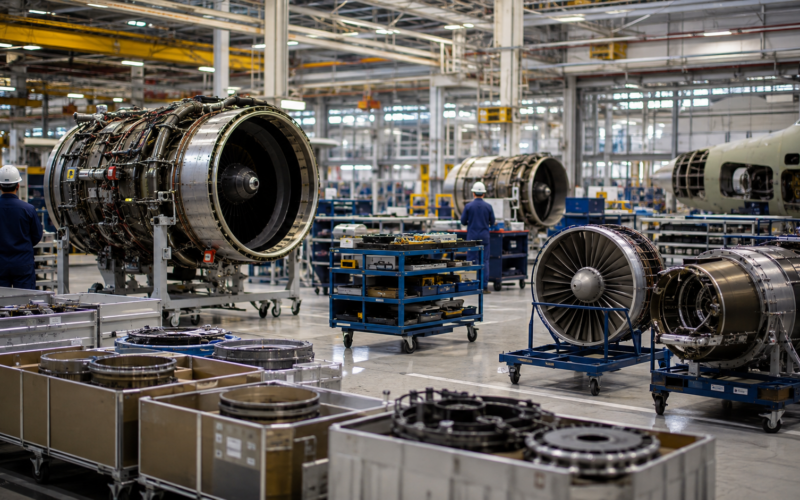
The weakness does not appear to be a demand problem. Honeywell Aerospace ended the quarter with backlog of $18.15 billion, 9% higher than a year earlier, while trailing 12-month orders increased 8%. The company has secured an estimated $15 billion of new lifetime-value wins so far in 2026, including a major avionics and power-systems selection covering IndiGo’s planned fleet of 810 Airbus A320neo-family aircraft. The problem is getting enough components through the production system to convert those orders into revenue while preserving the high-margin aftermarket activity that makes aerospace suppliers economically attractive.
That makes Honeywell Aerospace a particularly important test of the current commercial aviation cycle. Boeing and Airbus are attempting to raise aircraft production, airlines are flying ageing fleets harder, defence budgets remain elevated and demand for maintenance and replacement parts is robust. In theory, these conditions should create a powerful operating environment for a supplier with Honeywell Aerospace’s installed base. Instead, the company is finding that supply-chain capacity, rather than customer demand, is setting the near-term growth ceiling.
Why did Honeywell Aerospace shares fall 23% when second-quarter sales still increased 5%?
The scale of the selloff reflects the gap between expected and achievable growth rather than an outright contraction in the business.
Second-quarter sales increased to $4.52 billion from $4.29 billion. Commercial Aftermarket revenue rose 8% to $2.03 billion, Commercial Original Equipment revenue increased 6% to $679 million and Defense and Space revenue advanced 3% to $1.82 billion. Backlog expanded by approximately $1.55 billion year on year to $18.15 billion. These are not numbers associated with collapsing aerospace demand.
Profitability moved in the opposite direction. Adjusted EBIT fell from $1.07 billion to $995 million, while adjusted earnings per share dropped from $2.75 to $1.87. Reported net income fell to $256 million from $852 million, although the comparison was affected by separation-related expenses and other items that make adjusted measures more useful for assessing the continuing operating trend.
The larger shock came from guidance.
Honeywell Aerospace had entered independence expecting 7% to 9% organic sales growth during 2026. Management now expects only 4% to 5%. Expected pro forma standalone adjusted EBIT growth has been reduced to between flat and 3%, compared with the previous 7% to 10% range.
Full-year adjusted earnings per share are now expected at $7.60 to $7.90. Analysts surveyed by LSEG had been expecting approximately $8.86 before the reset. J.P. Morgan subsequently reduced its price target to $235 from $255 and argued that Honeywell Aerospace’s valuation discount to peers was likely to widen. Jefferies also set a $235 target and questioned why a business exposed to strong aerospace demand was delivering only mid-single-digit organic growth.
The market response therefore appears less like a reaction to one weak quarter and more like a reassessment of the earnings profile investors expected when Honeywell Aerospace became independent.

How are Boeing and Airbus production increases creating a margin problem for Honeywell Aerospace?
Honeywell Aerospace faces an unusual problem: some of its strongest customers require more equipment at precisely the moment when constrained supply makes that volume difficult to produce.
Commercial aircraft manufacturers are increasing production schedules, requiring Honeywell Aerospace to prioritise components for new Boeing and Airbus aircraft. These original-equipment deliveries are strategically important because they add Honeywell technology to aircraft that can generate aftermarket revenue for decades.
In the short term, however, original-equipment sales generally carry lower margins than replacement parts, maintenance, repairs, upgrades and other aftermarket services associated with an installed aircraft fleet.
Management has acknowledged that supply shortages are forcing Honeywell Aerospace to allocate resources toward customer production commitments even when doing so limits its ability to satisfy some of the more profitable aftermarket demand. Reuters reported that the company is prioritising Boeing and Airbus deliveries over parts of its revenue and margin-enhancing aftermarket business.
This explains why rising sales did not translate into comparable profit growth.
Commercial Original Equipment sales increased 6%, while Commercial Aftermarket rose 8%. The aftermarket business remained much larger at just over $2 billion of quarterly revenue, but the production constraint effectively prevents Honeywell Aerospace from maximising the mix of business it would prefer to serve.
The situation also creates a strategic dilemma.
Failure to supply Boeing and Airbus would risk customer relationships and could weaken Honeywell Aerospace’s position on aircraft platforms that may remain in service for decades. Prioritising original equipment, however, creates near-term margin pressure because scarce components and production capacity are being directed toward lower-margin channels.
The logical response is not to reduce original-equipment commitments. It is to increase supply capacity enough to serve both markets.
That is why the success of Honeywell Aerospace’s supplier-recovery programme may matter more to earnings over the next several quarters than the headline level of customer orders.
Where are the supply-chain problems hurting Honeywell Aerospace profitability most severely?
The segment results reveal where the operational pressure is concentrated.
Electronic Solutions generated second-quarter sales of $1.77 billion, up 8%, but adjusted EBIT declined 3% to $459 million. Higher volume and pricing were outweighed by an unfavourable sales mix and increased costs.
Engines and Power Systems experienced the sharpest deterioration. Sales increased only 1% to $1.41 billion, while adjusted EBIT plunged 32% to $174 million from $256 million. Management attributed the decline to an unfavourable mix and higher costs that more than offset pricing benefits.
Control Systems performed considerably better. Sales increased 7% to $1.34 billion and adjusted EBIT rose 8% to $389 million as pricing offset higher costs.
Engines and Power Systems therefore represents the most obvious operational pressure point.
This business contains propulsion engines, auxiliary power units and electric power systems, categories where manufacturing requires large numbers of precision mechanical components and specialised suppliers. Delays involving castings and similar components can prevent completion of a high-value system even when most other parts are available.
The economic impact is larger than delayed revenue alone.
A missing component can leave inventory incomplete, increase working capital, disrupt manufacturing schedules and force management to expedite materials or use more expensive alternatives. If the constrained component also restricts aftermarket deliveries, the company loses access to some of its highest-margin revenue opportunities.
This is why Honeywell Aerospace’s current problem should be viewed as an output-conversion challenge rather than simply a procurement issue.
Can Honeywell Aerospace fix its supplier network quickly enough to restore 2027 growth?
Management has already expanded the scale of its supply-chain response.
Honeywell Aerospace said it had qualified more than 50 new suppliers and expects to qualify another 50 during the second half of 2026. Supplier-tooling expenditure is expected to increase approximately 20% during the second half compared with the first half and roughly double between 2025 and 2027.
Approximately 70% of that tooling investment is being directed toward castings, highlighting where the company sees some of the most severe production bottlenecks.
Honeywell Aerospace also plans to increase the number of multi-sourced components by more than 15% during 2026. Multi-sourcing can reduce dependency on individual suppliers and improve resilience when one production line experiences labour, quality or capacity problems.
These measures are strategically sensible, but supplier qualification takes time.
Aerospace components operate under far more demanding regulatory and quality requirements than ordinary industrial parts. A manufacturer cannot simply replace a constrained supplier with the lowest-cost alternative and resume production immediately. Components may require technical validation, manufacturing-process approval, traceability, testing and customer or regulatory acceptance.
That creates a lag between investment and output improvement.
Chief Financial Officer Josh Jepsen indicated that the revised forecast reflects the supply chain’s demonstrated ability to ramp rather than the level of underlying customer demand. Management is effectively resetting guidance to a level that the current production network has shown it can deliver.
This approach lowers near-term expectations but creates a clearer 2027 test.
If supplier qualifications, tooling investments and multi-sourcing begin improving component availability during the second half, Honeywell Aerospace should enter 2027 with greater capacity to convert its backlog.
If bottlenecks persist, the problem becomes more structural and could require additional investment, inventory and customer prioritisation.
Does Honeywell Aerospace’s $18.2 billion backlog show demand is stronger than the share-price plunge suggests?
The backlog is one of the strongest arguments against interpreting the guidance cut as evidence of weak end-market demand.
Honeywell Aerospace reported $18.15 billion of backlog at the end of the second quarter, compared with $16.60 billion a year earlier. Trailing 12-month orders increased 8%, led by Defense and Space demand.
The company has also reported approximately $15 billion of estimated lifetime-value new wins during 2026.
The IndiGo agreement is particularly significant. Honeywell Aerospace was selected to provide avionics and power systems for 810 Airbus A320neo-family aircraft, which the company described as its largest selectable-equipment win involving new aircraft. Aeromexico also intends to deploy Honeywell’s Surface Alerts runway-safety technology across more than 100 Boeing 737 aircraft.
These contracts help demonstrate why the long-term opportunity remains intact.
Winning equipment positions on a new aircraft can create decades of potential maintenance, repair, replacement and upgrade revenue. The installed-base economics are one reason aerospace suppliers can generate attractive margins even when original-equipment manufacturing itself is comparatively less profitable.
Honeywell Aerospace highlighted this model before its separation. Its Investor Day strategy was built partly around large positions on long-life platforms and the recurring aftermarket opportunities generated by those installations.
The problem is that backlog does not generate shareholder returns until it becomes revenue and cash.
An expanding backlog combined with insufficient supplier capacity can actually increase operational pressure because customers expect delivery while inventory accumulates elsewhere in the production system.
The backlog therefore supports the demand thesis but does not solve the execution thesis.
Why does Honeywell Aerospace’s new standalone balance sheet make free cash flow especially important?
Honeywell Aerospace entered independence with a substantially different capital structure from the historical aerospace operation inside Honeywell.
At June 27, 2026, the company reported approximately $1.06 billion of cash and cash equivalents and $15.85 billion of long-term debt. The debt increase was linked to the separation process. Honeywell Aerospace raised approximately $15.84 billion of long-term debt during the first half and recorded approximately $15.09 billion of net transfers to its former parent.
This distinction is important.
The debt did not arise because Honeywell Aerospace suddenly consumed $15 billion through operating losses. It reflects the financial structure established around the spin-off.
It nevertheless becomes a real obligation for the independent company.
Interest expense, capital expenditure, shareholder distributions, supply-chain investments and potential acquisitions must now be funded within Honeywell Aerospace’s own financial structure rather than inside a diversified conglomerate.
Management maintained guidance for second-half free cash flow of $1.0 billion to $1.5 billion even while cutting sales and EBIT expectations. That makes cash conversion one of the most important numbers to monitor over the remainder of 2026.
Maintaining free cash flow despite weaker earnings would demonstrate that the business can fund supplier remediation and service its capital structure without sacrificing strategic investment.
A meaningful cash-flow shortfall would create a more difficult trade-off between debt reduction, shareholder returns, research and development, and manufacturing resilience.
The balance sheet therefore increases the value of predictable execution.
Has the Honeywell Aerospace spin-off thesis been damaged or merely delayed by the first guidance reset?
Honeywell Aerospace became independent on June 29 after Honeywell distributed one Aerospace share for every two Honeywell shares held by eligible shareholders. Approximately 316.94 million Honeywell Aerospace shares were outstanding at separation, and the business began trading on Nasdaq under HONA.
The strategic thesis behind independence was straightforward.
A standalone aerospace company could allocate capital specifically toward aviation and defence markets, make decisions without competing against unrelated businesses for investment, accelerate technology development and make acquisitions tailored to the aerospace portfolio.
Management also argued that the new structure would support stronger operational accountability and enable Honeywell Aerospace to focus on electrification, autonomy, safety and aftermarket growth.
The Q2 reset does not invalidate that logic.
In some respects, it strengthens the case for why greater operational focus was required. Supply-chain performance is now visible directly to shareholders rather than being absorbed inside the results of a larger industrial conglomerate.
What has changed is the amount of confidence investors are willing to place in the execution timetable.
Honeywell Aerospace entered public markets with an approximately $17.4 billion annual revenue base, around $4.3 billion of 2025 pro forma adjusted EBIT and roughly $18 billion of backlog. It is not an early-stage aerospace company attempting to prove product-market fit. It is a large incumbent trying to improve manufacturing execution while servicing one of the strongest aerospace demand environments in years.
That means the turnaround should be measurable.
Supplier qualifications, output, aftermarket fulfilment, Engines and Power Systems margins, backlog conversion and free cash flow can all be tracked quarter by quarter.
The spin-off thesis is therefore not broken, but the burden of proof has shifted from strategic presentation to operational delivery.
What are the key takeaways from Honeywell Aerospace’s 23% share-price plunge?
- Honeywell Aerospace shares fell 23% on August 6 and dropped as much as 26% intraday after the company reduced its 2026 outlook.
- Second-quarter sales increased 5% to $4.52 billion, but adjusted EBIT declined 7% to $995 million.
- Adjusted earnings per share fell 32% to $1.87, below market expectations.
- Full-year organic sales growth guidance was reduced to 4% to 5% from 7% to 9%.
- Pro forma standalone adjusted EBIT is now expected at $4.35 billion to $4.45 billion.
- Honeywell Aerospace still has strong demand, with backlog increasing 9% to $18.15 billion.
- Supply constraints are forcing the company to prioritise Boeing and Airbus original-equipment commitments over some higher-margin aftermarket demand.
- Engines and Power Systems is the largest immediate profitability concern, with quarterly adjusted EBIT falling 32%.
- Management is qualifying additional suppliers, investing heavily in tooling and increasing component multi-sourcing.
- Second-half free cash flow of $1.0 billion to $1.5 billion remains a critical test of the newly independent company’s financial resilience.
What must Honeywell Aerospace deliver next for the 23% selloff to become a reset rather than a warning?
Honeywell Aerospace’s first major setback as an independent company contains an unusual contradiction. Customer demand is not the problem. The company has an $18.2 billion backlog, billions of dollars of new wins, expanding commercial aftermarket demand and exposure to rising aircraft production and defence spending.
Its challenge is converting that opportunity into profitable output.
The August selloff shows that investors are no longer willing to value Honeywell Aerospace principally on the strength of aerospace-sector demand or the logic of the Honeywell breakup. The company must now demonstrate that supplier capacity can catch up with its order book.
Several measurable indicators will determine whether that happens.
Engines and Power Systems profitability needs to stabilise. Additional suppliers must reach qualified production. Aftermarket growth needs to accelerate without compromising Boeing and Airbus delivery commitments. The $1.0 billion to $1.5 billion second-half free-cash-flow target needs to hold despite increased supply-chain investment.
Progress on those measures would make the 2026 guidance reset look like a conservative recalibration during the difficult first months of independence.
Continued supply shortfalls would create a more serious problem because Honeywell Aerospace is already operating in an unusually supportive demand environment. A company cannot indefinitely explain below-market growth through supply constraints when its investment thesis depends on exploiting precisely the aerospace upcycle currently generating those orders.
The first standalone results have therefore changed the Honeywell Aerospace story. Independence itself is no longer the catalyst. Execution is.
Discover more from Business-News-Today.com
Subscribe to get the latest posts sent to your email.