
HiteJinro Co., Ltd. (KRX: 000080), South Korea’s dominant soju producer and the company behind the world’s best-selling spirits brand by volume, has launched JINRO Melon Limited Edition, a fruit-flavoured soju targeting international consumers across more than 20 countries simultaneously. The product, at 13% ABV, is positioned as a premium entry within the JINRO flavoured portfolio, distinguishing itself through a black packaging design that departs sharply from the brand’s familiar green-bottle aesthetic. The launch extends HiteJinro’s international flavour strategy into one of the highest-engagement fruit categories globally, at a moment when soju’s penetration into Western markets is accelerating alongside broader Korean cultural influence.
HiteJinro shares on the Korea Exchange have traded around 18,320 KRW recently, up roughly 4% over the past month and about 2.5% over the prior month, though down approximately 4.5% over the trailing twelve-month period. The stock trades at a trailing price-to-earnings ratio of around 11.5 times, reflecting modest domestic growth expectations offset by ongoing international expansion momentum. The JINRO Melon launch, while not a headline financial event in isolation, is a direct operational expression of the international volume strategy that investors in HiteJinro need to track over the medium term.
How does a melon-flavoured soju fit into HiteJinro’s broader international expansion strategy and what markets does it target first?
The choice of melon as a flavour vehicle is not arbitrary. Melon occupies a distinctive position across Asian consumer culture, associated with premium gifting, seasonal freshness, and aspirational consumption, particularly in Japan, South Korea, and Southeast Asia. By extending that cultural resonance into a soju format at 13% ABV, HiteJinro is targeting a consumer segment that is drawn to flavoured spirits but is not necessarily a core soju drinker. The 20-plus country rollout encompasses the United States, Japan, Vietnam, Australia, and the United Kingdom, markets chosen not by chance but because they combine existing JINRO retail infrastructure, Korean diaspora consumer bases, and demonstrated appetite for flavoured low-ABV spirits. This is not a test-and-learn geography; it is a simultaneous global push backed by an established distribution network.
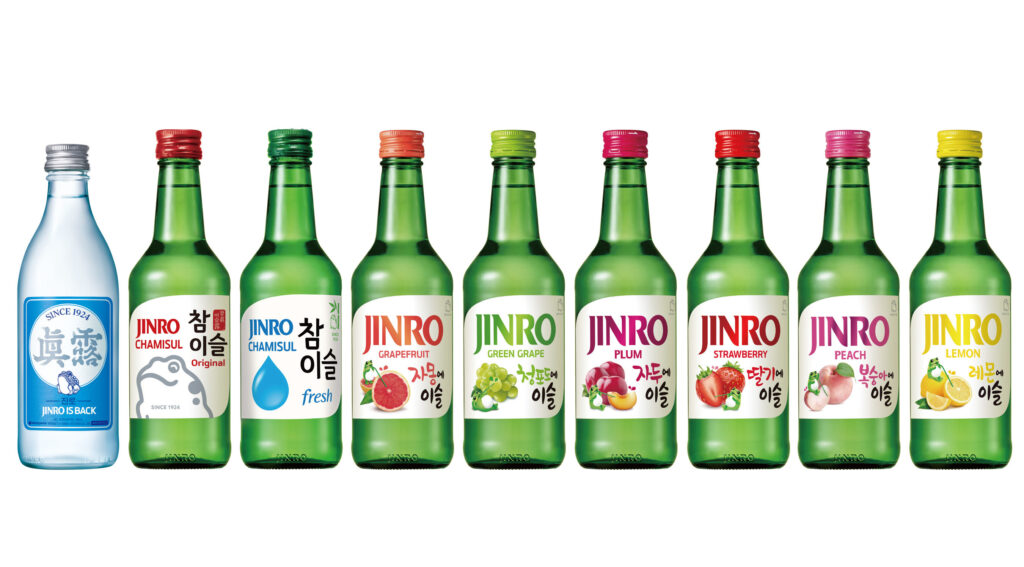
The premium black packaging signals a deliberate attempt to trade the product upward within the flavoured soju tier. JINRO’s standard fruit range, which spans grapefruit, green grape, plum, strawberry, peach, and lemon, has historically occupied the accessible end of the flavoured spirits shelf. The black bottle format introduces visual hierarchy within the brand’s own lineup, creating a price architecture that allows HiteJinro to capture both the volume-driven casual drinker and the occasion-driven consumer willing to pay more for perceived exclusivity. Whether the premium positioning holds at retail will depend heavily on how distributors price and shelf the product relative to the existing range.
What is driving international demand for Korean soju and how large is the opportunity that HiteJinro is pursuing with flavoured variants?
The structural tailwinds behind soju’s international expansion are significant. The global soju market was valued at approximately $5.57 billion in 2024 and is projected to reach $7.59 billion by 2030, growing at a compound annual growth rate of 5.4%. Soju exports from South Korea reached US$105 million in 2023, a 10% increase from the prior year, with growth largely driven by the expanding influence of Korean popular culture and growing interest in Korean cuisine. These are not marginal figures. They reflect a category in structural growth across geographies that were, a decade ago, functionally unaware of soju as a product category.
International market penetration has reached a point where approximately 40% of soju sales now come from outside South Korea. That number, while likely still heavily weighted toward diaspora consumption, marks a genuine shift in how the category is reaching non-Korean consumers. The North American soju market was valued at approximately $254.67 million in 2024 and is projected to reach $425.8 million by 2032, growing at a CAGR of 7.32%. The United States is among the highest-priority international markets for HiteJinro, and the JINRO Melon launch into that market carries more commercial weight than its limited-edition status might suggest.
Flavour innovations including fruit-infused varieties and lower-alcohol options have expanded the consumer base, particularly attracting younger demographics and female consumers who previously may have found traditional soju less appealing, with premium segments showing growth rates substantially higher than the overall market average. JINRO Melon is engineered specifically for this demographic opening.
How does JINRO Melon Limited Edition compare to competitor flavoured spirits and what are the execution risks in a premium limited-edition positioning?
The flavoured low-ABV spirits space is not uncontested. JINRO’s fruit range competes not only with rival South Korean brands such as Lotte Chilsung’s Chum Churum and Saero portfolio, but also with flavoured sake, flavoured shochu, and increasingly with RTD cocktail formats from global spirits companies. In Western markets particularly, consumers selecting a flavoured spirit at 13% ABV are simultaneously evaluating soju against hard seltzers, canned cocktails, and premium flavoured vodka at comparable price points. HiteJinro’s core advantage is brand recognition built on years of JINRO’s dominance as the world’s top-selling spirit by volume, a position it has held consistently. That recognition provides shelf pull that smaller or newer entrants cannot replicate, but it does not guarantee that premium positioning will translate into premium pricing without coordinated retailer and on-trade support.
The limited-edition label creates both opportunity and execution risk. Scarcity framing can accelerate trial and generate social media momentum, which is consistent with HiteJinro’s stated intention to push product-related content through official social media channels. But limited editions also carry the risk of consumer disappointment if distribution is uneven across markets, or of brand dilution if the product is effectively available everywhere despite the premium framing. HiteJinro has navigated this tension before with seasonal and limited releases, but a 20-plus country simultaneous launch complicates inventory management and retailer priority-setting in ways that a phased rollout would not.
What do domestic headwinds in South Korea mean for HiteJinro’s international flavoured soju strategy and investor positioning?
The domestic context matters because it shapes the strategic urgency behind international launches like JINRO Melon. South Korea’s total diluted soju shipments have declined steadily since 2017, falling from 945,860 kiloliters to below 830,000, reflecting both demographic decline and a cultural shift toward moderation among younger consumers. HiteJinro’s soju division, which has historically commanded more than 50% of South Korea’s domestic soju market, is therefore operating in a home market with structural volume headwinds that are not cyclical but demographic. International expansion is not merely a growth opportunity for HiteJinro; it is increasingly a volume replacement strategy.
HiteJinro reported a net income of negative 63.99 billion KRW in the most recent quarter, against a positive 34.03 billion KRW in the prior quarter, a swing of roughly negative 288%. That volatility is striking and underscores the pressure on management to demonstrate that international operations can offset domestic softness. A flavoured limited edition launching into 20 markets simultaneously is a visible signal of operational intent, but the financial test is whether international volume growth translates into margin improvement at the group level. HiteJinro’s next earnings release is scheduled for May 8, 2026, which will be the first opportunity to assess whether the international strategy is moving the revenue needle.
The company’s dividend yield sits at approximately 3.8% to 4.8% depending on the share class, which provides income support for longer-term holders navigating the domestic volume decline. The forward price-to-earnings ratio of roughly 12.6 times is not demanding relative to global beverage peers, though it reflects limited consensus enthusiasm for near-term earnings acceleration.
Key takeaways on what the JINRO Melon Limited Edition launch means for HiteJinro, its competitors, and the global flavoured soju category
- HiteJinro’s simultaneous 20-plus country rollout of JINRO Melon signals a shift from opportunistic international sampling to coordinated, multi-market flavour-led volume strategy.
- The premium black bottle packaging introduces a price tier within the JINRO fruit range that did not previously exist, testing whether HiteJinro can extract higher margin from flavoured soju internationally.
- Domestic soju volume in South Korea has been declining for nearly a decade, making international flavoured variants a volume replacement play as much as a growth story.
- The 13% ABV positioning places JINRO Melon directly in the competitive zone occupied by flavoured sake, flavoured shochu, canned cocktails, and premium hard seltzers in Western markets.
- North America represents the highest-growth international opportunity, with the regional soju market projected to grow at 7.32% CAGR through 2032, and JINRO’s existing distribution infrastructure gives it a first-mover shelf advantage.
- The limited-edition framing is a double-edged tool: it accelerates trial and social media pull but requires tight distribution discipline across 20-plus markets to sustain the premium narrative.
- HiteJinro’s upcoming May 8 earnings release is the near-term catalyst to watch, as it will reveal whether international expansion is generating meaningful revenue diversification against a deteriorating domestic base.
- Competitor brands including Lotte Chilsung’s Saero and newer entrants into the flavoured low-ABV segment will be watching JINRO Melon’s Western market performance closely before committing to similar premium-packaged launches.
- The Korean Wave cultural tailwind remains the most powerful marketing asset HiteJinro possesses in non-Korean markets, and JINRO Melon’s social content strategy is designed to ride that wave through organic consumer amplification.
- Investors in HiteJinro (KRX: 000080) should view this launch not as a material near-term earnings driver but as an indicator of management’s seriousness about international premiumisation as a long-term margin improvement lever.
Discover more from Business-News-Today.com
Subscribe to get the latest posts sent to your email.