

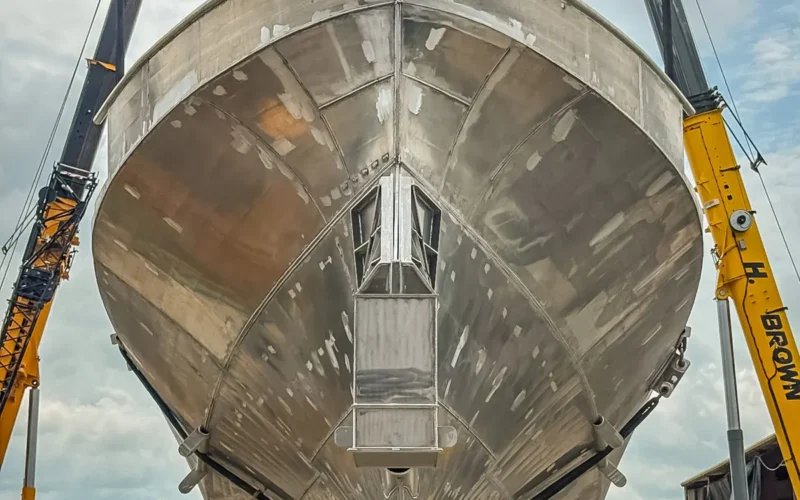
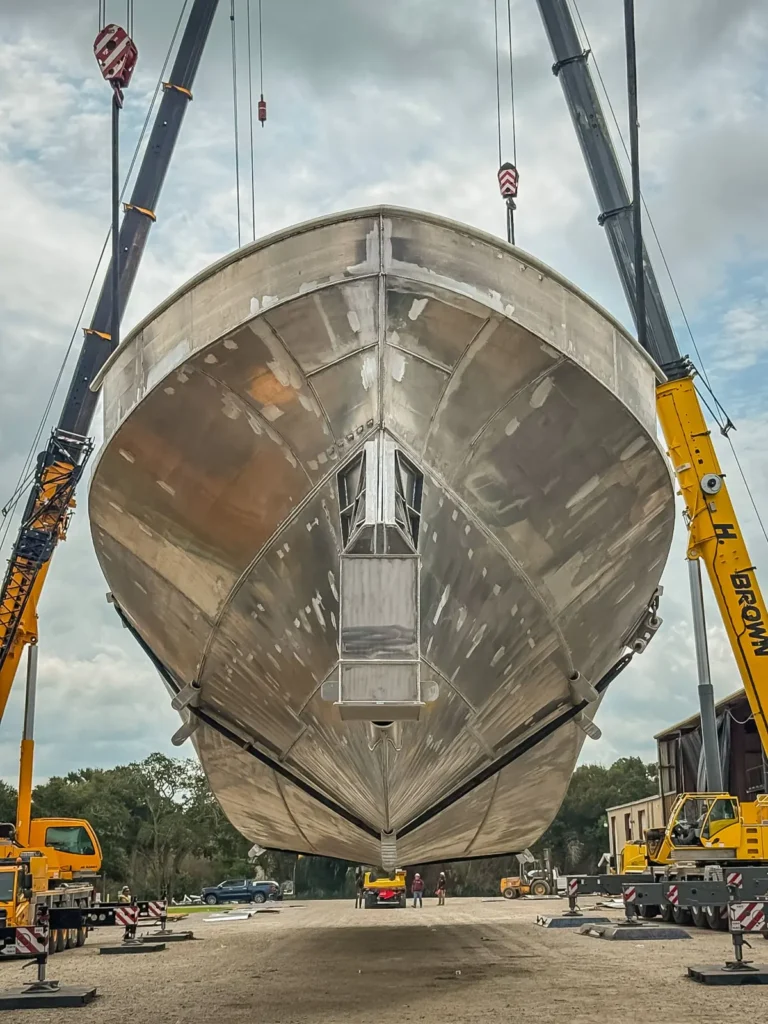
HII (NYSE: HII) has completed the structural build and hull flip of the first ROMULUS 151 unmanned surface vessel, moving its newest autonomous maritime platform from design and fabrication into a visibly more advanced stage of construction as five vessels take shape across two Louisiana shipyards.
The first hull is being built by Breaux Brothers Enterprises in New Iberia, where four ROMULUS 151 vessels are currently under construction. A fifth is being built at Halimar Shipyard in Morgan City, creating a distributed manufacturing network that HII is using to demonstrate that the platform can move beyond one prototype and toward repeatable production.
The hull flip completed on September 8 allows construction to progress into deck and pilothouse work. It is an industrial milestone rather than a US Navy production contract, and HII has not disclosed a customer contract value covering all five vessels, making it important not to describe the current build programme as a five-ship Navy procurement.
The commercial opportunity lies ahead. The US Navy selected ROMULUS earlier in 2026 to advance into the evaluation phase of its Medium Unmanned Surface Vessel programme, meaning HII is building physical inventory and manufacturing experience while the customer continues assessing future requirements.
What is the ROMULUS 151 and why is HII building five vessels before a major Navy production award?
ROMULUS is HII’s family of autonomous surface vessels designed around commercial-standard hull construction, modular mission payloads and the company’s Odyssey autonomy software. The approximately 151-class platform is designed for extended open-ocean operations and can support sensors, communications systems, weapons and smaller unmanned vehicles depending on mission configuration.
HII says the broader ROMULUS family can exceed 25 knots and support launch and recovery of REMUS unmanned underwater vehicles, aerial systems and other autonomous platforms. The concept is therefore not limited to replacing a crewed patrol craft with an unmanned equivalent; HII is positioning the vessel as a configurable node capable of carrying several kinds of maritime mission systems.
Building multiple hulls before a large programme-of-record order can shorten the path between evaluation and production if the Navy ultimately selects the platform. It also gives HII physical vessels for testing, customer demonstrations, software development and payload integration instead of relying primarily on simulations.
The strategy introduces capital risk because there is no guarantee the current five-vessel manufacturing effort converts into a substantially larger Navy order. HII is effectively accepting part of that risk in exchange for having a more mature platform available when procurement decisions are made.
Why could distributed shipyard production become a competitive advantage for HII?
The traditional US naval shipbuilding base is heavily concentrated around large yards whose capacity is already committed to aircraft carriers, submarines, destroyers, amphibious ships and other major programmes. Medium unmanned vessels could require a different manufacturing model if the Navy ultimately wants them in larger numbers and on shorter timelines.
HII is using smaller Gulf Coast commercial shipyards including Breaux Brothers and Halimar rather than inserting ROMULUS production directly into its most constrained major naval yards. Bayou Metal Supply has also been brought into the network for dedicated component production, creating a supply chain that can potentially expand without competing directly with carrier or destroyer work.
That approach could reduce one of the central bottlenecks in American shipbuilding: physical yard capacity. A modular unmanned vessel built to commercial standards does not necessarily require the same industrial environment as a nuclear-powered warship.
The model still needs to prove repeatability. Producing five vessels across two yards is very different from delivering dozens under a military production schedule with common quality, configuration control and cost discipline.
How does ROMULUS connect with HII’s existing unmanned-systems business?
HII is not entering maritime autonomy from scratch. Its Mission Technologies business already develops REMUS unmanned underwater vehicles and Odyssey autonomy software, giving the company experience in underwater robotics, mission planning and autonomous control.
The company says more than 700 REMUS vehicles have been delivered to over 30 countries, with more than 90% of those systems remaining operational after two decades. Those figures are HII’s own performance claims, but they illustrate why management sees autonomy as an existing competency rather than a speculative adjacency.
ROMULUS extends that experience from underwater vehicles into larger surface platforms. A surface vessel capable of carrying and deploying smaller autonomous systems could also increase demand for the wider HII autonomy portfolio rather than competing with it.
That ecosystem matters strategically because navies increasingly want manned and unmanned assets to operate together. HII’s commercial objective is therefore broader than selling one hull design; it wants Odyssey software, ROMULUS surface vessels and REMUS underwater systems to become interconnected components of future fleet architecture.
Does HII have enough financial scale to invest ahead of autonomous-vessel demand?
HII reported second-quarter 2026 revenue of $3.4 billion, up 10.9% year over year, while net earnings increased to $208 million from $152 million. New contract awards reached $6.7 billion during the quarter and total company backlog stood at $57.3 billion at June 30.
Mission Technologies, the segment housing HII’s unmanned activities, produced $760 million of second-quarter revenue, down 3.9% year over year. Segment operating income nevertheless increased 52.8% to $55 million, while operating margin improved to 7.2% from 4.6%.
HII specifically identified higher Unmanned Systems volume as one of the factors partly offsetting weaker activity elsewhere in Mission Technologies. That gives ROMULUS strategic significance even before it becomes a major revenue programme because autonomy can become a growth counterweight inside a division containing several different government-technology businesses.
The financial scale of HII’s traditional shipbuilding operations also gives it more capacity to fund autonomous-platform development than a small venture-backed robotics company. The trade-off is that any future ROMULUS programme will need to become meaningful enough to matter within an organisation already managing tens of billions of dollars of naval backlog.
What would turn ROMULUS 151 from a technology programme into a major HII revenue opportunity?
The most important milestone is progression through the US Navy’s Medium Unmanned Surface Vessel evaluation process. A formal production award would materially change the economic status of ROMULUS by converting privately built or developmental vessels into a funded fleet requirement.
The second milestone is repeatable production across the Gulf Coast manufacturing network. HII needs to demonstrate that several shipyards can build vessels to common specifications while autonomy, sensors and mission payloads are integrated without creating escalating unit costs.
The third issue is allied adoption. HII has explicitly positioned ROMULUS for US and allied customers, potentially increasing the addressable market if partner navies conclude that medium autonomous vessels can extend surveillance, logistics, anti-submarine or other missions without putting additional sailors at risk.
HII shares closed at $279.69 on September 11, down 0.70% for the session and below the $287.67 close recorded on September 8 when the hull milestone was announced. That movement provides no evidence of an immediate ROMULUS-driven revaluation, which is appropriate for a platform that remains in evaluation rather than funded large-scale production.
The first hull flip nevertheless matters because it demonstrates that the programme is becoming physical at the same time the Navy evaluates its future role. HII now has five ROMULUS 151 vessels under construction; what investors need next is evidence that those five vessels become the front end of a customer-funded production curve rather than the ceiling of the programme.
Discover more from Business-News-Today.com
Subscribe to get the latest posts sent to your email.