




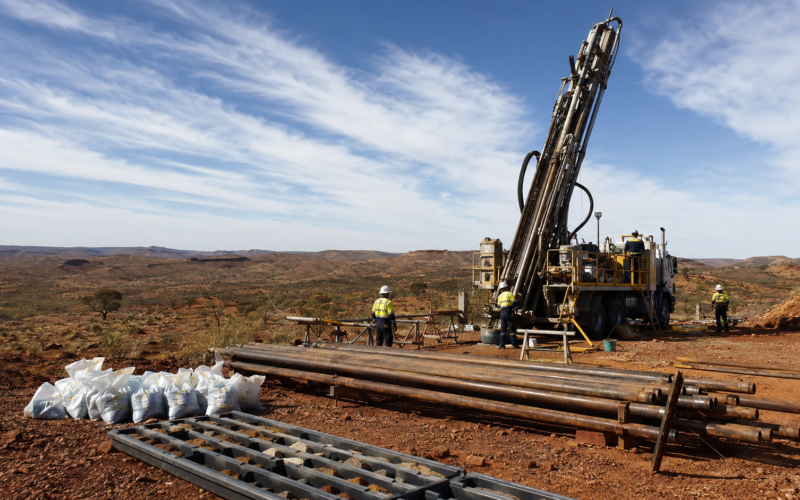
High-Tech Metals Limited (ASX:HTM) has reported the first assays from its 6,038-metre reverse circulation drilling campaign at the Mt Fisher Gold Project, with results received from 17 of the 41 completed holes. Highlights included 13 metres at 1.54 grams per tonne of gold from 192 metres and 12 metres at 2.30 grams per tonne from 171 metres, with higher-grade zones contained inside both intersections. The initial batch supports continuity within the existing mineralised system, but most holes testing the northern resource extensions remain pending. That distinction matters because the investment case now depends less on reconfirming gold inside the known footprint and more on proving that the current 35,000-ounce resource can grow into a larger, development-relevant inventory.
What do the first High-Tech Metals drilling results reveal about Mt Fisher’s gold continuity?
High-Tech Metals has reported several intersections that combine reasonable widths with internal zones of higher-grade gold. Hole 26MFRC017 returned 13 metres at 1.54 grams per tonne from 192 metres, including 5 metres at 3.38 grams per tonne. Hole 26MFRC010 produced 12 metres at 2.30 grams per tonne from 171 metres, including 5 metres at 4.95 grams per tonne, while another hole returned 10 metres at 1.35 grams per tonne from 152 metres, including 3 metres at 3.31 grams per tonne.
Further results included 6 metres at 1.40 grams per tonne from 146 metres, 6 metres at 1.08 grams per tonne from 196 metres and 2 metres at 5.49 grams per tonne from 181 metres. High-Tech Metals reported the intervals using a 0.2-gram-per-tonne cut-off and no more than 2 metres of internal dilution. The holes were generally drilled close to perpendicular to the mineralised geology, meaning the reported widths are considered reasonably representative of the underlying structures.
For investors, the principal positive is consistency rather than one spectacular bonanza-grade hit. Multiple holes have intersected the targeted mineralised horizon, reducing the risk that earlier results represented disconnected pockets of gold. The presence of higher-grade zones inside broader intervals may also become important if those zones can be modelled as continuous shoots capable of influencing future mine sequencing and head grades.
The results are not yet sufficient to demonstrate a materially larger mineable inventory. Only 17 of 41 holes have been reported, while the initial assays are predominantly located inside or close to the existing resource area. These holes improve geological confidence, but they do not yet resolve the larger valuation question surrounding the northern extensions.

Why are the pending northern extension assays more important than the first 17 Mt Fisher holes?
Most of the drilling designed to test the northern extension of Mt Fisher remains within the 24-hole assay backlog. That means the holes with the greatest potential to add mineralisation outside the current resource boundary have not yet been fully disclosed. High-Tech Metals expects the remaining results over the coming weeks, creating a concentrated period of exploration news flow.
This sequencing changes how the first batch should be interpreted. The released assays provide evidence that the geological model works inside the established system. The pending holes must demonstrate whether that model can be extended into areas that could contribute additional ounces rather than merely increasing confidence in ounces already recognised.
The current Mt Fisher Mineral Resource contains approximately 464,000 tonnes grading 2.32 grams per tonne of gold for around 35,000 ounces. That resource extends across roughly 600 metres of strike, while the broader structural and mineralised corridor has been traced for at least seven kilometres. The contrast between a relatively small defined resource and a much longer prospective trend provides the geological rationale for the drilling campaign, but kilometres of prospective geology do not become valuable until drilling converts them into coherent mineralised volumes.
Positive northern extension results could increase the potential strike length, support an updated Mineral Resource estimate and strengthen the case for more intensive Phase Two drilling. Weak or inconsistent results would suggest that the known system may be more constrained than the broader corridor implies, leaving High-Tech Metals dependent on infill work, deeper targets or other prospects within the landholding.
This is why the next assay batch may carry greater market significance than the first. Continuity inside a resource is useful. Continuity beyond the resource is what creates growth.
Can Mt Fisher’s wider and higher-grade zones improve the economics of a future mining scenario?
The reported intersections contain a mix of moderate-grade widths and higher-grade internal zones. That combination could be commercially relevant because broader mineralisation may support practical mining widths, while higher-grade shoots could lift the average grade delivered to a processing facility.
However, the economic value of an intersection depends on more than grade multiplied by width. Investors must consider depth, continuity, orientation, waste dilution, ground conditions, metallurgical recovery and the cost of accessing the mineralisation. Several of the latest intersections begin between approximately 146 metres and 196 metres downhole, meaning any future mine plan would need to evaluate whether the material is better approached through an expanded open pit, underground development or a combination of both.
Historic mining provides some evidence that the Mt Fisher system can support extraction. Open-pit operations during 1987 and 1988 reportedly processed approximately 218,000 tonnes at an average grade of about 4.3 grams per tonne of gold. Earlier mining also occurred between 1937 and 1949. Historical production is encouraging, but it does not prove that a modern restart would satisfy present-day cost, environmental, safety and capital requirements.
A larger resource could improve project flexibility by spreading fixed development costs across more ounces. Higher confidence in the location of richer shoots could also support selective mining or staged development. Conversely, a resource dominated by narrow, deeper or discontinuous zones could remain technically interesting without becoming financially compelling.
Gold prices above US$4,000 per ounce provide a supportive external backdrop for Australian developers, but elevated commodity prices do not repair weak geology or excessive capital costs. A strong gold market may widen the range of projects considered economically viable, yet High-Tech Metals must still prove that Mt Fisher can produce sufficient tonnes at acceptable grades and recoveries.
How does the Mt Fisher resource campaign connect with High-Tech Metals’ Wagtail production strategy?
High-Tech Metals is not advancing Mt Fisher as a standalone exploration story. The company is simultaneously working on resource growth at Mt Fisher, a near-term development assessment at Wagtail, metallurgical studies, historic stockpile opportunities and regional exploration across the broader Mt Fisher and Mt Eureka portfolio.
The development strategy places Wagtail closer to the front of the production queue. High-Tech Metals has scheduled an updated Wagtail Mineral Resource estimate and a Wagtail Scoping Study, with the study expected approximately four to five weeks after the latest Mt Fisher update. The company is also assessing mining scenarios, historic stockpiles and processing alternatives.
Previous metallurgical testing at Wagtail returned gold recoveries of up to approximately 97.2%, supporting the interpretation that the mineralisation is free-milling and potentially suitable for conventional gravity and cyanide processing. High-Tech Metals has also signed a non-binding memorandum of understanding with Wiluna Mining Corporation regarding a possible processing pathway. Neither the metallurgy nor the memorandum guarantees a production agreement, but together they reduce two common early-stage uncertainties surrounding gold recovery and access to processing infrastructure.
The strategic logic is to investigate whether Wagtail can provide a smaller and potentially faster route towards production while Mt Fisher builds a larger resource base. If successful, early Wagtail cash flow could eventually support broader exploration and reduce reliance on repeated equity funding. That is the attractive version of the plan.
The risk is that advancing several technical workstreams simultaneously can stretch management attention and exploration budgets. High-Tech Metals must avoid creating a portfolio in which every asset is nearly ready for the next stage but none reaches a firm development decision. The forthcoming Wagtail Scoping Study will therefore be important because it should convert part of the exploration narrative into measurable assumptions about mining, processing, capital and operating costs.
Could the seven-kilometre Mt Fisher corridor support a larger Northern Goldfields gold platform?
High-Tech Metals controls the Mt Fisher tenements and has expanded its interest in the neighbouring Mt Eureka Project. The combined portfolio covers approximately 1,150 square kilometres in the Northern Goldfields of Western Australia, about 120 kilometres east of Wiluna and 40 kilometres east of the Yandal greenstone belt.
The regional position matters because the company is attempting to build more than a single-deposit story. Mt Fisher, Wagtail, Dam-Damsel and additional exploration prospects could potentially contribute to a consolidated inventory capable of supporting shared geological work, processing negotiations and infrastructure planning.
The Dam-Damsel corridor hosts a reported gold resource of approximately 75,000 ounces, while Mt Fisher currently contains about 35,000 ounces. These resources remain modest individually, but aggregation can change strategic relevance if the deposits possess compatible metallurgy, practical haulage distances and complementary development schedules.
High-Tech Metals plans reconnaissance work across Dam-Damsel as part of its wider growth strategy. The company must determine whether regional mineralisation can be converted into several economically useful deposits or whether the landholding contains numerous small occurrences that are difficult to combine into a coherent operation.
District-scale acreage is often marketed as optionality, but large tenure positions can also become expensive distractions. High-Tech Metals will need to prioritise targets capable of adding ounces quickly and resist spending heavily on regional concepts before the principal Mt Fisher and Wagtail development questions are answered.
Does High-Tech Metals have enough cash to fund resource growth and development studies?
High-Tech Metals ended its latest reported quarter with cash and cash equivalents of approximately A$11.1 million. The balance sheet was strengthened after the company received about A$10.7 million from the exercise of options, giving it greater capacity to fund drilling, metallurgical testing, resource updates and the Wagtail Scoping Study.
That cash position is substantial relative to the company’s market capitalisation of roughly A$27 million. It lowers immediate financing pressure and allows High-Tech Metals to pursue Phase Two drilling without automatically returning to shareholders after every exploration campaign.
The funding advantage must still be managed carefully. Reverse circulation drilling, diamond drilling, geological modelling, resource estimation, engineering and environmental studies can consume cash quickly. Advancing a production scenario also introduces costs that do not exist during pure exploration, including mine design, permitting, infrastructure assessment and detailed metallurgical work.
The best capital-allocation outcome would be for the remaining assays and the Wagtail Scoping Study to establish clear priorities. Strong northern results could justify allocating additional funds to Mt Fisher expansion. A credible Wagtail development case could warrant spending on approvals and processing negotiations. Ambiguous outcomes across both assets would increase the risk that capital is divided among multiple workstreams without producing a decisive value milestone.
High-Tech Metals is therefore not facing an immediate balance-sheet problem. Its challenge is converting a relatively strong cash position into larger resources and a realistic production pathway before that cash advantage gradually disappears.
Why did ASX:HTM shares barely move despite multiple broad gold intersections?
High-Tech Metals shares closed around A$0.255 to A$0.26 following the announcement, gaining approximately 2% during the July 3 session. The company had a market capitalisation of about A$27 million, with its shares trading inside a 52-week range of approximately A$0.205 to A$0.355.
ASX:HTM was approximately 6% higher over the preceding week but remained about 2% lower over one month. This suggests that the announcement improved near-term sentiment without producing a wholesale reassessment of the company’s valuation.
The restrained reaction is understandable. The results confirmed mineralisation inside and around the established system, but the most consequential extension holes remain pending. Investors may therefore be waiting for evidence of resource growth before assigning greater value to the drilling program.
Liquidity also matters. High-Tech Metals is a small-cap explorer with limited trading volume, meaning individual sessions may not provide a reliable measure of institutional or broader market conviction. A modest share-price reaction does not necessarily imply weak geology, just as a large one-day spike would not establish commercial viability.
Market sentiment is likely to become more responsive when the company reports the northern extension assays, an updated resource or concrete Wagtail economics. The first results have kept the geological story intact. The next results must expand it.
What must High-Tech Metals deliver next to justify a sustainable ASX:HTM rerating?
The immediate milestone is the release of assays from the remaining 24 Mt Fisher holes. Investors should focus on whether the northern drilling extends mineralisation beyond the current resource, whether widths remain consistent and whether higher-grade zones can be correlated between sections.
The second milestone is an updated Mt Fisher Mineral Resource estimate. Additional ounces would be positive, but resource quality will matter as much as headline size. Classification, grade, depth and continuity will determine whether the revised inventory supports meaningful development work.
The third milestone is the updated Wagtail resource and Scoping Study. Those documents should provide the first structured view of possible mining methods, production scale, processing assumptions, capital intensity and economic sensitivity. A Scoping Study remains preliminary, but it will help separate plausible development options from geological enthusiasm.
High-Tech Metals has also indicated that Phase Two drilling could begin around mid-August 2026, with possible diamond drilling under consideration. Diamond core could improve structural understanding, support density measurements and provide material for further metallurgical testing.
Finally, the company must demonstrate discipline. Successful explorers are not rewarded merely for producing a crowded announcement calendar. High-Tech Metals must show that each campaign is moving Mt Fisher or Wagtail towards a larger resource, a lower-risk processing solution or an investable development decision.
The first Mt Fisher assays have provided evidence of broad and locally higher-grade gold mineralisation. The more difficult task begins with the remaining holes, because they must prove that the system grows beyond what the market already knows.
Key takeaways on what the Mt Fisher assays mean for High-Tech Metals and ASX:HTM
- High-Tech Metals has received results from 17 of the 41 holes completed during its 6,038-metre Mt Fisher drilling campaign.
- The first assays confirm multiple broad gold intervals with higher-grade internal zones inside the established mineralised system.
- The strongest result to date was 12 metres at 2.30 grams per tonne, including 5 metres at 4.95 grams per tonne of gold.
- Most drilling intended to test the northern resource extensions remains pending, making the next assay batch the more important resource-growth catalyst.
- Mt Fisher’s existing 35,000-ounce resource is small relative to the seven-kilometre mineralised corridor, creating upside but also significant geological uncertainty.
- Wagtail provides a parallel development opportunity supported by strong metallurgical recoveries and a potential toll-processing pathway.
- High-Tech Metals’ approximately A$11.1 million cash balance provides capacity to fund further drilling and studies without immediate financing pressure.
- The muted ASX:HTM market reaction shows that investors are waiting for confirmed resource expansion rather than continuity inside the known footprint.
- The updated Wagtail resource and Scoping Study could determine whether High-Tech Metals has a credible near-term production route.
- A sustained rerating will require additional ounces, practical processing options and evidence that the portfolio can progress beyond repeated exploration campaigns.
Discover more from Business-News-Today.com
Subscribe to get the latest posts sent to your email.



