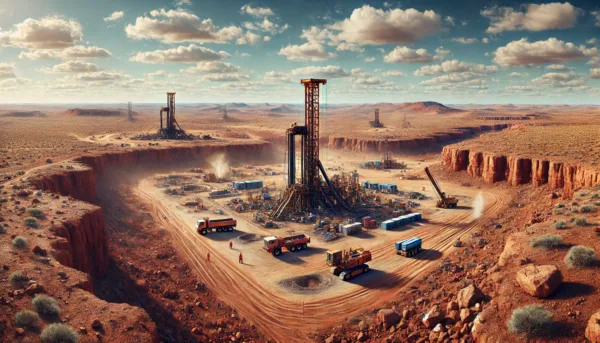




High-Tech Metals Ltd (ASX: HTM) has confirmed the presence of visible gold in multiple reverse circulation drill holes at the high-grade Wagtail deposit within its Mt Fisher–Mt Eureka gold portfolio in Western Australia. The drilling campaign, fully funded by SSH Mining Australia Pty Ltd under an existing development agreement, aims to refine the current JORC resource and assess the deposit’s viability for a near-term production decision.
The discovery is being interpreted as early evidence supporting historical high-grade mineralisation patterns, with initial assay results expected in mid-January 2026. If confirmed, Wagtail may become High-Tech Metals’ first producing asset, with minimal development lead time due to existing mining leases, nearby processing infrastructure, and a contractor-funded feasibility pathway.
How the Wagtail drill campaign fits into High-Tech Metals’ production-first gold strategy
Wagtail forms a key element in High-Tech Metals’ strategy to monetise small but high-grade deposits without undertaking greenfield development risk. Located within a granted mining lease, the deposit hosts an existing Mineral Resource of 14,600 ounces at 7.11 grams per tonne of gold under the 2012 JORC code. This modest but meaningful resource is part of the company’s broader plan to rapidly generate early-stage cash flow, enabling self-funded exploration across the larger 1,150 square kilometre Mt Fisher and Mt Eureka landholding.
High-Tech Metals is advancing a 3,000 metre infill reverse circulation drill campaign at Wagtail, with 31 holes totalling 1,271 metres completed prior to a temporary pause over the holiday period. Notably, the campaign has already recorded the occurrence of visible gold in quartz-sulphide veining across multiple drill holes. Such coarse gold mineralisation is consistent with the historical intercepts reported at Wagtail, including intervals of five metres at 41.13 grams per tonne gold and three metres at 55.14 grams per tonne.
Company executives have emphasised that laboratory assays will be required to confirm the grade and continuity of these observations. Nevertheless, the visual indications bolster confidence in Wagtail’s ability to yield high-margin mineralisation suitable for toll treatment, particularly given the project’s favourable logistics and low permitting hurdles.
Why the SSH Mining funding agreement is critical to High-Tech Metals’ execution model
SSH Mining Australia Pty Ltd, a wholly owned subsidiary of SSH Group Ltd (ASX: SSH), is not only managing but also fully funding the current drilling and pre-feasibility program at Wagtail. This mining agreement, first disclosed in September 2025, is structured to bring the Wagtail deposit to a Final Investment Decision without requiring upfront capital expenditure from High-Tech Metals.
The arrangement serves as a strategic enabler for High-Tech Metals, allowing it to progress de-risking activities while preserving its capital structure. SSH Mining benefits by positioning itself to participate in any future mining contract should the deposit be greenlit for production. The structure aligns the technical and economic interests of both parties and allows High-Tech Metals to maintain operational flexibility without excessive dilution or debt issuance.
In a sector where many juniors struggle to balance exploration upside with development execution, High-Tech Metals’ hybrid approach sets a precedent. It is leaning on a service-led partnership model to accelerate monetisation of smaller assets that might otherwise be sidelined.
What Wagtail’s geological indicators suggest about future development potential
The drill program to date has intersected visible gold in four holes and consistent quartz-sulphide veining across most of the 31 holes completed. Mineralisation is hosted within variably weathered mafic rocks, including dolerites and saprolitic clay zones, with sulphide phases such as pyrite and pyrrhotite observed in logged intervals. The style and setting of mineralisation align with mesothermal orogenic gold systems that are typical within the Archean Yilgarn Craton, one of the world’s most productive gold provinces.
The coarse nature of gold at Wagtail introduces both opportunity and risk. On one hand, it offers the potential for ultra-high-grade zones, which are commercially attractive even at relatively shallow depths. On the other, coarse gold systems can be prone to sampling variability, making resource estimation and reconciliation more challenging.
To address this, High-Tech Metals is undertaking metallurgical testing and will complement the RC program with diamond drilling in late January to obtain bulk samples. These efforts are geared toward improving metallurgical recovery estimates and informing mine design decisions.
How Wagtail’s infrastructure proximity and permitting status may compress its development timeline
Unlike many early-stage gold projects that face infrastructure delays, Wagtail is situated within direct trucking distance of multiple existing gold processing facilities. The project is accessible by established road networks and does not require a new plant or major permitting milestone to reach production. This opens the door to toll-treatment agreements, which are already being actively pursued by the company.
Discussions with third-party processors are underway, alongside concurrent workstreams including mine design, site infrastructure planning, and environmental permitting. If assays confirm economically viable grades and metallurgical recovery meets expectations, Wagtail could realistically transition to production in less than 12 months from FID.
The company is also conducting a scoping-level mining assessment in partnership with SSH Group across both Wagtail and the nearby Mt Fisher deposit. This regionalised approach allows for scenario modelling that includes blending potential, centralised processing, and integrated logistics.
How investor sentiment could shift as catalysts align in early 2026
Investor interest in junior gold equities has been muted in recent quarters due to macroeconomic uncertainty and a rotation into larger producers with existing cash flows. However, catalysts such as visible gold, assay results, and near-term production visibility often create outsized sentiment shifts in microcap names.
For High-Tech Metals, the assay results expected in mid-January 2026 will be pivotal. If they confirm high grades consistent with visible observations and historical data, institutional attention may follow. The company’s partnership structure with SSH Mining also adds a credibility layer often absent in junior-led standalone development stories.
Investors are likely to re-evaluate the company’s risk-reward profile if assay results, metallurgical recoveries, and toll-treatment agreements converge to support a production case. The staged nature of development, along with the de-risked funding model, means the company could achieve positive cash flow without requiring a plant build or project-level financing package.
How High-Tech Metals’ modular development model compares to its peers
In the context of Western Australian gold juniors, High-Tech Metals stands out for pursuing a modular and selective development strategy. Unlike peers chasing larger but lower-grade discoveries, the company is focused on developing small, high-grade deposits within trucking distance of existing mills. This lean model reduces capital intensity and shortens the timeline to production.
Companies such as Pantoro Ltd and Genesis Minerals Ltd have deployed similar phased development strategies, combining toll treatment and modular production hubs. High-Tech Metals is positioning itself to follow that playbook, potentially becoming a self-funded explorer over time.
With more than 1,150 square kilometres of exploration ground and access to key geological corridors in the Yilgarn Craton, the company has the optionality to scale. But unlike traditional greenfield developers, it is building its business on near-term output from proven ground rather than speculative upside.
What are the key takeaways from High-Tech Metals’ drilling results and development outlook?
- High-Tech Metals has intersected visible gold at the Wagtail deposit, validating the presence of coarse, high-grade mineralisation consistent with historical results.
- The Wagtail drilling and feasibility program is being fully funded and managed by SSH Mining under a strategic development agreement.
- The deposit is located on a granted mining lease and within hauling distance of active gold processors, enabling a fast-track path to production.
- Assay results due in January 2026 will be a key catalyst, with metallurgical testwork and diamond drilling underway to inform recovery and mine design.
- The modular development model reduces upfront capital needs and shortens the timeline to first cash flow compared to traditional greenfield projects.
- Discussions with nearby toll-treatment facilities are ongoing, and the company is advancing permitting and infrastructure planning in parallel.
- If successful, Wagtail could be developed into a low-cost, high-margin starter mine, enabling High-Tech Metals to self-fund broader exploration.
- Institutional sentiment may shift if assays validate the visible gold, especially given the low capex model and operational support from SSH Mining.
Discover more from Business-News-Today.com
Subscribe to get the latest posts sent to your email.