



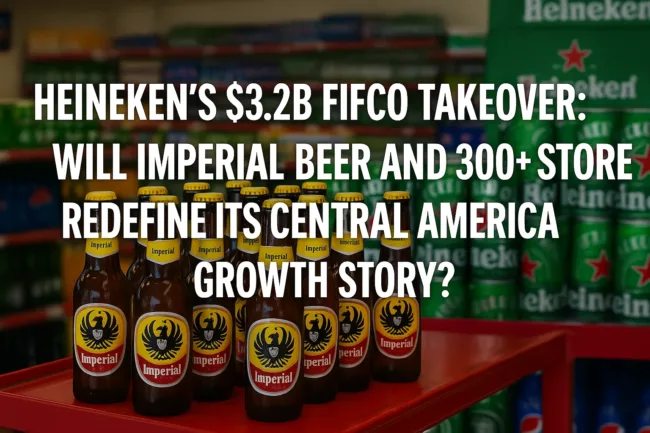
Heineken N.V. (Euronext Amsterdam: HEIA) announced a binding agreement to acquire the beverage and retail businesses of Florida Ice and Farm Company S.A. (FIFCOA.CJ) for about US$3.2 billion in cash, a landmark deal that cements the Dutch brewer’s ambitions to build scale and resilience in Central America. The acquisition, which is expected to close in the first half of 2026 pending regulatory and shareholder approvals, will add Costa Rica’s national beer Imperial, PepsiCo bottling rights, a portfolio of proprietary soft drinks, and over 300 convenience outlets across Costa Rica and neighboring markets.
Heineken said the deal will be immediately accretive to its operating margin and earnings per share before exceptional items, although it will also increase net debt by about €3.2 billion. The pricing implies a multiple of roughly 11.6 times EV/EBITDA based on 2024 results, underlining Heineken’s confidence in future growth and synergy potential.
What exactly is included in Heineken’s $3.2 billion acquisition of FIFCO’s Central America assets?
The scope of the deal goes far beyond a simple brewery purchase. Heineken will take over the 75 percent of Distribuidora La Florida in Costa Rica that it does not already own. This subsidiary is not only a market leader in beer and soft drinks but also operates more than 300 retail outlets strategically positioned to capture consumer demand in urban and suburban areas. The transaction also includes 75 percent of Nicaragua Brewing Holding and the 25 percent of Heineken Panama that the company does not yet own, consolidating its control in the region. Additionally, Heineken will buy FIFCO’s Beyond Beer business in Mexico, giving it a foothold in growing categories that extend beyond its traditional lager focus.
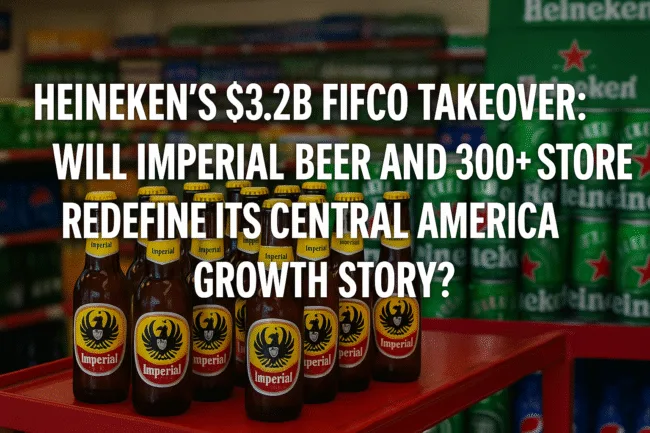
Critically, the acquisition provides ownership of Imperial, a storied Costa Rican brand that commands loyalty and cultural resonance unmatched by global labels. The PepsiCo bottling license further adds diversity, expanding Heineken’s reach into non-alcoholic beverages and improving utilization of bottling and distribution infrastructure. Together, these assets give Heineken something rare in brewing: a vertically integrated platform from production through retail, with proprietary brands supported by captive shelf space and direct consumer engagement.
Why does owning Imperial beer, a PepsiCo bottling license, and hundreds of retail stores transform Heineken’s business model?
In the traditional brewery model, margins often erode in the route to market because distribution, refrigeration, and retail placement are controlled by third parties. By securing FIFCO’s retail outlets, Heineken reduces dependence on external retailers and gains a first-party view of consumer behavior. This means more control over promotions, better pricing power, and a stronger ability to test new pack formats and categories. The addition of PepsiCo bottling rights increases throughput, ensuring production facilities remain efficient year-round, while non-beer beverages mitigate risk if beer volumes soften.
In effect, Heineken is buying an ecosystem. Imperial adds heritage and consumer loyalty, PepsiCo bottling ensures non-alcoholic category growth, and retail outlets close the loop on execution. For investors, this structure suggests a higher baseline margin profile compared to brewers who remain reliant on external distribution.
How do the deal economics compare to brewing sector benchmarks, and why did Heineken pay a premium?
The US$3.2 billion price tag represents a valuation multiple of about 11.6 times 2024 EBITDA, which may seem high compared to historical brewing acquisitions. However, the premium reflects the unique mix of assets. Distribuidora La Florida reported net revenues of US$1.13 billion, EBITDA of US$334 million, and operating profit of US$278 million in 2024, excluding FIFCO’s U.S. operations. These numbers show a portfolio with scale, profitability, and diversification already embedded.
For Heineken, the premium also buys strategic certainty. Rather than piecemeal entry into Central America through licensing or joint ventures, the brewer is consolidating ownership and securing brand and retail control that competitors such as Anheuser-Busch InBev or Molson Coors have struggled to replicate in the region. The timeline of a first-half 2026 closing is conservative, reflecting the complexity of cross-border regulatory approvals but also minimizing integration risks.
What do investor reactions and stock sentiment reveal about the market’s view of Heineken after the FIFCO deal?
Initial investor sentiment has leaned positive but cautious. Heineken shares in Amsterdam have been trading in the mid-€60s, near the lower end of their 52-week range of €63.6 to €82.8. The company’s forward P/E multiple remains in the low teens, leaving room for rerating if integration delivers the promised accretion. Analysts point to the €36 to €37 billion market capitalization and a dividend yield of about 3 percent as indicators of stability, while buy-side targets hover closer to €80, implying 20 percent upside.
The market does recognize risks from the step-up in leverage. Heineken has committed to maintaining its €1.5 billion share buyback program alongside the acquisition, which reassures investors that cash flow is robust. Still, institutional investors will be monitoring quarterly earnings for proof of synergy realization, particularly in distribution costs per hectoliter and gross margin expansion.
How does this acquisition fit into Heineken’s long partnership with FIFCO and the broader history of beverage consolidation?
Heineken’s relationship with FIFCO dates back to 1986, when the companies began collaborating in Central America. In 2002, Heineken acquired a 25 percent stake in Distribuidora La Florida, laying the groundwork for today’s buyout. Over the years, the brewer has seen firsthand how Costa Rica’s consumption patterns—spurred by urbanization, tourism, and a rising middle class—support sustainable volume growth.
This transaction is also part of a wider consolidation trend in the global beverage industry. As mature beer markets in Europe stagnate and competition intensifies, major players have sought to diversify into non-beer beverages and capture more of the distribution chain. Owning retail outlets and bottling licenses is increasingly viewed as a hedge against retail concentration and margin compression. In that sense, Heineken’s move mirrors broader sector strategies while also carving out a unique path by embedding retail into its business model.
What execution risks and integration challenges could undermine Heineken’s Central America ambitions?
The opportunities are significant, but so are the challenges. Integrating multiple businesses across Costa Rica, Nicaragua, Panama, and Mexico will require harmonizing logistics systems, IT platforms, and procurement processes. Regulatory reviews in several countries could delay closing or impose conditions, while currency volatility and inflation present ongoing financial risks.
Equally critical is the stewardship of Imperial and other local brands. Consumers in Central America often view national beers as cultural icons. Any perception that Heineken is diluting or over-commercializing Imperial could lead to backlash. The company will need to strike a balance between operational efficiency and cultural authenticity, ensuring that global scale does not erode local loyalty.
What should investors monitor in 2026 and beyond as Heineken integrates FIFCO’s assets and manages its balance sheet?
The most important metrics will be synergy delivery, debt management, and margin expansion. Investors will be looking for Heineken to demonstrate improvement in gross margins and working capital efficiency as retail outlets are folded into its supply chain. Deleveraging is expected to proceed alongside the buyback program, signaling confidence in cash generation. Analysts also suggest that the integrated platform could support bolt-on acquisitions in Guatemala, El Salvador, or Honduras once the FIFCO deal stabilizes, though the near-term focus will be on execution discipline.
Stock and sentiment analysis: is Heineken a buy, sell or hold after the FIFCO acquisition?
For investors, the Heineken-FIFCO deal represents a calculated bet on growth and control. With Imperial, PepsiCo bottling rights, and hundreds of retail outlets in hand, the company has secured assets that provide long-term competitive advantages. While the additional debt adds some near-term pressure, the pricing multiple of 11.6 times EBITDA looks justified given the strategic value. Based on analyst targets around €80 per share, our editorial stance—without being investment advice—would be to maintain a Hold rating with a bias toward Accumulate on any weakness. The long-term case rests on Heineken’s ability to deliver margin expansion and leverage diversification to withstand cyclical downturns in beer consumption.
What does this mean for beverage competition and regional growth in Latin America?
For competitors, the deal raises the stakes. Local breweries and soft drink companies will now face a global powerhouse with not only strong brands but also direct retail control. This could trigger further consolidation or partnerships in the region as rivals look to defend market share. For Central America, the acquisition signals international confidence in the region’s consumer fundamentals and could spur foreign investment in supply chains and retail infrastructure.
The Heineken-FIFCO acquisition is therefore more than just another brewery deal. It is a blueprint for how global beverage companies can combine brand heritage, category diversification, and retail control to build more resilient business models. If Heineken manages the integration with discipline and cultural sensitivity, the US$3.2 billion investment could reshape its financial profile and mark a turning point in the evolution of its global strategy.
Discover more from Business-News-Today.com
Subscribe to get the latest posts sent to your email.