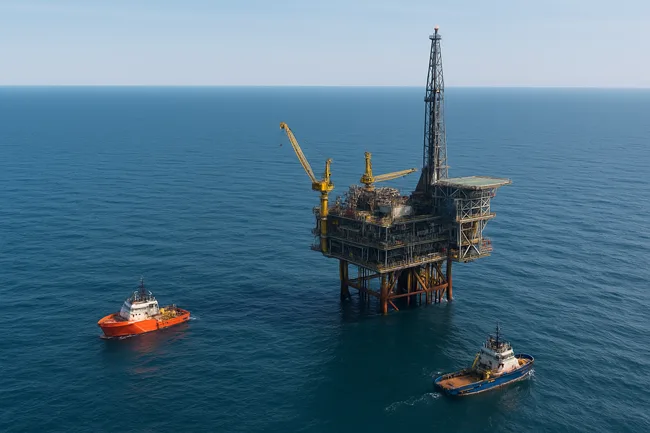
Ørsted A/S (CPH: ORSTED) said its U.S. offshore wind projects are moving forward again after a federal court lifted a suspension imposed during the second Donald Trump administration, removing a legal roadblock that had disrupted construction schedules and capital planning. The decision restores regulatory continuity for projects already under development and reopens a strategically important growth market for Ørsted at a time when offshore wind economics are under close investor scrutiny.
The ruling does not introduce new permits or incentives, but it eliminates a policy shock that had forced developers to pause activity despite existing approvals. For Ørsted, the practical impact is the ability to resume execution planning, reengage suppliers, and bring delayed assets back into its long-term delivery pipeline.
How the court’s decision restores execution certainty for Ørsted’s capital-intensive U.S. offshore wind developments
Offshore wind projects depend on tightly sequenced construction timelines, vessel availability, and long-dated financing structures. When a federal suspension interrupts that sequence, even temporarily, the consequences ripple through costs, contract terms, and expected returns. By lifting the Trump-era suspension, the court has reduced the risk of further stop-start disruptions for Ørsted’s U.S. projects.
This matters because Ørsted’s American portfolio represents multi-year capital commitments rather than optional pilot investments. Execution certainty, even without additional policy support, is often more valuable to project economics than headline subsidies, particularly in a higher interest rate environment.

Why policy-driven uncertainty, not demand, became the biggest risk to U.S. offshore wind economics
The suspension imposed during the Trump administration reflected political skepticism toward offshore wind rather than a collapse in demand for clean energy. State-level procurement targets, grid decarbonization goals, and corporate power purchase agreements continued to support the long-term case for offshore wind capacity.
However, federal-level unpredictability created a mismatch between demand signals and execution reality. Developers like Ørsted were left holding permitted but inactive projects, tying up capital without progress toward revenue. The court ruling narrows that gap by reinforcing legal checks on abrupt executive intervention in infrastructure projects.
What renewed project momentum means for Ørsted’s capital allocation discipline and return thresholds
Ørsted has spent the past two years recalibrating its investment strategy in response to rising construction costs, supply chain inflation, and higher financing expenses. Several global projects were delayed, restructured, or exited when returns fell below internal thresholds.
With U.S. projects back on track, Ørsted gains the ability to sequence investments more selectively. Projects with stronger contractual pricing, advanced permitting, and clearer state support can move forward, while weaker assets remain deprioritized. This flexibility supports Ørsted’s stated focus on disciplined growth rather than capacity expansion at any cost.
How the ruling reshapes competitive dynamics among offshore wind developers operating in the United States
The court decision benefits the broader offshore wind sector, but not all developers are equally positioned to respond. Larger, better-capitalized players such as Ørsted are more capable of restarting paused projects, renegotiating supplier contracts, and absorbing interim costs.
Smaller developers or newer entrants may face higher barriers if supply chain slots were lost or financing terms deteriorated during the suspension period. Over time, this imbalance could reinforce consolidation trends or lead to revised joint ventures as projects move back into active development.
Why legal stability may matter more than political alignment for long-term offshore wind investment
The significance of the ruling extends beyond Ørsted’s immediate projects. It signals to investors that U.S. offshore wind development is anchored not only in executive policy but also in judicial oversight. For long-lived infrastructure assets, legal durability often carries more weight than short-term political alignment.
This dynamic may encourage institutional capital to re-engage with U.S. offshore wind opportunities, albeit with continued caution around permitting timelines and community opposition risks.
Political and regulatory risks that remain for Ørsted despite the court lifting the suspension
While the suspension has been lifted, offshore wind remains politically sensitive in the United States. Local opposition, environmental litigation, and shifting federal priorities continue to pose risks to project timelines.
Ørsted has increasingly emphasized local economic benefits, port investments, and job creation as part of its U.S. strategy. These measures aim to reduce friction but cannot fully insulate projects from future regulatory or political challenges. The current ruling lowers risk but does not eliminate it.
How investors are likely to interpret the ruling for Ørsted’s valuation and medium-term outlook
Investor sentiment toward offshore wind developers has been cautious, reflecting concerns over cost overruns and policy volatility. The court’s decision removes one negative variable from Ørsted’s U.S. narrative, but markets are unlikely to reprice the stock meaningfully without evidence of improved project economics.
Investors will watch for updates on construction milestones, revised return assumptions, and capital expenditure phasing. If Ørsted can demonstrate that U.S. projects progress without further legal disruption, sentiment could improve gradually, anchored in execution rather than headlines.
What the decision signals about the long-term trajectory of U.S. offshore wind development
At a sector level, the ruling reinforces the idea that U.S. offshore wind is likely to advance through legal and institutional processes rather than through smooth political consensus. This reality favors developers with patience, balance sheet strength, and operational experience.
Ørsted’s statement that projects are back on track reflects cautious confidence. The company appears focused on stabilizing delivery rather than accelerating expansion, a stance that aligns with the current risk environment.
Key takeaways on what the court ruling means for Ørsted, investors, and the U.S. offshore wind sector
- The court’s decision removes a major execution barrier for Ørsted’s U.S. offshore wind projects.
- Regulatory continuity allows stalled assets to re-enter active construction and financing planning.
- Capital allocation flexibility improves as Ørsted can prioritize higher-quality U.S. projects.
- Legal oversight reduces the impact of abrupt policy reversals on long-term infrastructure investments.
- Larger developers gain a relative advantage as activity resumes across the sector.
- Political and permitting risks remain despite the lifting of the suspension.
- Investor sentiment is likely to improve only if execution milestones follow regulatory clarity.
- The ruling supports the long-term structural case for U.S. offshore wind without guaranteeing smooth delivery.
Discover more from Business-News-Today.com
Subscribe to get the latest posts sent to your email.