




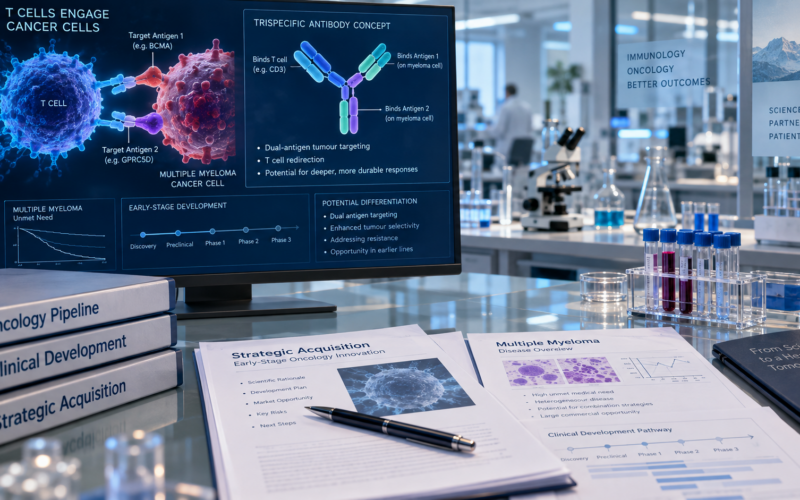
GSK plc (LSE: GSK; NYSE: GSK) has agreed to acquire full global rights to a trispecific T-cell engager from Chimagen Biosciences in a transaction worth up to $750 million. The candidate is being developed for multiple myeloma and is intended to bind T cells while targeting two separate antigens on tumour cells. GSK plans to begin a Phase I clinical study in 2027, placing the asset at the high-risk, early end of its oncology pipeline. The deal gives Chimagen an undisclosed upfront payment and eligibility for development and commercial milestones if the programme advances.
The acquisition is strategically important despite its relatively modest headline size because it adds a differentiated immune-cell therapy concept to GSK’s blood-cancer portfolio. Existing T-cell engagers have demonstrated that redirecting a patient’s immune system can produce meaningful responses in heavily treated multiple-myeloma patients. The challenge is to extend those responses, reach a broader patient population and improve tolerability and dosing convenience. GSK believes simultaneous engagement of two tumour antigens may help address escape mechanisms that can make a cancer resistant to a single-target therapy.
The transaction also strengthens an existing relationship rather than introducing an untested partner. GSK previously obtained rights to CMG1A46, Chimagen’s dual CD19 and CD20 T-cell engager, in a 2024 agreement carrying potential consideration of up to $850 million. That programme is in a Phase I trial for B-cell malignancies and B-cell-dependent autoimmune disorders. The second deal suggests that GSK has gained confidence in Chimagen’s antibody-engineering platforms, though neither programme has yet produced late-stage clinical evidence.
How could a trispecific T-cell engager work in multiple myeloma?
T-cell engagers are engineered antibodies designed to bring immune cells into close contact with malignant cells. One part binds a receptor on a T cell, while another recognises an antigen expressed by the cancer, creating an immune response against the tumour. A trispecific construct adds another binding function, which can be used to recognise a second tumour antigen or modify immune activity. In principle, a two-antigen approach could continue identifying cancer cells even if expression of one target falls during treatment.
That principle must still be proven in patients. Tumour-antigen expression varies between individuals and over the course of disease, while a more complex molecule can create manufacturing, dosing and safety challenges. The first study will need to establish an acceptable dose and characterise how the candidate behaves in the body before efficacy can be assessed meaningfully. A 2027 Phase I start means the programme is years away from a potential registration decision even under a favourable development path.
GSK describes the candidate as having potential to improve efficacy, durability and tolerability compared with existing T-cell engagers. Those are development goals rather than demonstrated clinical advantages. The company has not disclosed human-response data because the programme has not yet entered the clinic, and preclinical performance does not reliably predict success in a diverse patient population. The value of the asset will rise or fall with early safety findings, response depth and evidence that targeting two tumour antigens produces a practical benefit.
The commercial opportunity is substantial if the science translates. GSK cites external forecasts suggesting that the United States market for multiple-myeloma T-cell engagers could exceed $10 billion by 2032. The company estimates that approximately 180,000 new cases of multiple myeloma are diagnosed worldwide each year, making it the third most common blood cancer. The disease is treatable but remains incurable for most patients, and it commonly becomes refractory after successive therapies.
Why is GSK adding another blood-cancer programme now?
GSK is trying to build a deeper oncology franchise while preparing for future patent pressure in its established HIV portfolio. New chief executive Luke Miels has identified research and business development as central tools for maintaining growth beyond the exclusivity periods of today’s leading medicines. Blood cancers are a logical focus because GSK already has commercial, clinical and regulatory infrastructure in the area. Adding an early trispecific programme creates a longer-duration option that could complement marketed products and later-stage assets.
The company’s multiple-myeloma presence includes Blenrep, its antibody-drug conjugate directed at BCMA. Blenrep’s regulatory history has shown both the value and difficulty of developing treatments in a crowded disease, with efficacy weighed against treatment burden and safety. A T-cell engager could occupy a different place in the treatment sequence or eventually be tested in combinations. GSK will need clinical evidence to determine whether the new candidate competes with, complements or follows other portfolio products.
The Chimagen transaction fits a broader period of external investment. Earlier in 2026, GSK agreed to acquire Nuvalent for approximately $10.6 billion, its largest transaction in more than a decade, to expand its precision-oncology pipeline. It is also advancing antibody-drug conjugates and targeted medicines across blood cancers, women’s cancers, lung cancer and gastrointestinal tumours. The strategy spreads scientific risk across mechanisms and stages, but it increases the importance of disciplined portfolio choices when trial results disappoint.
Milestone-based economics provide some protection. Because the upfront payment is undisclosed and much of the $750 million depends on development and commercial success, GSK will not pay the full headline value if the programme fails early. Chimagen preserves upside if clinical progress and sales targets are achieved. That structure aligns incentives while limiting the buyer’s initial exposure to a preclinical asset.
What do GSK’s latest results say about its capacity to invest?
GSK reported second-quarter 2026 sales of £8.41 billion, up 5% at both actual and constant exchange rates. Specialty medicines generated £3.8 billion and grew 14%, while oncology sales increased 17% to approximately £600 million. HIV revenue reached £2.1 billion, up 10%, and vaccines sales rose 8% to £2.3 billion. That mix provides cash generation and commercial infrastructure to fund pipeline expansion.
Core operating profit increased 7% and core earnings per share rose 9% in constant-currency terms, but reported operating profit fell 75%. The reported decline reflected higher impairments, led by a £1.3 billion charge related to camlipixant, as well as higher contingent-consideration liabilities. The contrast is a useful reminder that drug development creates abrupt accounting and economic setbacks even when the underlying business is growing. GSK generated £2.9 billion of operating cash and £2.0 billion of free cash flow during the quarter, supporting both internal research and selective deals.
The new Chimagen candidate does not change near-term earnings forecasts because clinical spending will begin well before any possible revenue. Its financial relevance is optionality: a successful medicine in a multibillion-dollar market could become material in the next decade, while milestone terms limit the cost of failure. Investors must judge whether GSK is assembling a coherent portfolio or simply accumulating early programmes. Evidence from CMG1A46 may also influence confidence in Chimagen’s platform before the myeloma asset produces its own human data.
The company’s announcement says closing remains subject to customary conditions. After completion, the practical milestones will include preclinical-enabling work, regulatory clearance to start the trial, first-patient dosing and the initial dose-escalation findings. Each stage can alter programme timing and the probability that later payments become due. No assumptions about peak sales are dependable until the candidate demonstrates a clinically useful therapeutic window.
How has the market responded to GSK’s latest oncology move?
GSK’s New York-listed shares closed at $50.22 on Friday, September 18, down 1.64% for the session, giving the company a market value of about $208.2 billion. The London-listed stock finished at 1,877.5 pence, down 1.18%. The shares did not show a decisive repricing after the September 15 announcement, which is unsurprising given GSK’s scale, the undisclosed upfront payment and the candidate’s preclinical status. Broader pipeline progress and earnings expectations remain much larger valuation drivers.
That muted response does not mean the deal lacks strategic value. Early oncology programmes are often acquired before human data because the price and competitive landscape can change dramatically after proof of concept. GSK is accepting scientific uncertainty in exchange for full global control and the possibility of a differentiated product. Chimagen gains access to a partner with the resources to run global trials and commercialise in major markets.
Investors should now watch the planned 2027 trial start, the target profile selected for the first study and any preclinical disclosures that clarify differentiation. They should also compare the programme with other dual-target or multispecific myeloma candidates as the field develops. The $750 million figure may attract attention, but the more important question is whether engaging two tumour antigens can produce deeper, more durable benefit without adding prohibitive treatment complexity. That answer will emerge through clinical data, not transaction value.
Discover more from Business-News-Today.com
Subscribe to get the latest posts sent to your email.


