Alphabet Inc. (NASDAQ: GOOGL; NASDAQ: GOOG) is preparing to double Google Cloud’s technical infrastructure in Brazil by 2030 as enterprise adoption of artificial-intelligence agents begins creating additional demand for local computing capacity, sovereign data handling and high-performance inference.
The expansion will add localised compute, storage and AI-processing capability. Google Cloud has not disclosed a specific capital-expenditure figure for the Brazilian buildout, so the programme should be described by its capacity objective rather than assigning it a speculative project value.
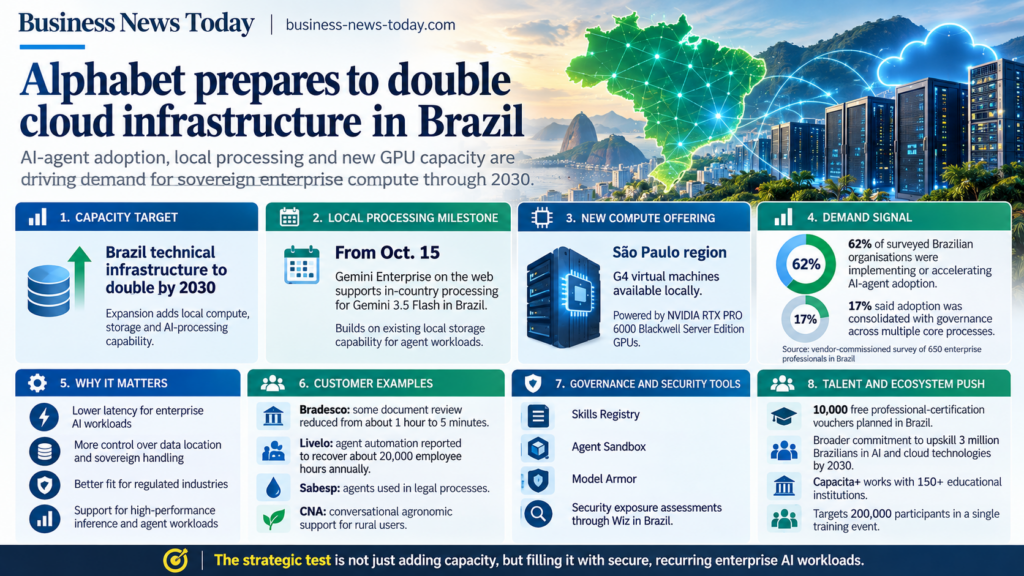
Starting October 15, Gemini Enterprise on the web will support in-country processing for Gemini 3.5 Flash in Brazil, complementing existing local storage capability for agent workloads. Google is also making G4 virtual machines powered by NVIDIA RTX PRO 6000 Blackwell Server Edition GPUs available from its São Paulo cloud region.
The combination addresses a problem emerging as enterprise AI moves beyond experimentation. Companies may want powerful models, but regulated workloads increasingly require assurances around latency, data location, governance and who can access information used by autonomous agents.
Why does Google Cloud need to double Brazilian technical infrastructure?
Agentic AI can consume considerably more computing resources than conventional enterprise software because models repeatedly reason, retrieve data, call tools and interact with other systems before completing a task.
Heavy inference workloads require both accelerator capacity and high-speed access to enterprise data. Keeping more of that infrastructure in Brazil can reduce latency while allowing organisations to meet policies that restrict where sensitive information is processed.
Google Cloud’s commissioned research found that 62% of surveyed Brazilian organisations were already implementing or accelerating AI-agent adoption. Only 17% said they had consolidated that adoption with the governance needed to deploy agents across multiple core processes.
The survey covered 650 enterprise professionals in Brazil and was commissioned by Google Cloud, so its findings should be treated as vendor-sponsored research rather than an independent census of the entire business market. The gap nevertheless illustrates the commercial problem Google is trying to solve: enthusiasm for agents is developing faster than the controls required for widespread production use.
What changes when Gemini Enterprise starts local processing on October 15?
Local processing means eligible Gemini Enterprise activity can remain within Brazilian infrastructure rather than automatically depending on remote regions for every processing step.
That can matter for financial institutions, utilities, healthcare groups and other organisations operating under internal or regulatory rules governing data location. Local processing can also reduce latency for applications requiring frequent interaction with models.
Google says customer data and outputs are not used to train base models without explicit consent. Data residency does not remove every privacy or security concern, but it gives enterprises another control when designing how agents interact with sensitive internal systems.
The change can also improve disaster-recovery design by allowing organisations to build architectures around regional infrastructure rather than treating Brazil only as an endpoint accessing computing elsewhere.
Why are NVIDIA Blackwell GPUs now relevant to Google Cloud’s Brazil strategy?
Google Cloud’s G4 virtual machines in São Paulo use NVIDIA RTX PRO 6000 Blackwell Server Edition GPUs. Their local availability gives Brazilian businesses access to accelerator infrastructure without building dedicated GPU clusters inside their own data centres.
Inference capacity is becoming increasingly important as companies move from occasional experimentation toward agents performing repetitive work throughout the business day. A successful enterprise deployment can generate thousands or millions of model calls rather than a handful of employee prompts.
Local GPU access can also appeal to software companies building AI applications for Brazilian customers. They can run latency-sensitive workloads closer to users while keeping infrastructure inside one established cloud environment.
Google still competes with Microsoft Azure, Amazon Web Services and locally focused providers. Doubling infrastructure alone therefore does not guarantee market share; customer adoption and utilisation will determine whether the additional capacity earns attractive returns.
What evidence does Google have that Brazilian companies are getting value from agents?
Google Cloud has highlighted several customer examples rather than relying solely on infrastructure forecasts. Bradesco is using Gemini Enterprise in fiscal, accounting and contractual analysis and reports cutting some document-review processes from roughly one hour to five minutes.
Livelo says agent automation across areas including review moderation and digital campaign workflows is recovering approximately 20,000 employee hours annually. Sabesp is using agents in legal processes, while agricultural organisation CNA is providing conversational agronomic support to rural users.
These examples are customer and vendor-reported outcomes and should not be assumed to apply automatically across other companies. They are nevertheless commercially useful because enterprise AI budgets increasingly need measurable productivity benefits rather than broad claims about technological potential.
The next stage is moving from isolated workflows into more interconnected agents. That transition makes security and governance more important because an agent capable of acting across several applications has considerably more potential impact than a chatbot that only generates text.
Why is Google adding Skills Registry, Agent Sandbox and stronger security controls?
Google Cloud is introducing a Skills Registry intended to govern which capabilities specific agents or employees can use. This becomes increasingly important when companies operate multiple agents rather than one centrally managed AI application.
Agent Sandbox provides an isolated environment where agents can execute code, use command-line tools or interact with a computer environment without receiving uncontrolled access to core enterprise systems.
Google is also expanding Model Armor and offering Brazilian organisations security exposure assessments through Wiz. These additions connect the Brazilian infrastructure announcement with Google’s wider cybersecurity portfolio following its investment in cloud-security capabilities.
Governance may become one of the most defensible parts of enterprise AI infrastructure. Models themselves can change rapidly, but companies still need identity, permissions, auditing and policy layers that determine what those models are allowed to do.
How does Brazil fit Google Cloud’s wider AI infrastructure strategy?
Google Cloud has been one of Alphabet’s fastest-growing businesses as demand for AI infrastructure, data services and enterprise models increases. Alphabet entered 2026 planning extraordinarily high infrastructure expenditure across servers, data centres and networking to support both internal AI development and cloud customers.
Brazil gives Google a large Latin American enterprise market with an existing São Paulo cloud region and customers across banking, retail, agriculture, utilities and insurance. Doubling local capacity therefore expands an established footprint rather than creating the company’s first regional presence.
The company is also investing in skills alongside hardware. Google plans to provide 10,000 free professional-certification vouchers in Brazil and has a broader commitment to upskill three million Brazilians in AI and cloud technologies by 2030.
Its Capacita+ programme is working with more than 150 educational institutions and is targeting 200,000 participants in a single training event, underscoring how hyperscaler competition increasingly includes developer and workforce ecosystems alongside infrastructure.
What should investors watch as Google doubles Brazilian infrastructure?
Utilisation is the most important measure. Technical capacity creates value only when Brazilian and Latin American customers consume enough compute, storage and AI services to justify the investment.
Local Gemini adoption is another indicator. October 15 gives enterprises a clear date from which additional data-residency capability becomes available, allowing investors and competitors to watch whether regulated industries expand production use.
The third measure is whether customer productivity stories become repeatable. Bradesco’s reported reduction from one hour to five minutes and Livelo’s 20,000 recovered hours are powerful examples, but enterprise AI becomes economically significant only when such outcomes appear across many customers and workflows.
Google Cloud is therefore combining three layers of its Brazil strategy: more physical infrastructure, stronger sovereign and governance controls, and AI applications tied to measurable work. Doubling technical capacity by 2030 is the headline commitment; filling that capacity with secure, recurring enterprise workloads will determine whether Brazil becomes one of Google Cloud’s most consequential AI markets in Latin America.
Discover more from Business-News-Today.com
Subscribe to get the latest posts sent to your email.