



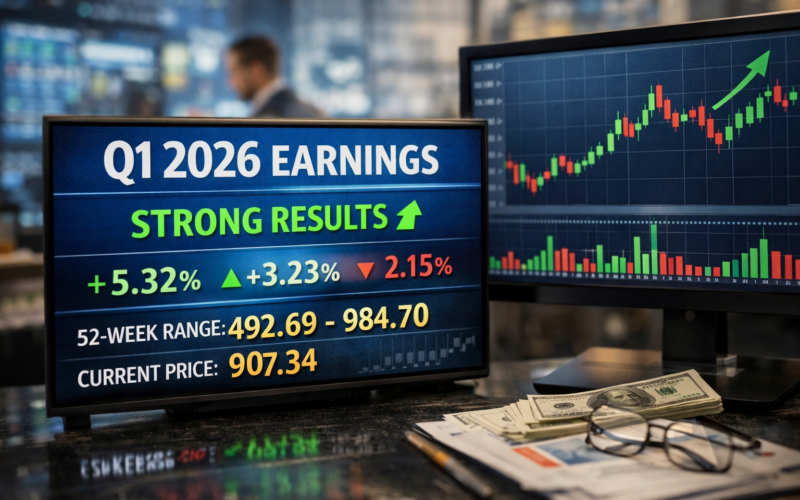
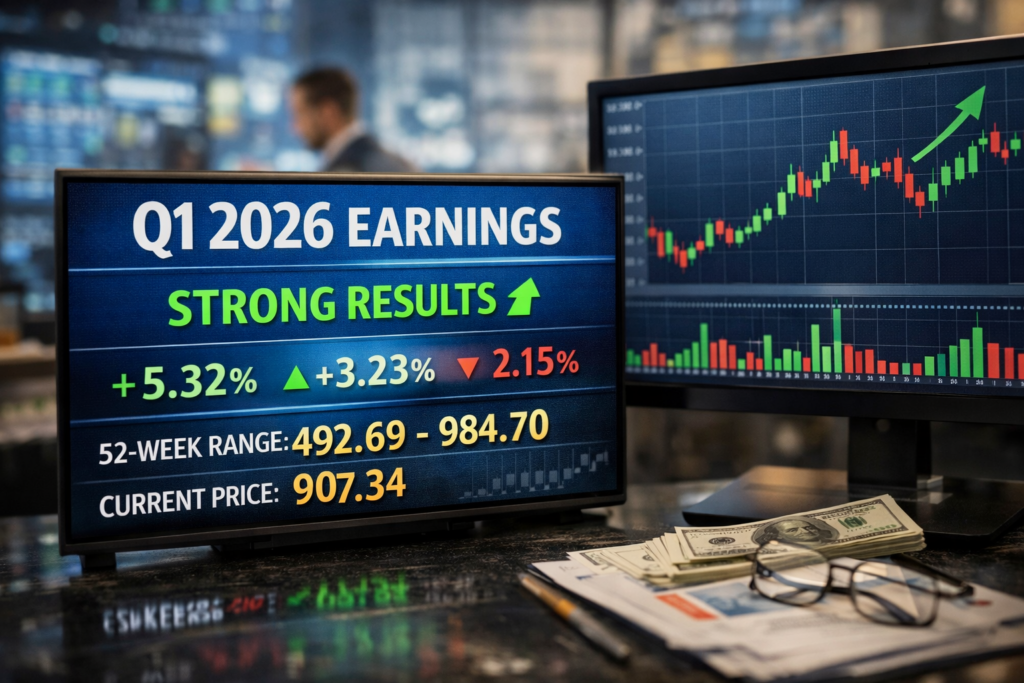
Goldman Sachs (NYSE: GS) just delivered its second-highest quarterly revenue in the firm’s 157-year history, and for retail investors who have been watching GS from the sidelines, today’s numbers land at a genuinely important moment. The firm reported Q1 2026 earnings before market open on April 13 that beat analyst expectations on the headline, with record equities trading revenue and a surge in investment banking fees powered by a recovered mergers and acquisitions pipeline. The stock has traded between a 52-week low of USD 492.69 and a high of USD 984.70, and currently sits around USD 907, making the valuation debate the central question for anyone considering a position now.
What makes Goldman Sachs fundamentally different from other large American banks?
Goldman Sachs is not a retail bank in any meaningful sense. You will not find a Goldman checking account at a branch down the road, and the firm has largely exited the consumer lending experiment it pursued earlier this decade. What Goldman does, and does better than almost anyone, is operate in the spaces where large amounts of capital need to move: advising on corporate mergers, underwriting equity offerings, trading securities across global markets, and managing money for the world’s wealthiest individuals and institutions.
The three segments that matter to investors are Global Banking and Markets, Asset and Wealth Management, and Platform Solutions. The first two do the heavy lifting. Global Banking and Markets covers investment banking fees, trading revenues in equities and fixed income, and financing. Asset and Wealth Management oversees the firm’s fee-generating alternatives, mutual funds, and private wealth operations. Platform Solutions, which includes what remains of the consumer experiment, is small and shrinking in strategic importance.
The 2026 version of Goldman is a firm that has consciously repositioned itself toward fee-based recurring revenues. Asset and Wealth Management now contributes roughly 30% of post-provision revenue, a structural shift that makes the earnings profile meaningfully more stable than it was five years ago. That transformation is core to how CEO David Solomon has framed the investment case for the firm heading into this earnings cycle.
How strong were Goldman Sachs Q1 2026 earnings relative to what Wall Street expected?
The headline numbers from this morning’s release are hard to argue with. Net revenues of USD 17.23 billion came in above the analyst consensus estimate of approximately USD 17.06 billion. Diluted earnings per share of USD 17.55 beat the LSEG consensus of USD 16.49 by around 6.4%, extending a pattern of consistent outperformance. Net earnings of USD 5.63 billion were 19% higher than the same period a year earlier.
Equities trading posted record revenues, driven by elevated client activity as institutional investors repositioned through a volatile quarter marked by geopolitical uncertainty. Investment banking fees of USD 2.84 billion came in roughly USD 340 million above the StreetAccount estimate, a 48% year-on-year increase that reflects the M&A recovery gathering real pace. The firm also recorded a 19.8% annualised return on common equity, above the mid-teens targets management had guided the market toward.
One notable miss sits within the otherwise strong print. Fixed income, currencies, and commodities revenues fell 10% year on year to USD 4.01 billion, a miss of approximately USD 910 million versus the StreetAccount estimate. That is not a trivial shortfall. It suggests that while trading volumes were elevated, the mix shifted sharply toward equities and away from fixed income, which is more sensitive to interest rate positioning and credit market conditions.
Why did Goldman Sachs return USD 6.38 billion to shareholders in a single quarter?
The capital return number deserves attention. During Q1 2026, Goldman returned USD 6.38 billion to common shareholders, comprising USD 5.0 billion in share buybacks at an average cost of USD 923.49 per share and USD 1.38 billion in common stock dividends. The firm also declared a quarterly dividend of USD 4.50 per share.
The scale of the buyback reflects a specific regulatory context. The March 2026 revision to Basel III capital requirements for Category I banks lowered aggregate requirements by 2.4%, effectively freeing capital that Goldman had been holding against potential regulatory demands. That freed capital has gone straight to shareholder returns rather than sitting idle. A buyback of this size at this pace, if sustained, would retire a meaningful share of the float and deliver an EPS accretion effect that can force a re-rating of the stock even if the underlying revenue picture stays flat.
Investors watching GS for the next few quarters should treat the pace of capital returns as a live signal. If management sustains buybacks above USD 4 billion per quarter, the EPS math becomes compelling even under conservative revenue assumptions. The dividend yield at current prices is just under 2%, which is modest but backed by a conservative payout ratio in the 31 to 35% range, meaning the cash return is well protected even in a softer operating environment.
What does the record USD 3.65 trillion in assets under supervision tell investors about Goldman’s long-term revenue base?
Assets under supervision reached a record USD 3.65 trillion during the quarter, the firm’s 33rd consecutive quarter of long-term fee-based net inflows. That is not a metric that gets the same attention as quarterly EPS, but it matters structurally. Fee-based assets generate revenue regardless of whether Goldman wins a specific deal in a given quarter, which provides a revenue floor that insulates the firm from purely cyclical investment banking swings.
The private wealth and alternatives businesses within Asset and Wealth Management have been growing at a faster pace than the institutional side, and Goldman has been deliberately targeting ultra-high net worth clients and family offices as a growth driver. The firm’s acquisition of Innovator Capital Management in Q2 2026 adds to the active ETF capability, diversifying the fee mix further. Goldman completed the acquisition of Industry Ventures in Q1 2026, expanding its private markets access for institutional clients.
That said, Asset and Wealth Management revenues in Q1 2026 declined 14% versus Q4 2025, a sequential drop that the firm attributed to lower incentive fees and the timing of carried interest recognition rather than any structural deterioration. The year-on-year comparison remains positive at 10% growth, but investors should watch the sequential trend here as a signal of whether the alternatives business is scaling as smoothly as management suggests.
How does the 2026 M&A supercycle thesis hold up after today’s Goldman results?
Goldman’s own 2026 M&A Outlook, published earlier this year, described the current environment as one in which tremendous public and private capital, the momentum of artificial intelligence as a dealmaking driver, and a more constructive regulatory backdrop are converging to produce what the firm described as another strong M&A cycle. Second-half 2025 saw global M&A volumes rise 40% year on year, and deals above USD 500 million in the Americas, EMEA, and Asia Pacific were up 74%, 150%, and 300% respectively.
The Q1 2026 investment banking numbers support that thesis in practice. Advisory fees, driven by completed merger transactions, were the primary driver of the 48% year-on-year rise in investment banking revenue. Goldman retained its number-one position in both announced and completed M&A and equity and equity-related offerings globally. The IB backlog is reportedly at a four-year high, which is a forward-looking indicator of future fee recognition.
The geopolitical environment, however, introduces genuine uncertainty. The US-Iran conflict that escalated from late February has pushed Brent crude above USD 102 at points during April, and Goldman’s own research has indicated that oil at USD 105 to USD 115 would raise US recession probabilities meaningfully. A sustained risk-off environment could freeze M&A pipelines quickly, as boards delay decisions and financing windows tighten. That is the central tension between the fundamental setup and the macro backdrop.
How should retail investors think about GS stock valuation at USD 907 after the earnings beat?
At around USD 907, Goldman trades at approximately 17 times forward 12-month earnings, a modest premium to the broader financial sector average of around 15 times and a more visible premium to JPMorgan at roughly 14 times. The firm’s price-to-tangible book value of around 2.5 times is also above historical norms for the sector, reflecting the market’s willingness to pay for Goldman’s earnings quality and capital return profile.
The analyst consensus sits in a hold range, with price targets that range from USD 560 at the bearish end to USD 1,100 at the optimistic end, and a mid-point around USD 930 based on multiple aggregators. Morningstar’s five-star value price for GS sits at USD 929, suggesting the stock is close to fairly valued on a long-term intrinsic basis at current levels. The average 12-month analyst price target tracked by Investing.com sits at approximately USD 934.
The stock has already pulled back sharply from its 52-week high of USD 984.70 set in January 2026. The low of USD 492.69 reflects the volatility the financial sector absorbed over the past twelve months, with a trough around April 2025 that appears to have coincided with peak geopolitical and rate anxiety. Investors entering now are buying a firm that has already recovered most of that ground. The upside case from here depends on the M&A cycle running longer and deeper than current consensus assumes, and on the Fed maintaining a steady rate environment that keeps deal financing accessible.
What are the execution risks retail investors tend to underestimate when buying Goldman Sachs stock?
The most consistent risk in Goldman’s model is revenue concentration. Even with the diversification into Asset and Wealth Management, the firm remains heavily reliant on the capital markets environment. A sharp equity market correction, a sudden widening of credit spreads, or a pronounced slowdown in deal activity can compress revenues at speed, as the fixed income miss in Q1 2026 illustrates even in a nominally strong quarter. The firm’s efficiency ratio of 60.5% means that a meaningful portion of revenues is consumed by compensation and operating costs that are partly variable but not fully flexible downward.
Private credit risk has also emerged as a specific concern for large financial institutions in 2026. Goldman’s private credit arm reportedly faced redemption requests approaching a 5% cap earlier in the year, a signal of liquidity pressure in a market that does not have the same exit mechanisms as publicly traded debt. If the AI-driven software sector credit deterioration that analysts have flagged accelerates, Goldman’s wholesale loan book could face impairments beyond the USD 315 million provision for credit losses reported in Q1.
Finally, the fixed income miss warrants monitoring. A USD 910 million shortfall against estimates is not explained away by the equities beat alone. If FICC revenues have structurally shifted lower due to changing volatility patterns in rates and currencies, the revenue mix story becomes more complicated than the headline beat suggests.
Key takeaways for retail investors watching GS (NYSE) in April 2026
- Goldman Sachs delivered Q1 2026 EPS of USD 17.55 and revenues of USD 17.23 billion, beating analyst expectations and recording its second-highest quarterly revenue in the firm’s history.
- Record equities trading and a 48% year-on-year jump in investment banking fees drove the outperformance, with the M&A pipeline described internally as being at a four-year backlog high.
- The firm returned USD 6.38 billion to shareholders in a single quarter, including USD 5.0 billion in buybacks, amplified by regulatory capital relief from the March 2026 Basel III revision.
- Assets under supervision reached a record USD 3.65 trillion, with 33 consecutive quarters of long-term fee-based net inflows providing a structural revenue floor beneath the cyclical trading business.
- The FICC revenue miss of approximately USD 910 million below estimates is the one number that complicates the otherwise clean beat and warrants watching over the next two quarters.
- At around USD 907 per share, GS trades near the analyst consensus fair value of USD 930, meaning the earnings beat alone is unlikely to produce a dramatic re-rating without sustained evidence of M&A pipeline conversion and FICC recovery.
- The central risk to the thesis remains macro: sustained elevated oil prices, US-Iran escalation, and any freeze in deal financing conditions could slow the M&A cycle that underpins the bull case for the stock.
Discover more from Business-News-Today.com
Subscribe to get the latest posts sent to your email.


