

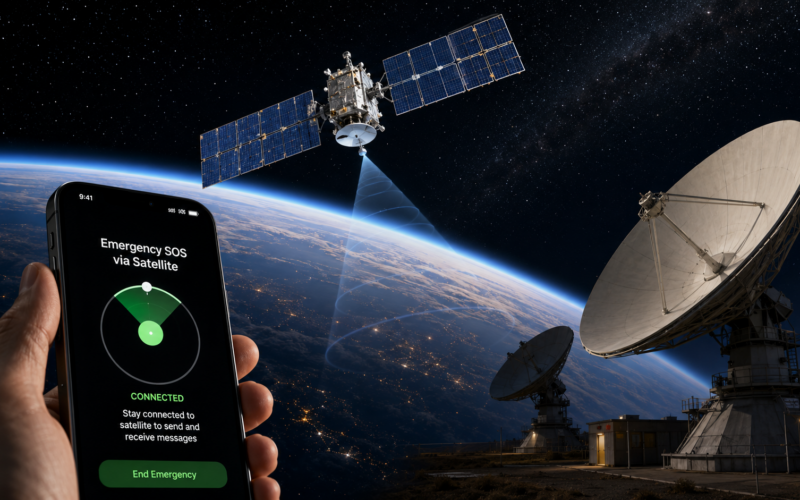
Globalstar (NASDAQ: GSAT) is the Covington, Louisiana-based satellite operator that emerged from quiet obscurity once the Apple iPhone Emergency SOS via satellite service revealed it as the underlying network, and has since become one of the most consequential M&A stories in space tech. On 13 April 2026, Amazon entered into a definitive merger agreement to acquire Globalstar from Thermo Funding II LLC and others for USD 10.9 billion, with each Globalstar share electing either USD 90 in cash or 0.3210 Amazon shares capped at USD 90 value. The agreement comes after months of sale exploration that started with a Bloomberg report in late October 2025 and ran through reported talks with SpaceX before Amazon emerged as the buyer. The next discrete catalysts are the regulatory review window, the resolution of Apple’s structural veto exposure as the 20 percent equity holder with 85 percent network capacity control, and the satellite construction milestones with MDA Space and SpaceX that underpin the Extended MSS Network build-out. For a retail investor landing on GSAT from a satellite, M&A, or Apple-ecosystem feed, the question is whether the USD 90 deal price actually closes.
What does Globalstar actually do and why does Amazon want the L-band spectrum?
Globalstar provides Mobile Satellite Services across the United States, Canada, Europe, Central and South America, and internationally through a low Earth orbit satellite constellation. The product portfolio spans Commercial IoT devices for asset tracking, utility meter monitoring, oil and gas asset monitoring, and rail and cargo container tracking, plus the consumer SPOT and Duplex two-way voice and data products. The customer base spans forestry, maritime, government, oil and gas, mining, leisure, emergency services, construction, and transportation sectors, with the company having been founded in 1993.
The strategic significance to Amazon runs through the spectrum portfolio rather than the legacy satellite services business. Globalstar holds licensed Band 53 and n53 mid-band terrestrial spectrum in the United States, plus L-band and S-band spectrum used for satellite operations. The combination is precisely what Amazon needs to advance its own LEO satellite buildout, internally referred to as Project Kuiper, with the spectrum giving Amazon a path to direct-to-device satellite connectivity that would compete head-on with SpaceX’s Starlink Direct to Cell service. The Globalstar in-orbit network and ground station infrastructure provide an operational starting point for what would otherwise be a multi-year clean-build for a hyperscaler entering satellite-to-cell.
The risk inside the standalone business is concentration. Apple-related wholesale capacity accounted for 66 percent of total revenue in Q1 2026, with the relationship covering the technical and commercial framework for Emergency SOS, iMessage, and Find My satellite services on iPhone. The customer concentration is what creates both the durability of the revenue line and the structural Apple veto exposure that now sits at the centre of the merger story.

How does the USD 10.9 billion Amazon merger agreement structure the deal economics?
The merger agreement signed on 13 April 2026 carries a headline enterprise value of USD 10.9 billion, with consideration payable in cash and Amazon stock. Each Globalstar stockholder will elect to receive either USD 90 in cash per share or 0.3210 shares of Amazon common stock, with the stock consideration capped at USD 90 per share in value. The structure gives shareholders the optionality of liquidity through the cash election or continued exposure to Amazon’s growth through the stock election, with the cap protecting against runaway Amazon appreciation that would otherwise tilt the consideration imbalance.
The agreement includes milestone-based adjustments capped at USD 110 million, which allows the consideration to flex modestly based on operational milestones that have not been publicly itemised in detail. The merger is subject to regulatory approvals, customary closing conditions, and Globalstar shareholder approval. The seller side of the transaction reflects the Thermo Funding II LLC ownership position alongside other equity holders, with the Thermo entity being the historical principal sponsor of the Globalstar restructuring.
The implication for retail investors is that the deal price establishes a clean reference point for any directional view on GSAT. A position taken at a meaningful discount to USD 90 is fundamentally a bet on the deal completing, while a position at a premium is functionally a bet on a higher competing offer emerging. The merger arbitrage spread between the recent quotes and the USD 90 reference is the closest the market gets to a probability-weighted forecast of deal completion.
Why does Apple’s 20 percent stake and 85 percent network capacity create veto risk?
The Apple position in Globalstar is structurally larger than the equity stake implies. Apple owns approximately 20 percent of Globalstar’s equity, but the operational arrangement gives Apple control of 85 percent of the network capacity through the wholesale capacity services agreement that underpins Emergency SOS, iMessage via satellite, and Find My via satellite on iPhone. The capacity control is what gives Apple structural leverage over any change of control transaction.
The veto risk runs through several legal and commercial mechanisms. First, the wholesale capacity agreement likely contains change-of-control provisions that would require Apple consent or could trigger termination rights. Second, the 20 percent equity position is large enough to materially affect any shareholder vote on the merger, with the threshold for shareholder approval typically a majority of outstanding shares. Third, the operational dependence of Apple’s iPhone satellite services on the Globalstar network gives Apple a regulatory and commercial interest in who ultimately controls the network operator.
The implication for the deal is that an Amazon acquisition without Apple’s consent or alignment is structurally extremely difficult to close. The market currently appears to be pricing some probability that Apple will either accept the Amazon ownership outcome, negotiate revised commercial terms, or strike a parallel deal that preserves Apple’s operational relationship with the Globalstar network under Amazon ownership. The most credible bear case for the deal completion is that Apple withholds consent and the merger does not close on the announced terms.
What does Project Kuiper need from Globalstar to compete with Starlink direct-to-device?
Amazon’s Project Kuiper is the planned LEO satellite broadband constellation that Amazon has been building out toward an operational deployment. The strategic gap that Globalstar fills is direct-to-device cellular connectivity using existing smartphone hardware, where Starlink Direct to Cell has been progressing through the T-Mobile partnership in the United States. Amazon needs both the spectrum to operate a direct-to-device service in major markets and the in-orbit operational infrastructure to commence service quickly rather than waiting for Project Kuiper to reach the constellation maturity required.
The Globalstar acquisition delivers both. The L-band and S-band spectrum gives Amazon a direct-to-device service capability across multiple major markets. The existing satellite constellation and ground infrastructure provide a transitional service capability while Project Kuiper continues to deploy. The Globalstar gateway footprint, ground stations in Brazil, South Korea, and Alaska, and the broader operational footprint compress what would otherwise be a multi-year build into a transaction.
The risk for the strategic rationale is that Apple’s continuing commercial use of the Globalstar network would compete with Amazon’s intended direct-to-device service offering on the same network. The resolution is either Apple retains exclusive use of a portion of the capacity, Amazon and Apple negotiate a coexistence framework, or the deal restructures to give Apple separate operational continuity. Each path has different economic and operational implications.
How did the Q1 2026 print and the FY2026 guidance frame the standalone GSAT business?
The Q1 2026 results, reported in early May 2026, gave a clean view of the standalone Globalstar business heading into the deal. Total revenue of USD 70.1 million was up from USD 60.0 million in the prior-year quarter, driven mainly by the wholesale capacity services line tied to the Apple relationship. Service revenue reached USD 66.7 million with Commercial IoT and government services both growing year over year. Operating income turned positive at USD 8.2 million versus an operating loss in the prior year.
The bottom line remained loss-making, with net loss of USD 17.4 million or USD 0.16 per share driven by higher interest expense and derivative losses. Cash and cash equivalents declined to USD 358.4 million from USD 447.5 million as the company funded heavy investment in new satellites and the Extended MSS Network. Total assets reached USD 2.38 billion with property and equipment of USD 1.43 billion, and total liabilities of USD 2.03 billion left stockholders’ equity at USD 342.8 million.
The full-year 2025 results, reported in February 2026, set the platform for the 2026 guidance. Revenue reached USD 273.0 million with record adjusted EBITDA of USD 136.1 million at a 50 percent margin. Adjusted free cash flow was USD 171.5 million. The 2026 guidance subsequently raised to USD 280 million to USD 305 million in revenue with approximately 50 percent adjusted EBITDA margin reflects continued growth in the wholesale capacity, Commercial IoT, and government services lines, supported by the ongoing rollout of the RM200M two-way satellite IoT module and the C-3 next-generation satellite system build-out.
What does the XCOM RAN private 5G platform add to the Globalstar growth story?
XCOM RAN is the private 5G platform that Globalstar acquired from Qualcomm in early 2025 and has progressively integrated into its enterprise networking portfolio. On 7 April 2026, the company launched the end-to-end private 5G solution combining XCOM Radio Series, XCOM Core, XCOM Orchestrator, and an XCOM Industrial Router for Industry 4.0 applications. The Supercell O-RAN architecture supports Band n48, n78, and the licensed Globalstar Band n53 for private deployments, with multi-tenant, multi-spectrum capabilities and a focus on rapid integration with partner hardware and industrial AI automation use cases.
The strategic significance is the convergence of Globalstar’s spectrum and satellite capabilities with terrestrial private 5G capability, which creates a hybrid network proposition for enterprise and government customers. The Virewirx Phase II SBIR contract from the Office of the Under Secretary of War on 24 February 2026, valued at USD 1.9 million, selected XCOM RAN as the technology partner for an advanced private 5G system for tough RF environments. A third-party benchmark reportedly indicated four times the throughput against Wi-Fi, distributed antenna systems, and small cells, validating the cooperative processing and self-organising features for mission-critical use.
The implication for retail investors is that XCOM RAN represents a separate revenue and earnings stream that is largely independent of the Apple wholesale capacity concentration. In a standalone Globalstar scenario, XCOM RAN deployments at industrial, defence, and enterprise customers would diversify the revenue mix and reduce the customer concentration risk. In an Amazon ownership scenario, XCOM RAN becomes a complementary capability inside the broader Amazon enterprise networking portfolio.
What is the regulatory timeline and what happens if the merger does not close?
The merger is subject to standard regulatory approvals including Hart-Scott-Rodino antitrust review in the United States, potentially CFIUS review given the satellite communications and national security adjacencies, and equivalent reviews in non-US jurisdictions where Globalstar operates significant infrastructure. The realistic closing window for a transaction of this size and complexity runs between six and twelve months from announcement, which would put the expected closing into the late 2026 or first half 2027 window.
The deal has several pathways to non-completion. Apple withholding consent or triggering rights under the wholesale capacity arrangement is the most material risk. A US antitrust pushback citing the consolidation of satellite and terrestrial connectivity capabilities under Amazon is a secondary risk, although the precedent for satellite operator consolidation has generally been permissive. A failure of Globalstar shareholders to approve the merger is a tertiary risk, with the Thermo Funding II controlling position likely making this risk lower.
The implication for retail investors is that the share price sensitivity to deal completion news is structurally elevated through the regulatory window. A position in GSAT at any discount to USD 90 is functionally a long position on deal completion, while a position at a premium prices an upward revision or a competing bid. If the merger fails to close on the announced terms, the share price would likely revert toward the pre-deal trading range of approximately USD 50 to USD 70, which is meaningfully below the current quote.
What are retail investors on X, Reddit and Stocktwits actually saying about GSAT today?
Retail conversation on GSAT has shifted decisively from the standalone Apple-partnership narrative to a merger arbitrage discussion. Cashtag threads on X frame GSAT as one of the cleanest defined-outcome trades in the satellite space, with the bull case anchored on the USD 90 cash deal price and the Amazon strategic logic, and the bear case anchored on the Apple veto risk. The conversation is unusually focused on legal and structural questions rather than operational or competitive ones.
On Reddit and Stocktwits the conversation has been more split. The bullish posts argue that Amazon would not have signed a definitive merger agreement without confidence in either Apple’s consent or a workable alternative resolution, that the USD 110 million milestone adjustment cap is small relative to the deal size, and that the merger closing probability is high. The cautious posts focus on the structural Apple leverage, the historical pattern of large M&A transactions facing regulatory delays, and the downside scenario where the deal does not close and the share price reverts substantially.
The implication for a retail investor framing a position is that GSAT is now functionally a merger arbitrage position rather than a fundamental satellite company position. The directional view is best framed as a probability assessment on deal completion within the announced terms, the time value of money over the regulatory window, and the downside scenario if completion fails. The next material information event will be either an Apple statement of position on the merger, a regulatory filing update, or a Q2 2026 earnings call commentary that addresses the closing timeline.
Key takeaways for GSAT retail investors weighing the Amazon merger arbitrage
- Amazon entered into a definitive merger agreement on 13 April 2026 to acquire Globalstar for USD 10.9 billion, with each share electing USD 90 cash or 0.3210 Amazon shares capped at USD 90 in value
- The merger is subject to regulatory approvals and includes milestone-based consideration adjustments capped at USD 110 million
- Apple holds approximately 20 percent of Globalstar’s equity and controls 85 percent of the network capacity through the wholesale capacity services agreement, creating structural veto risk
- Q1 2026 revenue of USD 70.1 million was up from USD 60.0 million, with Apple-related wholesale capacity accounting for 66 percent of revenue and operating income turning positive at USD 8.2 million
- FY2026 guidance of USD 280 million to USD 305 million in revenue with approximately 50 percent adjusted EBITDA margin reflects continued growth across wholesale capacity, Commercial IoT, government services, and the C-3 satellite system build-out
- The XCOM RAN private 5G platform launched on 7 April 2026 represents a separate revenue stream targeting industrial, defence, and enterprise customers
- A merger failure scenario would likely see the share price revert toward the pre-deal trading range of approximately USD 50 to USD 70, materially below the USD 90 deal reference
Discover more from Business-News-Today.com
Subscribe to get the latest posts sent to your email.