




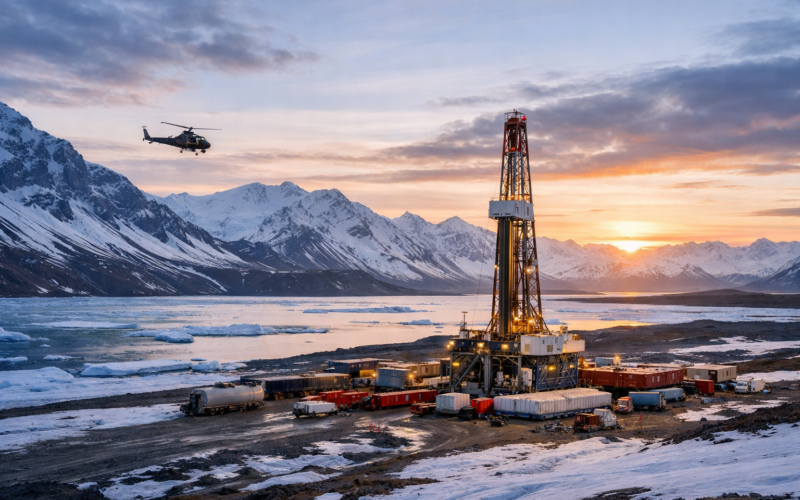
Greenland Energy Company (NASDAQ: GLND) is a freshly listed frontier oil explorer targeting the Jameson Land Basin in East Greenland, widely described as one of the largest undrilled onshore hydrocarbon basins on the planet. The company completed a SPAC merger with Pelican Acquisition Corporation on 25 March 2026 and began trading on the Nasdaq the following day, opening to a flurry of retail investor attention driven by a resource estimate of up to 13 billion barrels of recoverable oil, a Halliburton drilling services agreement, and a geopolitical backdrop amplified by US President Donald Trump’s public interest in Greenland. The next major catalyst is the spud of the first exploration well in the Jameson basin, targeted for the second half of 2026. Everything between now and that moment is logistical, and the pieces are moving faster than many investors expected.
What exactly does Greenland Energy Company do and why is the Jameson Land Basin significant?
Greenland Energy Company is an upstream oil exploration business incorporated in Texas and focused entirely on the Jameson Land Basin, a roughly 8,429 square kilometre concession area spread across three onshore licences in East Greenland. The company holds the right to earn a 70% interest in the project by funding 100% of the cost of drilling two exploration wells. The remaining 30% is retained by 80 Mile PLC, the AIM-listed vehicle of White Flame Energy A/S, which originally held the licences.
The basin has been described by geologists as one of the most prospective undrilled hydrocarbon provinces in the world. Major oil company ARCO invested the equivalent of more than USD 275 million in today’s dollars to evaluate Jameson during the 1980s, following its discovery of the Prudhoe Bay field in Alaska. ARCO’s work included 1,800 kilometres of 2D seismic acquisition, detailed field mapping, and the construction of the Constable Point Airfield, which remains an operational piece of infrastructure in the region.
An independent prospective resources report prepared in 2025 by US-based petroleum consultants Sproule ERCE estimated gross un-risked recoverable prospective resources of approximately 13.03 billion barrels of oil at the P10 level across 58 identified prospects and leads within the basin. The report was prepared in accordance with the Petroleum Resources Management System (PRMS 2018) framework. Sproule’s findings rank Jameson among the most significant untested hydrocarbon provinces globally, with geological comparisons drawn to mature North Sea assets.
It is important to read that figure correctly. A P10 prospective resource is not a reserve or a contingent resource. It represents the high-side estimate of what could theoretically be recoverable if drilling confirms the geological model, before any commercial assessment has been made. The figure captures the scale of the prize if the basin performs as the seismic data suggests, not a number investors should bank on without the drill bit confirming it.
How did the Pelican SPAC merger bring Greenland Energy to the Nasdaq and what does the structure mean for shareholders?
Greenland Energy Company came to market through a business combination with Pelican Acquisition Corporation, a blank-cheque special purpose acquisition company that had been listed on the Nasdaq under the ticker PELI. Pelican’s shareholders approved the merger at an extraordinary general meeting on 19 March 2026, and the combined entity began trading as GLND on 26 March 2026. ThinkEquity LLC served as financial adviser throughout the transaction.
The business combination valued the company at USD 215 million at the implied listing price, giving GLND a market capitalisation in the USD 218 to 345 million range across its first days of trading. With approximately 12 million shares outstanding, GLND sits in micro-cap territory by Nasdaq standards, which contributes to the elevated price volatility investors have observed in the first trading week. On its opening day the stock surged well above its listing reference, pulled back sharply, and then swung again on the announcement of the Stampede Drilling agreement on 27 March 2026.
The SPAC structure means the company carries no operating history as a publicly traded entity and has generated no revenue from production. Its current value is entirely driven by the prospective resource base and the probability the market assigns to successful drilling. That places GLND firmly in the speculative exploration category, alongside other frontier plays where the stock price is essentially a call option on geological success.
What does the Stampede Drilling agreement mean for the 2026 well campaign and when is the first well expected to spud?
On 27 March 2026, just two days after completing its Nasdaq listing, Greenland Energy announced a five-year strategic drilling agreement with Stampede Drilling Inc., a Calgary-based contract driller listed on the Toronto Stock Exchange under SDI. The agreement secures Stampede’s Rig 12, which has been configured for Arctic operating conditions, along with Stampede’s technical crews and personnel. The market responded with a 33% premarket surge in the GLND share price when the news crossed.
Under the terms of the deal, two boreholes of 3,500 metres each are planned for the second half of 2026. Both wells will be drilled within the Jameson Project area under the joint venture structure with 80 Mile. Greenland Energy will fund 100% of the drilling costs to earn its 70% interest, with the first well representing the most significant near-term binary event for shareholders. The company has separately secured Halliburton for drilling services and engaged Canadian shipping company Desgagnes to transport heavy equipment to East Greenland under an arrangement coordinated with Royal Arctic Line, Greenland’s state-owned coastal shipping operator.
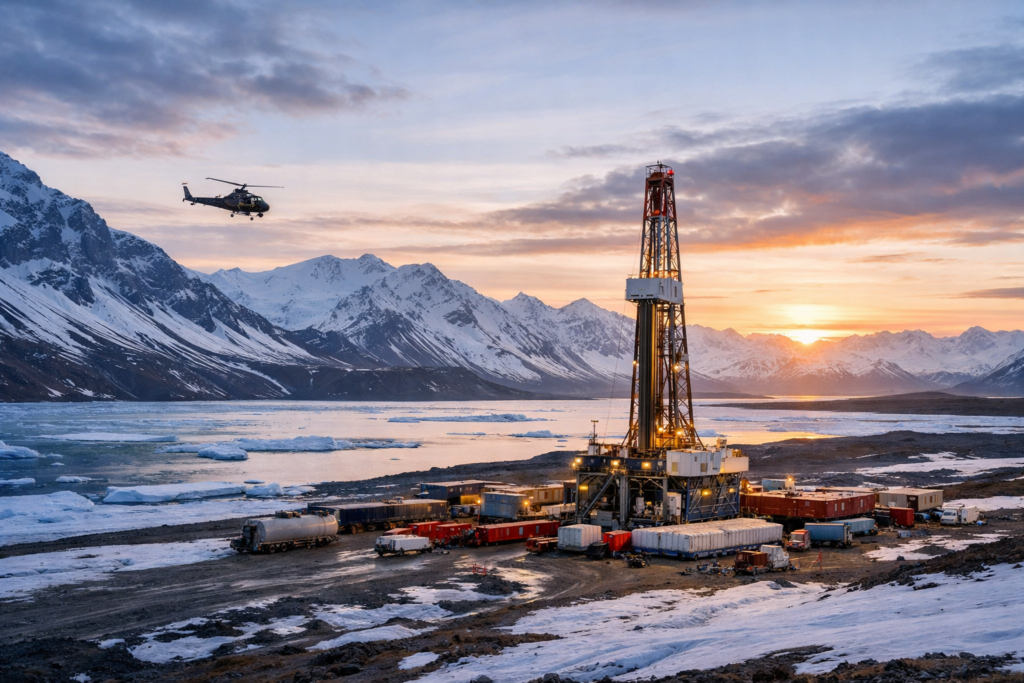
The Greenland Government has already approved the mobilisation of heavy equipment to the site, including bulldozers, trucks, and housing units. Company disclosures confirm that equipment has been delivered to East Greenland and a three-mile access road to the drilling location is scheduled for construction once the equipment is offloaded. With logistics, rig, and services contracts now in place, the critical path to the spud date in H2 2026 is primarily weather and Arctic access season, which opens through the northern summer.
Why does the geopolitical backdrop around Greenland and US energy policy matter for GLND investors right now?
The timing of GLND’s Nasdaq listing sits at an unusually charged intersection of US foreign policy and energy security. President Trump has repeatedly and publicly called for the annexation of Greenland on national security and strategic resource grounds, citing the island’s location relative to Arctic shipping lanes and its potential hydrocarbon and mineral wealth. While Greenland’s government and the Kingdom of Denmark have firmly rejected any transfer of sovereignty, the debate has focused global capital markets attention on Greenland’s energy and resource assets in a way that no amount of company marketing could replicate.
For Greenland Energy specifically, the geopolitical noise is a double-edged backdrop. On the positive side, the narrative of US-linked resource development in the Arctic aligns with broader themes of energy security and Western supply chain diversification that have attracted institutional attention across the energy sector. The company’s own press materials describe the Jameson project as contributing to global energy security, a framing that resonates with current US policy sentiment. Larry G. Swets, Jr., who serves as Executive Chairman of the combined company, brings a capital markets and international background that positions GLND to access that narrative effectively.
On the risk side, Greenland’s government operates under a moratorium on offshore oil exploration, and analysts have noted the careful distinction the company makes between onshore licence activity, which remains permitted, and offshore activity, which does not. The moratorium was introduced as part of Greenland’s climate commitments, and the fact that exploration licences were extended despite the moratorium has drawn commentary from energy analysts who see it as a signal of pragmatic resource governance rather than ideological prohibition. Regulatory risk nonetheless remains a real consideration for any investor building a position.
How is the market currently pricing GLND stock relative to the scale of the resource and what are the comparable frontier explorers?
GLND opened trading at a market capitalisation of around USD 215 to 345 million depending on which day’s close is used as the reference point. Volatility has been significant in the first week, with the 52-week range spanning from USD 7.10 to USD 23.00 and single-day swings of 25% to 37% in both directions. That kind of price action is entirely normal for a freshly listed micro-cap exploration play with no revenue, no production, and a binary catalytic event on the horizon.
On a notional valuation basis, Sproule ERCE’s P10 estimate of 13.03 billion barrels of gross un-risked prospective resource implies that GLND is being priced at somewhere between USD 0.02 and USD 0.03 per barrel of un-risked resource at current market capitalisation levels. That is broadly consistent with how frontier exploration plays are priced before the drill bit reaches the target, where the market applies a steep probability discount to the resource figure. For comparison, 80 Mile PLC’s retained 30% interest in Jameson was notionally valued at approximately USD 104 million at GLND’s close on its first day, against a full-earn-in GLND valuation of roughly USD 345 million.
The question retail investors are pricing in real time is what probability they assign to commercial hydrocarbon discovery. If the first well encounters oil shows that match the seismic model and confirm the structural integrity of the basin, the resource narrative shifts dramatically from speculative to contingent, and re-rating potential is material. If the well is dry or encounters unexpected geological complexity, the stock will face significant downward pressure regardless of the scale of the undrilled inventory. That binary risk profile is what defines frontier exploration investing.
What are the execution risks between now and the H2 2026 spud date that retail investors should understand clearly?
Arctic logistics are the most immediate operational risk. Jameson Land Basin is a remote onshore location in East Greenland accessible only during a narrow seasonal window defined by sea ice conditions and weather. The construction of the three-mile access road to the drill site is a prerequisite for rig mobilisation, and any delays in equipment delivery, weather-related disruptions, or complications with the Royal Arctic Line logistics chain could push the spud date from early H2 2026 into late in the year or even into 2027. The company has been explicit that the campaign is targeted for H2 2026 but has not provided a specific spud date.
Financing is a second consideration. The company has disclosed that Greenland Energy will fund 100% of drilling costs to earn its 70% interest, but has not published a detailed cost estimate for the two-well programme in its public materials at this stage. Frontier Arctic drilling is materially more expensive than conventional onshore programmes due to logistics, mobilisation, and the technical requirements of operating in extreme cold. Retail investors should monitor any future financing announcements, particularly equity raises, which would be dilutive to existing shareholders.
Geological risk remains the central unknown. The Sproule ERCE report identifies 58 prospects and leads, which indicates significant geological complexity and the presence of both larger and smaller targets within the basin. The selection of the initial well location and the quality of the seismic data used to high-grade that location are factors that will not be fully visible to retail investors before drilling commences. ARCO’s historic work, while extensive for its era, was conducted decades before modern seismic reprocessing techniques were applied to the dataset.
Finally, GLND carries standard SPAC-era risks including potential dilution from warrants issued as part of the Pelican Acquisition structure, limited trading history, and the concentration risk that comes with a single-asset exploration company where the entire investment thesis rests on one geological basin.
Why are retail investors following GLND on Twitter and forums and what is the community thesis behind the stock?
GLND has attracted immediate retail investor interest across financial social media primarily because it combines several narratives that travel well online: a multi-billion-barrel resource headline, a Trump-era geopolitical angle on Greenland, a SPAC-to-Nasdaq listing story, and the inherent drama of Arctic frontier exploration. The stock has been trending on Twitter/X under both the GLND cashtag and Greenland-related geopolitical discussions since its listing week, with volume on its first days of trading reaching nearly eight million shares, unusual for a micro-cap company with fewer than 12.5 million shares outstanding.
The community thesis, broadly stated, is that GLND represents a low-float, high-headline-risk exploration play where even a modest upgrade in the market’s probability assessment of drilling success could produce outsized price moves given the relatively small market capitalisation. The parallel AIM listing of 80 Mile PLC under the ticker 80M gives international investors a second instrument to track the same asset, and several commentators on social platforms have flagged the implied valuation gap between the two instruments as a point of ongoing interest.
It is worth noting that high social media engagement and retail community interest in a micro-cap exploration stock is a factor that influences price volatility rather than a fundamental signal. The stock will ultimately be judged on what comes out of the drill hole in East Greenland, not on forum sentiment. Community interest can create entry and exit liquidity for traders, but it does not change the geological or financial fundamentals of the Jameson basin.
What does the milestone timeline from listing to first well results look like for shareholders tracking GLND?
The sequence between GLND’s Nasdaq debut and the first well result spans approximately six to nine months depending on logistics and weather. The key steps are as follows. Equipment has already been delivered to East Greenland and government approval for heavy equipment mobilisation is in place. Construction of the three-mile access road to the drill pad is the first operational milestone on the critical path. Once the road is complete, Stampede’s Rig 12 will need to be transported and assembled at the site, a process that involves both the Desgagnes shipping arrangement and ground-based logistics.
First spud of the initial 3,500-metre well is targeted for H2 2026, with the Arctic access season typically running from approximately July through to October depending on sea ice and weather conditions. Drilling a vertical well of that depth in frontier Arctic conditions is likely to take several weeks to a few months depending on encountered formations. The company will be required to file regulatory disclosures as material events occur, meaning shareholders should track SEC filings alongside any company press releases for operational updates.
If the first well delivers positive hydrocarbon results, the next decision point will be whether to proceed to the second well under the five-year Stampede agreement or to pause for further evaluation and potential partner engagement. A discovery would trigger a formal resources reclassification process with an independent competent person’s report required before any contingent resource statement could be made. That process typically takes several months after drilling completion, meaning a definitive resource upgrade following a discovery is a 2027 event at the earliest.
Key takeaways for retail investors watching Greenland Energy Company (NASDAQ: GLND)
- Greenland Energy Company (NASDAQ: GLND) completed a SPAC merger with Pelican Acquisition Corporation on 25 March 2026 and began trading the following day, targeting the Jameson Land Basin in East Greenland with a 70% earn-in interest across approximately 2 million acres.
- An independent 2025 assessment by Sproule ERCE estimated 13.03 billion barrels of gross un-risked recoverable prospective resources at P10 across 58 prospects in the basin. This is a high-side pre-drill estimate and not a reserve or contingent resource figure.
- The company has locked in a five-year drilling agreement with Stampede Drilling for Arctic-capable Rig 12, with a two-well campaign targeting 3,500-metre boreholes in H2 2026. Halliburton and Desgagnes have also been engaged for services and logistics respectively.
- The next major catalyst is the spud of the first Jameson well, expected in the second half of 2026 subject to Arctic access season conditions and logistics completion. That event is the binary inflection point for the investment thesis.
- Key risks include Arctic logistical complexity, the cost burden of 100% drilling carry without a publicly disclosed budget, SPAC dilution from warrants, and the geological uncertainty inherent in any frontier exploration programme before the drill result.
- The geopolitical backdrop of Trump-era US interest in Greenland’s resources has amplified the stock’s social media profile, but does not reduce geological risk. GLND trades as a speculative frontier exploration play where the share price reflects probability-weighted expectations of drilling success rather than any current production or revenue.
- 80 Mile PLC (AIM: 80M) retains a 30% free-carried interest in Jameson, offering a parallel instrument through which investors can track the same asset on the London market.
Discover more from Business-News-Today.com
Subscribe to get the latest posts sent to your email.
