

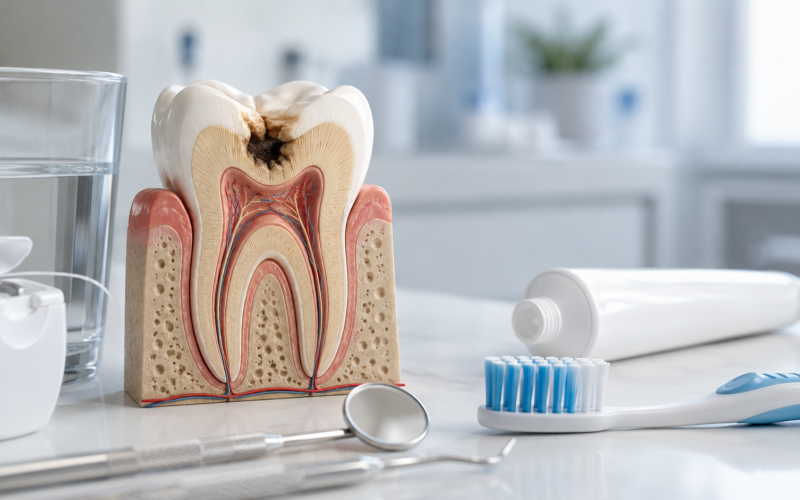
Tooth decay can begin quietly with a small area of weakened enamel and progress into a cavity, toothache, infection and even a dental abscess if it is allowed to advance. Also known as dental caries, tooth decay is one of the most common oral health problems and can affect children, teenagers, adults and older people.
The encouraging part is that dental caries is largely preventable, and very early enamel damage may sometimes be stopped or partly reversed before a permanent cavity forms. Good brushing habits, fluoride exposure, sensible eating patterns and regular dental examinations can significantly reduce the likelihood that decay will progress.
Tooth decay does not develop simply because a person eats chocolate or forgets to brush once. It results from a repeated biological process involving bacteria in dental plaque, fermentable carbohydrates such as sugars and starches, acids, saliva and the mineral structure of the tooth.
When bacteria metabolize sugars, they produce acids that temporarily lower the pH around the tooth surface. Repeated acid attacks gradually remove minerals from enamel. If mineral loss becomes greater than the repair provided by saliva and fluoride, the enamel can break down and a cavity may eventually form.
Understanding how dental caries develops is important because treatment becomes more complicated as decay moves deeper into the tooth. A small early lesion may need preventive management, while advanced disease can require a filling, root canal treatment or, in severely damaged teeth, extraction.
What is tooth decay and how does dental caries gradually damage the enamel and deeper tooth tissues?
Tooth decay is a disease process in which acids produced by bacteria contribute to the progressive loss of minerals from the hard tissues of the tooth. The outermost layer, known as enamel, is highly mineralized and protects the more sensitive structures underneath.
Decay frequently begins with microscopic changes rather than an obvious hole. An early lesion may appear as a white, chalky area where enamel has lost minerals. Dark discoloration can also occur, but a black spot does not automatically prove that active tooth decay is present. Dentists assess the appearance, texture, location and sometimes dental imaging before deciding whether a lesion requires treatment.
When mineral loss continues, the enamel can eventually collapse and create a cavity. Decay may then extend into dentine, the softer tissue located underneath the enamel.
Dentine contains microscopic tubules that communicate more closely with the inner portion of the tooth. Once decay reaches this layer, sensitivity to cold, heat, sweets or pressure can become more noticeable.
If the disease progresses still further, bacteria and inflammation may affect the pulp, which contains nerves, blood vessels and connective tissue. At this stage, pain can become severe and treatment becomes more complex.
What causes tooth decay and how do dental plaque, bacteria, sugars and starches interact in the mouth?
Dental caries develops through an interaction between susceptible teeth, microorganisms, fermentable carbohydrates and time.
The mouth naturally contains a large and diverse community of microorganisms. Many are harmless or even contribute to a balanced oral environment. Problems arise when conditions repeatedly favor acid-producing bacteria within dental plaque.
Dental plaque is a sticky microbial biofilm that forms on tooth surfaces. It is not simply food debris. Bacteria attach to the tooth and become embedded within a complex matrix containing bacterial products, proteins and other substances.
Bacteria associated with dental caries include organisms such as Streptococcus mutans, although modern research shows that decay involves communities of microorganisms rather than one bacterial species alone.
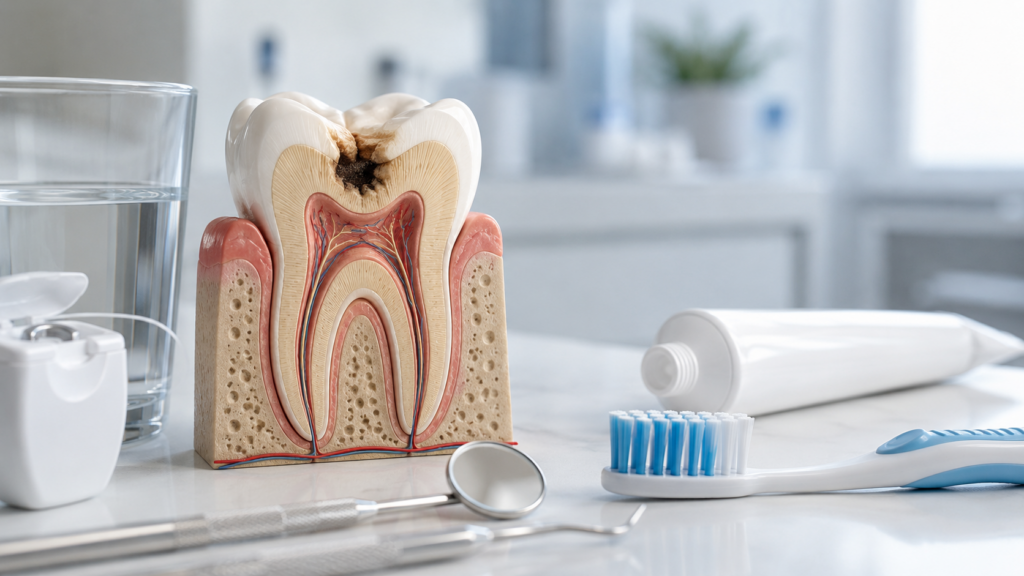
When a person consumes fermentable carbohydrates, particularly free sugars, plaque bacteria metabolize them and produce organic acids. These acids lower the pH at the enamel surface and encourage minerals such as calcium and phosphate to leave the tooth.
The frequency of sugar exposure can be especially important. Continually sipping sugary drinks or repeatedly snacking on sweets throughout the day can subject teeth to numerous episodes of acid production.
Starchy foods can also contribute when they are broken down into fermentable carbohydrates and remain around the teeth, particularly when combined with added sugars.
How does dental plaque produce acid and why can repeated sugar exposure eventually create cavities in teeth?
After sugary or fermentable carbohydrate-containing food enters the mouth, plaque bacteria begin using those carbohydrates as an energy source. Acid is produced as a metabolic by-product.
The resulting fall in plaque pH changes the environment surrounding the enamel. When conditions become sufficiently acidic, minerals start dissolving from the tooth surface in a process called demineralization.
Fortunately, teeth are not continuously losing minerals. Saliva helps neutralize acids, washes away food particles and supplies calcium and phosphate that can support remineralization.
Fluoride also strengthens this protective process by helping the tooth surface become more resistant to future acid attacks.
Problems develop when acid-producing episodes occur too frequently or last for prolonged periods. The tooth does not receive enough time to recover between attacks, and cumulative mineral loss can exceed remineralization.
This is why the pattern of eating and drinking can matter almost as much as the total quantity of sugar consumed. Frequent grazing on sugary snacks may maintain an acidic environment for longer periods than consuming a similar amount as part of a meal.
What are the early warning signs of tooth decay before a painful dental cavity develops?
Early tooth decay may cause no pain at all. This is one reason regular dental examinations are important.
An initial enamel lesion may appear as a white or chalky area, particularly near the gum line or in places where plaque accumulates. Some lesions become brown or darker over time.
Once a true cavity develops, the tooth surface may become visibly damaged or rough. Food may repeatedly become trapped in the affected area.
Sensitivity is another common symptom. A person may experience discomfort when consuming cold drinks, hot foods or sweets. Sensitivity does not always indicate decay, however, because gum recession, enamel wear and other dental conditions can produce similar sensations.
As caries progresses deeper into dentine, sensitivity can become stronger or last longer. Toothache may develop spontaneously or occur during chewing.
Persistent pain, swelling or severe tenderness suggests that the condition may have progressed beyond a small uncomplicated cavity and should be assessed promptly.
Why do some cavities develop between teeth or inside pits and fissures where they are difficult to see?
Not every cavity appears on an easily visible front surface of a tooth. Dental caries often develops in areas where plaque can accumulate and cleaning is difficult.
The chewing surfaces of molars contain natural grooves known as pits and fissures. Food particles and plaque can collect within these narrow spaces, making them particularly vulnerable to decay.
Areas between adjacent teeth are another common location. A toothbrush may not clean these surfaces adequately on its own, which is why interdental cleaning can be important.
Decay can also develop around the margins of existing restorations if plaque accumulates or a restoration deteriorates.
Older adults may experience root caries when gum recession exposes the tooth root. Root surfaces are less mineralized than enamel and can therefore be more susceptible to acidic damage.
Because many of these sites are difficult to inspect at home, a tooth may appear normal while decay is developing in a hidden area.
Can an early stage of tooth decay be reversed before a permanent cavity forms in the enamel?
One of the most important developments in modern understanding of dental caries is recognition that early mineral loss does not always have to progress into an irreversible cavity.
When the enamel surface remains intact, early demineralization may sometimes be arrested or partly reversed through remineralization.
Fluoride plays a major role in this process. Fluoride toothpaste exposes tooth surfaces to fluoride regularly, helping strengthen enamel and making it more resistant to acid attack.
Saliva is equally important because it neutralizes acids and supplies minerals required for repair.
Reducing the frequency of sugary foods and drinks gives saliva more opportunity to restore a healthier oral environment between meals.
Once the enamel has physically collapsed and a true hole has formed, however, the lost tooth structure cannot simply grow back. Dental restoration may then be necessary.
The distinction between early mineral loss and an established cavity is one reason dentists increasingly focus on detecting caries before extensive drilling and restoration become necessary.
How are dental cavities treated and when does a decayed tooth usually require a filling or restoration?
Treatment depends on how far the decay has progressed.
Very early lesions without physical cavitation may sometimes be managed using fluoride, dietary modification, improved plaque control and professional monitoring.
When decay has produced a cavity that cannot be predictably cleaned or remineralized, the damaged portion of the tooth may need to be removed or otherwise managed and the area restored.
Modern dental fillings can be made from several materials. Tooth-colored composite resin is widely used, while other restorative materials may be selected depending on the location, size of the cavity, bite forces, moisture control and individual clinical circumstances.
The purpose of a restoration is not merely cosmetic. It helps restore tooth shape and function while creating a surface that can be maintained more effectively.
No filling lasts forever, which means preventing new disease around restored teeth remains important even after treatment has been completed.
What happens when untreated tooth decay reaches the pulp and causes severe pain or infection?
The pulp lies at the center of the tooth and contains nerves, blood vessels and connective tissue. When decay progresses sufficiently deeply, bacterial irritation can trigger inflammation within this confined space.
Early pulp inflammation may sometimes produce sensitivity that disappears after the stimulus is removed. More advanced inflammation can cause spontaneous pain, prolonged sensitivity or severe throbbing toothache.
If the pulp becomes irreversibly inflamed or dies, bacteria may spread through the root canal system toward tissues surrounding the root.
An infection can then develop around the root tip and may eventually produce a dental abscess.
At this stage, symptoms may include severe toothache, tenderness during biting, gum swelling, facial swelling, unpleasant taste or drainage.
Not every painful tooth follows exactly the same progression, which is why clinical examination and dental imaging may be necessary to determine the underlying problem.
What is a dental abscess and when can untreated tooth decay become a serious health problem?
A dental abscess is a localized collection of pus associated with bacterial infection. An abscess related to tooth decay can form when infection originating in the pulp spreads through the root and into surrounding tissues.
Severe tooth decay is not normally life-threatening when treated appropriately, but untreated dental infections can occasionally spread beyond the immediate tooth.
Facial swelling, fever, difficulty swallowing, difficulty breathing or rapidly increasing swelling requires urgent medical or dental attention.
An abscess should not be managed simply with painkillers while the underlying tooth is ignored.
Antibiotics may be required in certain circumstances, particularly when infection is spreading or systemic symptoms are present, but antibiotics alone do not repair a severely decayed tooth or remove infected pulp.
The source of the infection usually needs definitive dental treatment.
How does root canal treatment save a tooth when decay or infection has reached the dental pulp?
Root canal treatment is used when the pulp becomes irreversibly inflamed, infected or necrotic but the tooth can still be restored and retained.
During treatment, the dentist gains access to the internal root canal system and removes infected or damaged pulp tissue. The canals are cleaned, shaped and disinfected before being filled and sealed.
The tooth then requires an appropriate restoration to protect it and restore function. Depending on how much tooth structure has been lost, this may involve a filling, an onlay or a crown.
Older descriptions sometimes suggest that root canal treatment always requires four or five days or several appointments. Modern treatment varies considerably. Some cases can be completed in one visit, while complex infections or difficult anatomy may require multiple appointments.
The duration depends on the tooth, degree of infection, root anatomy and clinical circumstances rather than a fixed number of days.
How should you brush your teeth to prevent dental caries without damaging enamel or gums?
Brushing twice daily with fluoride toothpaste remains one of the most effective habits for preventing tooth decay.
The goal is to clean all accessible tooth surfaces and remove plaque without applying excessive force.
Older advice sometimes recommends brushing in the “opposite direction” of the teeth, but modern oral hygiene guidance focuses more on systematically reaching the gum line and all tooth surfaces with gentle, controlled movements.
Aggressive horizontal scrubbing can injure gums and contribute to wear around the neck of the tooth.
A soft-bristled toothbrush is suitable for most people. Electric toothbrushes can also be effective when used correctly.
Brushing before bedtime is particularly important because salivary flow decreases during sleep, reducing some of the mouth’s natural protective effects.
After brushing with fluoride toothpaste, repeatedly rinsing the mouth with large amounts of water may wash away fluoride. Allowing a small amount of fluoride to remain around the teeth can extend its protective effect.
Why is cleaning between the teeth important when a toothbrush cannot reach every plaque-filled surface?
Toothbrush bristles cannot reliably clean every surface between adjacent teeth.
Plaque can remain in these spaces and contribute to both dental caries and gum disease.
Dental floss, interdental brushes or other appropriate interdental cleaning devices can help remove plaque from areas inaccessible to ordinary brushing.
The most suitable method depends on the size of the spaces, alignment of the teeth, presence of orthodontic appliances and individual dexterity.
People with braces, bridges or certain dental restorations may require specialized cleaning techniques.
Interdental cleaning should therefore be regarded as a complement to brushing rather than an optional replacement for it.
How do sugary snacks, sticky foods and sweet drinks increase the risk of developing tooth decay?
Sugar itself does not drill a hole directly into enamel. The problem arises because plaque bacteria metabolize fermentable carbohydrates and produce acids.
Sticky sweets can remain in contact with tooth surfaces for prolonged periods, while sugary beverages can repeatedly bathe teeth in fermentable carbohydrates.
Frequent sipping may be particularly harmful because each exposure can initiate another acidic episode.
The same concern applies to apparently healthier products containing substantial free sugars, including some fruit drinks, sweetened teas, energy drinks and flavored beverages.
Reducing the frequency of sugar intake is therefore an important preventive measure.
Eating sugary foods as part of a main meal is generally less damaging than repeatedly consuming them throughout the day because saliva production during meals helps with clearance and neutralization.
Water remains one of the most tooth-friendly everyday beverages.
How can fluoride toothpaste, dental sealants and regular dental visits reduce the risk of cavities?
Fluoride is one of the most important tools available for preventing dental caries.
Regular exposure through appropriately formulated toothpaste helps reduce enamel mineral loss and encourages remineralization of early lesions.
Dentists may recommend additional fluoride treatments for people at higher risk of decay.
Dental sealants can provide another layer of protection, especially on the chewing surfaces of molars. A sealant is applied over vulnerable pits and fissures, creating a smoother barrier that makes it harder for plaque and food to accumulate within deep grooves.
Regular dental examinations allow early lesions to be identified before pain develops. The appropriate interval between check-ups varies according to an individual’s oral health and risk factors rather than following one schedule for everyone.
Preventive dentistry is particularly effective because early management is usually simpler, less invasive and less expensive than treating advanced decay.
What should you remember about preventing tooth decay and protecting your teeth throughout life?
Tooth decay is a dynamic disease caused by repeated imbalance between acid-driven mineral loss and the natural repair mechanisms of saliva and fluoride.
The process can begin before a visible cavity appears, which means waiting for toothache is not an effective approach to dental health.
Brushing twice daily with fluoride toothpaste, cleaning between the teeth, limiting frequent sugar exposure and attending appropriate dental examinations can substantially reduce the risk of cavities.
A small area of early enamel demineralization may sometimes be controlled before it becomes a hole. Once a cavity progresses into deeper tooth structures, restorative treatment becomes more likely.
Allowing decay to reach the pulp can result in severe pain, infection and dental abscess, potentially requiring root canal treatment or extraction.
Healthy teeth also contribute to far more than an attractive smile. Comfortable chewing supports nutrition, pain-free teeth support sleep and concentration, and maintaining natural teeth can improve quality of life throughout adulthood.
The most effective strategy is therefore not to wait until a tooth starts hurting. Dental caries is easiest to manage when prevention and early detection come first, making everyday oral hygiene one of the simplest long-term investments in overall health.
Discover more from Business-News-Today.com
Subscribe to get the latest posts sent to your email.