


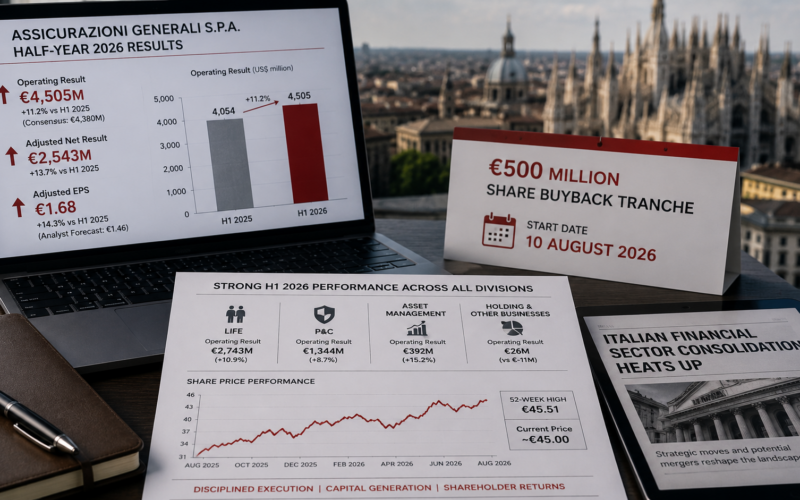
Assicurazioni Generali S.p.A. (BIT: G), Italy’s largest insurer, delivered a broad first-half 2026 beat on Thursday 6 August 2026 and set an €500 million share buyback tranche to begin on 10 August 2026. Chaired by Andrea Sironi, the board approved half-year numbers showing operating result up 11.2% to €4,505 million against a company-collected consensus of €4,380 million, adjusted net result up 13.7% to €2,543 million, and adjusted earnings per share up 14.3% to €1.68 versus a €1.46 analyst forecast. The immediate strategic tension is not whether Philippe Donnet’s team executed, but whether Generali shares, hovering just below the 52-week high of €45.51 and enmeshed in a broader Italian financial consolidation battle, can still re-rate on top of a fully priced-in operational story.
What did Assicurazioni Generali actually deliver in the first half of 2026 to justify the earnings beat call?
Gross written premiums rose 5.8% on a reported basis to €53.4 billion, with the Life segment up 5.5% to €33.45 billion and Property and Casualty up 6.3% to €20 billion. Life net inflows reached €8.3 billion, a record for any first half in Assicurazioni Generali’s history and up 33.9% on the prior period, and New Business Value climbed 21.1% to €1,890 million on a New Business Margin of 5.86%. On a standalone second-quarter basis, the operating result advanced 14.5% year on year to €2.3 billion. Reported net result climbed 17.9% to €2,538 million, close to identical to the adjusted figure and signalling limited one-off distortion this half.
Group Chief Executive Officer Philippe Donnet framed the numbers as evidence that the “Lifetime Partner 27: Driving Excellence” strategic plan is running well ahead of the guidance envelope, with management now internally comfortable that the medium-term targets can be exceeded even without a formal upgrade. Group Chief Financial Officer Cristiano Borean pointed to broad-based contribution across every segment rather than any single tailwind.

How does the €4,505 million operating result break down across Life, Property and Casualty and Asset and Wealth Management?
Life delivered an operating result of €2,194 million, up 8.8%, supported by traditional savings inflows in Asia rising 57.8% year on year and steady contributions from Germany and Central and Eastern European markets. The €1.89 billion New Business Value figure is particularly meaningful because it was struck on higher volume alongside an expanded margin, rather than one at the expense of the other. Property and Casualty produced an operating result of €2,141 million, up 4.7%, but with a Combined Ratio at 91.5%, deteriorating half a percentage point from the prior-year comparable and reflecting a step-up in natural catastrophe losses. The undiscounted Combined Ratio, which strips out the benefit of claims discounting, stood at 93.8%.
Asset and Wealth Management was the segment that most decisively over-delivered, with the operating result up 31.3% to €735 million. Within that, Asset Management contributed €334 million, up 17.3%, while Wealth Management, driven by Banca Generali, rose 45.8% to €401 million on the back of performance fees of €126 million against €42 million in the first half of 2025. The Holdings and other activities segment recorded a €276 million operating loss, narrowed slightly from €280 million the year before.
Why does the €8.3 billion Life net inflows figure matter more than the headline gross premium growth?
Gross written premium is a top-of-funnel metric heavily influenced by product mix and mark-to-market savings dynamics. Net inflows are the metric that captures whether policyholders are actually leaving money with Assicurazioni Generali after surrenders, lapses and maturities. The 33.9% jump to €8.3 billion is therefore a stronger signal than the 5.5% Life gross written premium growth and, combined with the 21.1% rise in New Business Value, points to a Life franchise adding real economic value rather than simply cycling capital through the balance sheet. It also comes off a base of €13.5 billion full-year 2025 inflows, meaning first-half 2026 has already collected roughly 62% of the prior full year in six months.
The New Business Margin at 5.86% remains comfortably inside the roughly 6% strategic target range, and management flagged during the analyst call that it would accept a marginally lower margin if that trade-off drove absolute New Business Value higher. That is the disciplined signal shareholders will want to see calibrated at the 18 November 2026 investor day in London.
What does the 91.5% Combined Ratio and the natural catastrophe drag tell investors about Property and Casualty pricing power?
Natural catastrophe losses consumed 3.6 percentage points of Assicurazioni Generali’s Property and Casualty Combined Ratio in the first half of 2026, more than double the 1.7 point drag in the first half of 2025. The current-year attritional loss ratio actually improved to 64.3%, and prior-year reserve development contributed a favourable minus 3.3 points, so the deterioration is a catastrophe story rather than an underwriting-quality story. Non-motor gross written premiums rose 5.8% and motor premiums rose 6.0%, with Germany and Central and Eastern Europe leading motor.
Management flagged that it will reinforce a flexible approach to tariff adjustments in Property and Casualty given the rising frequency of natural catastrophe events. This is a notable pricing signal because it comes against a broadly softening commercial property market where the Marsh Global Insurance Market Index has recorded eight consecutive quarters of rate declines, with second-quarter 2026 global commercial property rates down 12%. Assicurazioni Generali is telling brokers, in effect, that its rate stance on catastrophe-exposed non-motor lines is decoupling from the wider soft market.
How does the €500 million share buyback fit alongside the 216% Solvency II ratio and the November investor day?
The new €500 million buyback tranche will begin on 10 August 2026 and complete during the second half of 2026, with the shares purchased to be cancelled. It sits under the ongoing shareholder-return architecture of the Lifetime Partner 27 plan, which has already delivered a €500 million buyback executed during 2025. Assicurazioni Generali and its subsidiaries currently hold 22.8 million treasury shares, equivalent to 1.5% of share capital.
The Solvency II ratio at 30 June 2026 stood at 216%, down three points from 219% at the end of 2025. That decline absorbs the full impact of the buyback programme, regulatory changes and the end of the subordinated bond grandfathering regime, while capital movements added roughly on the offsetting side. A pending Solvency II review effective 30 January 2027 should add approximately 15 percentage points to the ratio, which means Assicurazioni Generali is entering the second half of 2026 with capital headroom that could support either further buybacks, further bolt-on Asset and Wealth Management deals, or both. The 18 November 2026 investor day is the moment management will likely quantify how that headroom gets deployed.
What is Banca Generali contributing and why did the Asset and Wealth Management line grow 31.3%?
Banca Generali’s contribution to the Assicurazioni Generali Asset and Wealth Management segment rose 45.8% to €401 million in the first half of 2026, and roughly two-thirds of the year-on-year uplift came from performance fees that expanded to €126 million from €42 million. That is a favourable capital markets tailwind rather than a durable structural gain, and investors should model it accordingly. Underlying growth in Asset Management, which added €334 million, up 17.3%, was more consistent with the underlying trajectory.
Total Assets Under Management reached €944 billion at 30 June 2026, up 4.9% from year-end 2025. The Contractual Service Margin, the stock of unearned Life profit that will unwind through future income statements, rose to €35.8 billion from €34.6 billion at year-end 2025. The Life Contractual Service Margin trajectory is the closest thing insurance investors have to a forward-earnings visibility metric, and it is moving in the right direction.
Why does the Intesa Sanpaolo bid for Monte dei Paschi complicate the Assicurazioni Generali investment thesis?
Assicurazioni Generali sits inside an active takeover contest for control of Italian banking-insurance economics. Intesa Sanpaolo launched a €30.6 billion unsolicited cash-and-share offer for Banca Monte dei Paschi di Siena on 8 June 2026, and the Monte dei Paschi group holds a 13.32% economic interest in Assicurazioni Generali through Mediobanca S.p.A. following Monte dei Paschi’s acquisition of Mediobanca in 2025. Intesa Sanpaolo’s board on the same day approved the purchase of a 3.01% stake in Assicurazioni Generali alongside a hedging derivatives contract, a move Intesa Sanpaolo Chief Executive Officer Carlo Messina described as pre-emptive against any defensive counter-move by the insurer.
Beyond Monte dei Paschi, the register also includes the Del Vecchio Group at 10.15%, UniCredit Group at 8.80% including a derivative on 5.39% of the capital via BNP Paribas, the Caltagirone Group at 6.32%, and the Benetton Group at 4.91%. That concentration means the operational quality of the first-half print interacts with a shareholder register where decisions on control, board composition and strategic direction sit with a small number of large positions. A clean beat and a €500 million buyback strengthens Assicurazioni Generali management’s hand in that dialogue but does not remove the overhang.
What does the Redion platform launch and the 18 November investor day mean for the strategic narrative?
Assicurazioni Generali used the results release to formalise the launch of Redion, a global care platform for travel and mobility assistance, employee benefits and health services, which management said already generates more than €5.8 billion of annual business volume across more than 190 countries. Redion is a repackaging and consolidation play across services already inside the group, but the presentation of it as a distinct global platform signals that Assicurazioni Generali intends to compete more visibly in the services adjacencies where European life insurers have traditionally under-monetised captive customer bases.
The 18 November 2026 investor day in London is the next scheduled test of the equity story. It will be the first structured opportunity for management to lay out how the exceeded medium-term targets, the pending Solvency II reform tailwind, and any board-level decisions on succession or governance under Sironi feed into an update or extension of the Lifetime Partner 27 framework.
What should investors track as Assicurazioni Generali executes its €500 million buyback and heads into November’s investor day?
- Adjusted net result grew 13.7% to €2,543 million and reported net result grew 17.9% to €2,538 million, with adjusted EPS at €1.68 beating a €1.46 consensus by roughly 15%.
- Operating result rose 11.2% to €4,505 million against a company-collected consensus of €4,380 million, with all four operating segments contributing.
- Life delivered record first-half net inflows of €8.3 billion, up 33.9%, and New Business Value of €1,890 million, up 21.1%, on a New Business Margin of 5.86%.
- Property and Casualty operating result of €2,141 million grew 4.7% despite a natural catastrophe loss ratio contribution rising to 3.6 percentage points from 1.7 points a year earlier, with the Combined Ratio at 91.5%.
- Asset and Wealth Management operating result grew 31.3% to €735 million, but the Banca Generali contribution of €401 million was flattered by performance fees of €126 million versus €42 million, a comparison that will normalise.
- Solvency II sat at 216% after absorbing the new €500 million buyback, and a January 2027 regulatory review is expected to add approximately 15 percentage points, giving Assicurazioni Generali capital flexibility.
- The €500 million buyback starts on 10 August 2026 and completes during the second half of 2026, with shares to be cancelled, on top of the €500 million tranche already executed in 2025.
- Assicurazioni Generali shares closed at €44.83 on results day, near the 52-week high of €45.51 and above the average 12-month analyst price target of around €38.94, meaning the beat is largely priced in and the next re-rating leg needs the 18 November 2026 London investor day to deliver.
- The Intesa Sanpaolo €30.6 billion offer for Monte dei Paschi di Siena, filed on 8 June 2026, and the 3.01% Assicurazioni Generali stake Intesa Sanpaolo has taken alongside a hedging contract keep the insurer inside an active Italian banking consolidation contest that could reshape its shareholder register.
- Key forward proof points are the 18 November 2026 London investor day, the 30 January 2027 Solvency II review outcome, and evidence in the second half that Life New Business Margin has held near the 6% strategic target as volumes continue to grow.
Discover more from Business-News-Today.com
Subscribe to get the latest posts sent to your email.



