



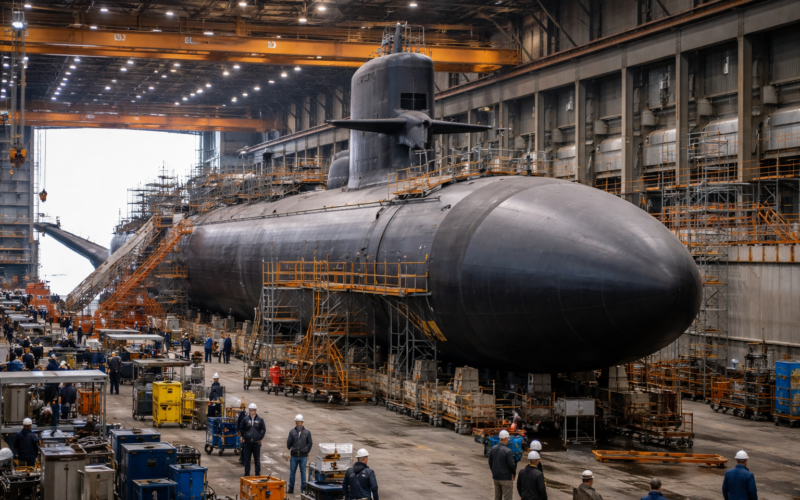
General Dynamics Corporation (NYSE: GD) has won another major U.S. Navy contract action, with its Electric Boat unit receiving a $1.27 billion modification tied to Virginia-class submarine lead yard support, development studies, and design efforts. The award is not for a brand-new submarine hull, but it is strategically important because it funds the engineering backbone that keeps the Virginia-class production system functioning. The work will run through April 2027, with most of it concentrated in Groton, Connecticut, reinforcing Electric Boat’s central role in the United States undersea industrial base. For investors, the headline adds backlog support, but for defense planners the more meaningful signal is that the Navy is still spending heavily on the less glamorous, absolutely unavoidable plumbing of submarine production.
Why does General Dynamics Electric Boat’s $1.27 billion contract modification matter for Virginia-class submarine production?
This award matters because lead yard support is where the quiet work of sustaining a submarine class actually happens. It covers engineering updates, design refinement, technical support, production problem-solving, and the integration work needed to keep multiple boats moving through construction with fewer unpleasant surprises. In plain English, this is the part of naval shipbuilding that prevents a multi-billion-dollar program from becoming a very expensive exercise in discovering new mistakes one hull at a time.
For the Virginia-class program, that matters more than ever. Attack submarines are a core element of U.S. undersea deterrence, intelligence gathering, anti-submarine warfare, precision strike, and Indo-Pacific force posture. The United States wants more undersea capacity, but the industrial base has spent the last several years wrestling with schedule pressure, supplier constraints, labor shortages, and the difficulty of supporting both the Virginia-class line and the Columbia-class ballistic missile submarine program at the same time. When the Navy pays for more lead yard and design support, it is effectively admitting that production stability is now an engineering and industrial-management challenge as much as a procurement challenge.
That is why this is not just another defense-contract number to drop into a backlog table. The contract modification is part maintenance, part insurance policy, and part signal flare. It suggests the Navy is still in a mode where protecting the continuity of submarine production is worth significant incremental spending.
What does this submarine award reveal about the U.S. Navy’s current shipbuilding priorities?
The award reinforces a clear hierarchy in U.S. naval investment: undersea platforms remain among the most protected priorities even in a budget environment where many programs compete for scarce dollars. Surface combatants, unmanned systems, missile defense, and aviation all matter, but nuclear-powered submarines sit in the category of capabilities Washington is least willing to underfund.
That is partly because submarines are hard to replace quickly. Shipyards cannot simply decide to behave like smartphone factories and double output next quarter. Skilled labor takes years to build, nuclear certification standards are unforgiving, and supplier ecosystems cannot be expanded by motivational speech. By funding continuing design and yard support, the Navy is addressing the fact that submarine capacity depends on engineering continuity as much as steel and hardware.
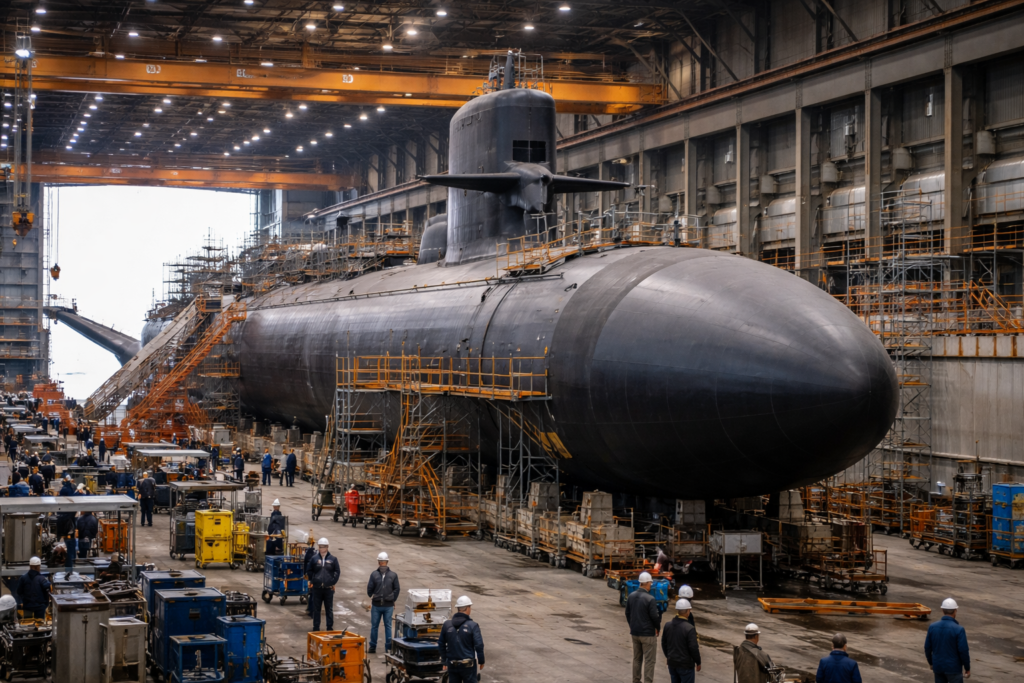
The contract also highlights how the Navy is trying to keep the Virginia-class program from being squeezed by the strategic urgency of Columbia-class construction. Columbia is the top national priority because it underpins the sea-based nuclear deterrent, but the Virginia-class is the workhorse attack-submarine line. The United States cannot afford a world in which one priority silently cannibalizes the other. Spending on support infrastructure for Virginia-class work is one way to reduce that risk.
How should investors interpret the financial impact on General Dynamics Corporation stock and sentiment?
For General Dynamics Corporation, the immediate financial interpretation is straightforward. The modification adds funded work to a program area where Electric Boat already occupies a highly defensible strategic position. The award itself does not radically alter the company’s long-term investment case, but it reinforces the durability of defense-related revenue streams tied to naval programs with very high barriers to entry.
General Dynamics Corporation shares were trading at about $349.09 on April 2, 2026, with a 52-week range of $239.20 to $369.70. Based on recent closing data, the stock was up roughly 0.7% over the last five trading days but down about 4.8% from early March levels. That price action suggests the market is not treating this specific award as a transformational upside surprise. That is sensible. Investors generally understand that General Dynamics Corporation already lives inside the submarine story. What they are watching is not whether Electric Boat wins more work, but whether the company can convert that work into execution, margin stability, and long-cycle cash generation.
In that sense, this award is supportive rather than catalytic. It strengthens revenue visibility, but it does not erase the broader questions that tend to shape sentiment around defense primes. Can the industrial base deliver on schedule? Can labor productivity improve? Can supply chains support parallel submarine programs without persistent friction? Those questions still matter more to valuation than a single contract modification, even a large one.
Still, from a sentiment perspective, it is hard to read the award as anything other than constructive. The Navy is continuing to put real money behind Electric Boat’s role in the submarine enterprise, which underlines the strategic stickiness of the business. In an uncertain market, sticky government-funded demand is not the worst personality trait for a stock to have.
What execution risks still surround General Dynamics Electric Boat and the wider submarine industrial base?
The main risk is that more money does not automatically translate into faster or cleaner outcomes. Defense contracting has a long history of proving that the federal government can spend enormous sums and still end up arguing with itself about schedule slips. Submarine construction is especially vulnerable because the work depends on a limited pool of specialized labor, a deeply tiered supplier network, and technical precision that leaves very little room for improvisation.
Electric Boat’s dominance is an advantage, but concentration also creates pressure. If one node in the submarine ecosystem struggles, the consequences ripple across the fleet plan. Newport News is also involved in the awarded work, which reinforces the reality that this is a shared industrial-base challenge, not a one-yard issue. The broader question is whether the Navy and its prime contractors are merely paying to manage congestion or actually improving the system’s throughput.
There is also the risk of cost creep inside support-heavy contract structures. Lead yard work is essential, but it can be opaque to outsiders because the value lies in engineering continuity rather than a visible end product. That can make it harder for investors and even policymakers to judge whether incremental spending is solving structural problems or just financing perpetual complexity.
A further risk is strategic overload. The United States is asking its submarine industrial base to deliver on fleet readiness, new construction, maintenance recovery, AUKUS-related pressure, and long-term deterrence modernization all at once. That is a lot to put on any industrial system, even one wrapped in patriotic branding and congressional affection.
What happens next for General Dynamics Corporation, Virginia-class submarines, and U.S. undersea strategy?
The next phase is less about contract announcement theater and more about evidence of execution. Over the next year, the real indicators will be schedule discipline, labor productivity, supplier stability, and whether the Navy can keep Virginia-class output from drifting under the weight of broader submarine demand. If these support contracts translate into smoother production and fewer disruptions, Electric Boat’s role becomes even more central and difficult to dislodge.
For General Dynamics Corporation, this strengthens the case that marine systems will remain a core strategic pillar, especially as Washington continues prioritizing undersea deterrence and contested maritime operations. The company does not need this award to reinvent itself. It needs awards like this to keep proving that it sits on one of the most durable franchises in U.S. defense.
For the industry, the message is broader. The Pentagon is not just buying platforms. It is increasingly buying resilience, engineering continuity, and industrial-base survival. That may sound less dramatic than ordering another warship, but in practice it is often more important. A fleet plan is only as credible as the industrial system underneath it, and right now Washington is still paying up to make sure that system does not blink.
Key takeaways on what this development means for General Dynamics Corporation, its competitors, and the defense industry
- The broader industry takeaway is that undersea modernization now depends as much on engineering and industrial resilience as on procurement of new platforms.
- General Dynamics Electric Boat’s $1.27 billion award reinforces its status as a critical choke point in the U.S. submarine industrial base.
- The contract is strategically important even though it is not a new submarine procurement because lead yard work protects production continuity.
- The Navy is signaling that submarine engineering support and design capacity remain urgent funding priorities alongside hull construction.
- The modification underscores that Virginia-class output still requires active industrial-management intervention, not just budget appropriations.
- General Dynamics Corporation gains additional backlog visibility, but investors will care more about execution quality than the headline value alone.
- Huntington Ingalls Industries’ Newport News role in the work highlights how submarine readiness depends on coordinated yard performance, not isolated prime success.
- The award suggests Washington is still trying to prevent Columbia-class urgency from crowding out Virginia-class production momentum.
- Persistent labor, supplier, and schedule risks mean more funding does not automatically equal faster fleet delivery.
- Defense investors may view the contract as supportive for sentiment because it confirms durable Navy demand in a strategically protected segment.
Share this:
Discover more from Business-News-Today.com
Subscribe to get the latest posts sent to your email.