




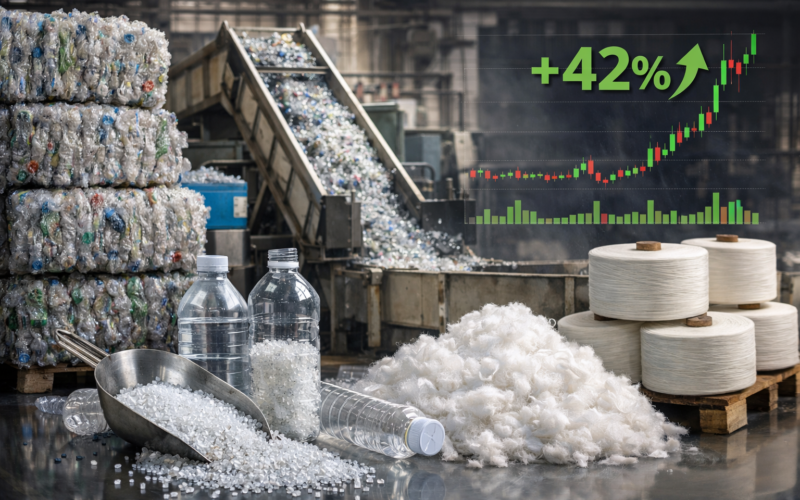
Ganesha Ecosphere Limited is India’s largest recycler of post-consumer PET bottles, converting discarded plastic into recycled polyester staple fibre (rPSF), specialty yarns, and food-grade rPET granules used across textile, automotive, packaging, and FMCG supply chains. The Kanpur-headquartered company has been building toward a regulatory moment since the government first signalled mandatory recycled content targets years ago, and that moment arrived on April 1, 2026, when the Plastic Waste Management Amendment Rules 2026 formally required a minimum of 40% recycled PET content in rigid food-contact packaging. The stock responded immediately: GANECOS hit the 20% upper circuit on NSE on April 1, with combined volumes on NSE and BSE jumping nearly ten-fold to 4.07 million shares as retail and institutional investors rushed to position in what many see as the single most direct beneficiary of India’s push toward a circular plastic economy.
The catalyst is not a rumour or a corporate announcement. The Ministry of Environment, Forest and Climate Change formally notified the rules and Ganesha Ecosphere itself filed the exchange notification on April 1, 2026. For retail investors who landed here from a cashtag on X or a ValuePickr thread, the practical question is not whether the mandate is real but whether the company can actually execute against the opportunity and at what valuation the market is now pricing that outcome.
What does Ganesha Ecosphere actually make and why is it positioned differently from a standard textile company?
Ganesha Ecosphere is not a conventional yarn spinner. The company collects used PET bottles through a national network of rag-pickers, aggregators, and balers, then processes them through mechanical and chemical recycling into three distinct product streams: rPSF (the fibre used in pillows, non-wovens, automotives, and apparel), spun and dyed texturised yarns for garment manufacturers, and food-grade rPET granules and flakes used in bottle-to-bottle recycling. That last stream, operated primarily through its wholly owned subsidiary Ganesha Ecopet Private Limited at a facility in Warangal, Telangana, is the one most directly exposed to the new packaging mandate.
The differentiation matters because food-grade rPET granules require regulatory approvals that most recyclers cannot obtain. Ganesha Ecopet holds approvals from the US-FDA, the European Food Safety Authority (EFSA), and India’s own FSSAI, meaning it can supply granules to brands whose packaging needs certification for direct food contact. This is not a commodity business: the feedstock collection network, the process technology from Starlinger (an Austrian equipment specialist), and the multi-regulatory approval stack all represent barriers that a new entrant would take years and hundreds of crores to replicate.
As of FY25, the company recycled more than 150,000 metric tonnes of PET waste and processed 8-plus billion bottles, accounting for roughly 16-18% of India’s entire post-consumer PET bottle waste stream. Management has stated a target of capturing 25% of that stream by 2026. With total installed capacity across all product lines at 196,440 tonnes per year across six manufacturing plants in Uttar Pradesh, Uttarakhand, Telangana, and Nepal, GESL is not a micro-cap story built on aspiration alone. There is real industrial infrastructure behind the ticker.
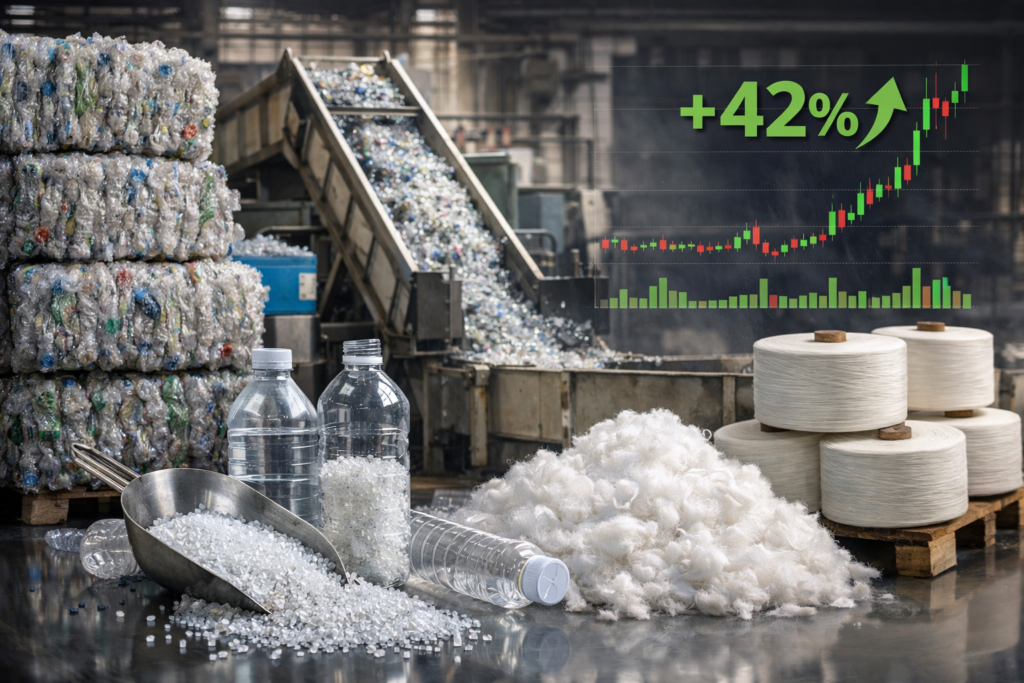
Why did GANECOS hit the upper circuit on April 1, 2026, and what does the new government mandate actually require?
The Plastic Waste Management Amendment Rules 2026 established a phased recycled content target framework effective April 1, 2026. For Category I packaging (rigid plastics, which includes PET bottles used in food and beverages), brands are now legally required to incorporate a minimum of 40% recycled content, rising to 60% by FY29. Category II flexible packaging carries a 20% target, and multilayer packaging faces a 10% floor. The Central Pollution Control Board is developing audit and verification guidelines within six months of the notification date to enforce compliance.
The market reaction to the formal notification was sharp because investor attention had been suppressed for months by what Ganesha Ecosphere’s management described as draft notification ambiguity. The Ministry had circulated a draft version of the rules in late 2025 that caused FMCG brands to pause their rPET supply chain integration, waiting for the final text before committing to long-term contracts. That ambiguity directly caused the near-wipeout in the company’s Warangal granule operation during Q2 and Q3 FY26: capacity utilisation at the facility dropped to around 50%, and the consolidated business swung to a net loss of Rs 0.50 crore in the September 2025 quarter.
The April 1 notification ended that uncertainty in a single stroke. ICICI Securities flagged Ganesha Ecosphere alongside Uflex as a direct beneficiary in a same-day note, and retail investor forums including ValuePickr updated live with slides quantifying the opportunity at approximately Rs 15,000 crore across the recycled plastics market. The ten-fold jump in trading volumes on April 1 was a textbook case of a long-anticipated catalyst arriving with compressed price action: the stock had shed more than 60% from its 52-week high of Rs 1,742.30 set in April 2025 to a low of Rs 653.25 in January 2026, leaving compressed valuation at exactly the moment the regulatory trigger fired.
What is the milestone sequence between now and the point where earnings actually recover from the mandate?
Understanding the path from regulatory notification to earnings uplift requires following several concurrent tracks. The first and most immediate is Warangal utilisation recovery. The Ganesha Ecopet facility had total food-grade rPET capacity of 42,000 tonnes per year as of mid-2024 following the installation of two additional Starlinger recoSTAR PET 165 HC iV+ recycling lines. Running at 50% utilisation during the demand freeze, the facility was producing well below its economic potential. As brand owners now face a legal obligation to source recycled content, demand for certified food-grade granules is expected to recover sharply, and management’s guidance heading into Q3 FY26 was for utilisation to exceed 70% imminently.
The second track is the company’s announced expansion programme. As disclosed in the Q3 FY26 earnings transcript, Ganesha Ecosphere has a Rs 130 crore brownfield expansion at Warangal in progress and a larger Rs 450 crore expansion planned. This follows an earlier, broader announcement of Rs 700-750 crore in total capex covering an additional 90,000 tonnes per year of rPET capacity, split between brownfield expansion at Warangal and a new greenfield facility in Odisha. The Odisha plant would add approximately 67,500 tonnes per year. This is the most significant capacity addition in the company’s history and will take 18-24 months from Board approval to commercial commissioning.
The third track is the standalone legacy business. The rPSF and yarn divisions, which had been under pressure from weak demand and raw material volatility in H1 FY26, showed a meaningful sequential recovery in Q3 FY26: standalone PAT more than doubled quarter on quarter to Rs 15.94 crore as production volumes rose 13% and the company pivoted more aggressively toward higher-margin non-woven and home furnishing segments. If that recovery continues into Q4 FY26 while Warangal granule volumes also normalise, the earnings profile entering FY27 could look materially different from what the market was pricing in January.
Q4 FY26 results (covering January to March 2026) are expected in May 2026 and will be the first quarterly read on how quickly the granule business is recovering post-notification. That number will be the key near-term earnings catalyst for holders watching the thesis play out.
How is the rPET market structured in India and where does Ganesha Ecosphere sit within the demand-supply equation?
India’s PET recycling ecosystem processes close to 90% of the country’s post-consumer PET bottles, which is one of the highest informal recycling rates in the world. The raw material is abundant and cheap, collected through a grassroots network of waste pickers. What the market has lacked is the downstream processing infrastructure to convert that feedstock into certified food-grade rPET at scale, because the equipment investment is substantial, regulatory approvals are demanding, and the technical process requires consistent quality control that informal recyclers cannot offer.
The Indian rPET market was valued at approximately USD 10.67 billion in 2023 and is projected to grow at a compound annual rate of around 7.4%, reaching approximately USD 17.53 billion by 2030. That market-level figure includes the entire rPET value chain. The more relevant near-term number for GESL is the demand uplift from the packaging mandate specifically. The ValuePickr community’s circulating analysis cited a total market opportunity of roughly Rs 15,000 crore from the regulatory shift toward recycled content in rigid packaging, with near-term demand expected to exceed available certified supply.
Ganesha Ecosphere is not the only player in this space. Uflex, which also surged 20% on April 1, has exposure to recycled flexible packaging. Indorama Ventures, a global PET producer, has announced intentions to establish recycling capacity in India. Race Eco Chain entered a joint venture with GESL in September 2024, taking a 51% stake in a new entity with Ganesha holding 49%, to establish PET bottle washing lines across India. These partnerships and new entrants suggest the market opportunity is large enough that Ganesha is not trying to go it alone, and that strategic capital is forming around the circular plastics theme in India more broadly.
For retail investors, the structural insight is that the supply of certified food-grade rPET in India is structurally short relative to the mandated demand. GESL is one of the very few companies with the regulatory approvals, the feedstock network, and the process technology already in place to serve brand owners immediately. The Warangal ramp and the Odisha greenfield are both aimed at closing that supply gap before new entrants can establish themselves.
How does the macro backdrop of EPR regulations and global sustainability mandates affect the long-term thesis for GANECOS?
Extended Producer Responsibility (EPR) is the regulatory architecture underpinning the entire circular plastics push in India. Under the EPR framework, companies that manufacture, import, or sell packaged goods are obligated to ensure the recycling of a defined proportion of the plastic they put into market. The recycled content mandate announced on April 1 is the demand-side complement to that supply-side obligation: it does not just require brands to fund recycling, it requires them to actually use recycled material in their new packaging.
The escalation schedule matters. The 40% requirement for rigid packaging in FY27 rises to 60% by FY29. Brands in the FMCG and beverage sectors, which are the primary consumers of PET packaging, are now facing a multi-year compliance trajectory. Coca-Cola is already cited in GESL’s own communications as a brand trusting the company to circularise its packaging. The incentive for brands to lock in long-term supply agreements with certified recyclers rather than scrambling at spot each quarter is strong, and Ganesha has stated it is in active discussions for exactly such arrangements.
The global context amplifies this. The EU has its own mandatory recycled content requirements for PET beverage bottles, and major international brands operating across geographies are aligning their procurement standards globally. Ganesha’s EFSA and US-FDA approvals mean the Warangal facility can supply export markets as well as domestic ones, giving it an optionality that purely domestic recyclers lack. Union Budget 2026-27 also emphasised manufacturing, infrastructure, and exports, with the packaging sector specifically called out as a beneficiary of India’s evolving trade relationships with the EU and the US.
How is the market currently pricing GANECOS versus what the regulatory newsflow and earnings recovery would imply?
After the four-session, 42%-plus rally from the January 2026 low, GANECOS is trading around Rs 1,076-1,110 (as of April 2-3, 2026), giving it a market capitalisation of approximately Rs 2,300-2,900 crore depending on price. The book value per share stands at approximately Rs 471, implying a price-to-book of around 2.3x at the higher end of the recent range. The trailing PE is elevated because the earnings base has been severely depressed by the demand freeze in the granule business during H1 and Q3 FY26: consolidated PAT for the nine months to December 2025 was barely Rs 20 crore.
The more relevant valuation lens for a business at an earnings inflection point is forward earnings, and that requires forming a view on what Warangal utilisation normalisation and the legacy business recovery can deliver in FY27. Analyst consensus (with four to five analysts covering the stock) had a one-year price target of approximately Rs 1,242 before the April 1 re-rating. The stock has partially closed that gap already. The question the market is now debating is whether the mandate kickstart justifies a fresh upward revision to target prices, or whether the stock has front-run the earnings recovery.
It is worth noting that the 52-week high of Rs 1,742 was set in April 2025 when the regulatory direction was already understood but not yet formalised. That high was followed by a sell-off as regulatory ambiguity caused actual demand destruction. If the demand environment now normalises and the Odisha and Warangal expansion capex executes on schedule, the stock could re-test and ultimately exceed those prior highs. But the path involves execution risk, funding risk from the substantial capex programme, and the possibility that CPCB enforcement of the mandate is gradual rather than immediate.
What are the execution risks and financial vulnerabilities investors watching GANECOS need to understand clearly?
The most immediate risk is that the Rs 700-750 crore capex programme is larger than the company’s historical spending profile and substantially larger than what ICRA, which rates GESL’s debt, had modelled before the announcement. ICRA revised its outlook to Stable (from Positive) specifically because the higher-than-expected capex will keep total debt elevated. The agency estimated total debt to OPBITDA in the range of 2.3x to 3.2x between FY25 and FY27, which is manageable but leaves less headroom for operational setbacks. Approximately 40-45% of the total capex is expected to be funded by incremental debt. Promoters have also pledged around 30% of their shareholding, which in a volatile market can create pressure if margin calls are triggered.
Project execution is the second risk. The Odisha greenfield is at an early stage: as of earlier ratings assessments, land had not been finalised and major approvals had not been secured. Greenfield projects in Indian manufacturing are vulnerable to land acquisition delays, environmental clearances, and contractor availability. An 18-to-24-month completion timeline for a project of this scale in a new geography carries real slippage risk. Meanwhile, the market is partly pricing in capacity that does not yet exist.
The third risk is enforcement pace. The mandate is now law but the Central Pollution Control Board audit framework is still being written, with a six-month window for guideline development. FMCG brands will monitor enforcement intensity before converting spot purchases into firm long-term contracts. If enforcement is gradual, the volume ramp in the granule business could take longer than the stock’s current momentum implies.
Raw material cost is a further variable. Ganesha flagged a 10-15% rise in raw material costs in recent quarters. PET bottle feedstock pricing is tied to crude oil (which affects virgin PET pricing and therefore the premium or discount recycled material commands) and to the availability and cost of informal collection networks. Feedstock cost pressure that cannot be passed through to customers would further compress margins in the recovery phase.
Why are retail investors on ValuePickr and Indian markets forums so active around GANECOS right now?
GANECOS has a dedicated thread on ValuePickr, India’s most analytically sophisticated retail investor forum, that has been tracking the company’s circular economy thesis for years. The thread became significantly more active in the days around the April 1 notification, with forum participants sharing the government’s mandate slide deck (circulating in FMCG and packaging WhatsApp groups), analysis of the demand-supply gap, and the implications of the phased escalation schedule. The consensus view among engaged forum members is that GESL is the clearest direct play on India’s rPET mandate given its combination of approved capacity, collection infrastructure, and regulatory certifications.
On X (formerly Twitter), cashtag activity around GANECOS spiked on April 1 and has remained elevated as the stock continued gaining into April 2. The stock appeared among the most actively traded by value on April 2, recording a traded value of Rs 254.68 crore in a single session, placing it among the highest-value turnover equities in the market despite its small-cap status. That liquidity profile is unusual for a stock of this market capitalisation and reflects genuine institutional and retail co-participation rather than a thin-market price move.
Retail investors are drawn to the stock for a reason that is simple to articulate: it is the only sizeable, exchange-listed, profitable business in India with existing certified capacity to serve a government-mandated demand. The story has the structural hallmarks that Indian retail forums respond to: a policy-driven inflection, a clear beneficiary with a moat, a prior sell-off that created a low entry point, and a phased regulatory escalation that extends the investment window. The risk is that by the time a retail investor reads the story, the easy return may have already occurred.
Key takeaways for investors evaluating the GANECOS regulatory re-rating thesis
- India’s Plastic Waste Management Amendment Rules 2026 mandate 40% recycled content in rigid food-contact packaging from April 1, 2026, rising to 60% by FY29. This is the demand trigger the rPET industry has been waiting for and Ganesha Ecosphere is the largest certified domestic supplier with immediate capacity.
- GANECOS gained more than 42% in four sessions from its January 2026 low of Rs 653.25, hitting the 20% upper circuit on April 1 on nearly ten times its average volume. The stock still sits around 38% below its 52-week high of Rs 1,742.30 set in April 2025.
- The near-term earnings catalyst is Q4 FY26 results, expected in May 2026, which will show how quickly the Warangal food-grade rPET granule facility has recovered from the demand freeze caused by regulatory ambiguity in H2 FY25 and Q3 FY26.
- The company has announced Rs 700-750 crore in expansion capex over 18-24 months, targeting an additional 90,000 tonnes per year of rPET capacity across brownfield Warangal expansion and a new greenfield facility in Odisha. ICRA has flagged higher-than-expected leverage as a risk, and promoter pledge at around 30% of holdings is a watch point.
- The regulatory mandate is now law but enforcement timelines depend on CPCB audit guideline development, which has a six-month window. Investors should track the pace of brand-owner procurement decisions for long-term rPET supply contracts as the clearest leading indicator of volume recovery.
- Ganesha Ecosphere holds US-FDA, EFSA, and FSSAI approvals for food-grade rPET, a regulatory moat that new entrants would need years to replicate and that positions the company for both domestic compliance demand and export markets in Europe and North America.
- Key risks to monitor: capex execution and funding (particularly for the Odisha greenfield, where land and approvals are still pending), enforcement pace from the CPCB, raw material cost pressures in the feedstock collection network, and the elevated trailing PE on a suppressed earnings base.
Discover more from Business-News-Today.com
Subscribe to get the latest posts sent to your email.