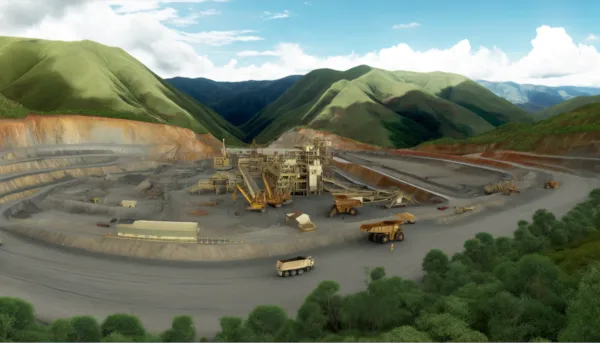
Odyssey Marine Exploration, Inc. is attempting one of the most ambitious strategic reinventions in the small-cap resource sector after filing a registration statement tied to its proposed merger with American Ocean Minerals Corporation. The all-stock transaction would create a combined company with a pro forma equity valuation of roughly $1 billion and reposition Odyssey Marine Exploration, Inc. from a company historically associated with marine exploration and shipwreck recovery into a publicly traded marine critical minerals platform focused on seabed resource development.
The proposed merger arrives as governments and industrial companies intensify efforts to secure future supplies of nickel, cobalt, manganese, copper, and other strategic materials linked to electrification, artificial intelligence infrastructure, energy storage, and defense manufacturing. That broader geopolitical shift is helping move deep-sea mining from a speculative concept toward a potentially important strategic resource discussion.
Why is Odyssey Marine Exploration, Inc. repositioning itself around the global critical minerals race?
For much of its public-market history, Odyssey Marine Exploration, Inc. operated within a niche segment of maritime exploration focused on underwater recovery operations and historical wreck projects. While those activities occasionally attracted investor attention, they rarely produced the type of scalable long-term growth story that institutional investors typically favor.
The proposed merger with American Ocean Minerals Corporation represents a major departure from that legacy identity. Instead of remaining tied to marine recovery narratives, Odyssey Marine Exploration, Inc. is attempting to align itself with one of the fastest-growing geopolitical and industrial themes in global markets: critical mineral security.
That transition matters because governments across North America, Europe, and Asia are increasingly concerned about supply-chain concentration tied to battery materials and industrial metals. China’s influence across several strategic mineral supply chains has accelerated interest in alternative sourcing strategies, including seabed resource development.
American Ocean Minerals Corporation’s strategy reflects that changing environment. The proposed platform combines Cook Islands exploration interests associated with CIC Limited and Moana Minerals Ltd. with United States pathway projects pursued under the Deep Seabed Hard Mineral Resources Act framework administered by the National Oceanic and Atmospheric Administration.
That multi-jurisdictional structure could become strategically important because deep-sea mining remains politically and environmentally controversial. Diversifying across regulatory pathways may reduce the risk that a single permitting setback or geopolitical issue disrupts the company’s broader commercialization ambitions.
The merger also gives Odyssey Marine Exploration, Inc. something many struggling small-cap companies seek but rarely achieve successfully: a narrative reset. Investors who once viewed the company through the lens of marine recovery operations may begin evaluating it instead as a speculative but potentially strategic critical minerals platform.
How could the Cook Islands and United States projects reshape marine mining investment narratives?
The Cook Islands component of the proposed portfolio is attracting attention because the Pacific region has become increasingly important in seabed mining discussions. Polymetallic nodules located across sections of the Pacific Ocean are believed to contain commercially important concentrations of nickel, cobalt, manganese, and copper that could eventually support battery and industrial supply chains.
If commercial extraction becomes economically and politically viable, companies with early-stage exploration exposure in these regions could benefit from rising strategic interest. At the same time, the United States pathway projects may ultimately carry even greater capital-markets significance. American policymakers are increasingly emphasizing domestic and allied mineral supply-chain resilience, particularly for materials tied to electrification, artificial intelligence infrastructure, and defense systems.
If the combined company successfully advances projects through United States legal and regulatory structures, it could position itself as one of the few publicly traded companies directly aligned with future American seabed mineral development efforts. That possibility may eventually attract strategic partnerships, industrial interest, or institutional capital seeking exposure to domestic critical mineral themes.
Still, investors are unlikely to overlook the speculative nature of the industry. Commercial-scale deep-sea mining has not yet matured into a fully proven industrial business model. Extraction economics, environmental standards, permitting timelines, and processing logistics remain uncertain across much of the sector. As a result, the value attached to these assets today depends heavily on future optionality rather than existing revenue generation.
Why does the proposed $1 billion valuation reflect changing investor attitudes toward strategic minerals?
The proposed merger values the combined company at approximately $1 billion on a pro forma equity basis. While that valuation may appear aggressive relative to the company’s current operating profile, it reflects how investors increasingly view critical minerals through the lens of long-term industrial infrastructure rather than conventional commodity cycles.
Markets are placing growing value on companies positioned around electrification, supply-chain resilience, artificial intelligence infrastructure, and strategic manufacturing inputs. In many cases, valuations are driven as much by geopolitical relevance and future scarcity expectations as by near-term financial performance.
American Ocean Minerals Corporation also enters the merger with a relatively strong capital position for an early-stage resource platform. The company disclosed that it raised more than $230 million from institutional and strategic investors ahead of the transaction, including approximately $156 million in private placement financing and approximately $75.6 million in pre-public financing. The combined company expects to hold around $175 million in cash following completion of the merger.
That liquidity matters because marine mineral development requires large amounts of capital long before commercial production begins. Exploration campaigns, offshore testing, environmental studies, underwater robotics, and permitting work can consume substantial funding without generating immediate returns. The projected cash balance could therefore provide the combined company with greater flexibility than many speculative mining peers during the next phase of technical and regulatory development.
How could environmental scrutiny and regulatory uncertainty limit the seabed mining industry’s growth?
Despite growing strategic interest in critical minerals, environmental opposition remains the largest long-term challenge facing the deep-sea mining industry. Environmental groups and marine scientists continue warning that large-scale seabed extraction could damage fragile ocean ecosystems that remain poorly understood scientifically. Concerns surrounding biodiversity loss, sediment plumes, and broader ecological disruption are becoming increasingly central to regulatory debates.
Those concerns create a difficult balancing act for companies attempting to commercialize marine minerals. The combined Odyssey Marine Exploration, Inc. and American Ocean Minerals Corporation platform must convince investors and regulators that seabed extraction can occur responsibly while still remaining economically viable.
This issue matters because environmental scrutiny now directly affects permitting timelines, investor participation, and political support. Some institutional investors may hesitate to support companies associated with controversial extraction practices, regardless of commodity demand fundamentals.
Technical success alone may therefore not be enough. Companies operating in this sector may eventually need to demonstrate unusually high levels of environmental transparency and regulatory discipline to sustain long-term market confidence.
Why are investors likely to view this merger as a referendum on the future of seabed mining itself?
Investor sentiment toward OMEX will likely remain volatile because the proposed transaction represents more than a standard corporate merger. Markets are effectively being asked to evaluate whether seabed critical minerals can evolve into a commercially and politically sustainable industry.
That question extends beyond Odyssey Marine Exploration, Inc. or American Ocean Minerals Corporation individually. The answer could influence future investment across marine resource development, underwater robotics, offshore extraction systems, and strategic mineral infrastructure.
The transaction also reflects a broader trend where smaller public companies increasingly use transformational mergers to reposition themselves around emerging industrial themes. Rather than pursuing a traditional initial public offering, American Ocean Minerals Corporation appears to be leveraging Odyssey Marine Exploration, Inc.’s Nasdaq listing and public-company infrastructure as a faster route into public markets.
Whether this strategy ultimately succeeds may depend less on geological potential and more on management’s ability to navigate regulation, environmental scrutiny, financing demands, and commercialization timelines.
The ocean floor may hold enormous mineral wealth, but public markets have historically shown limited patience for capital-intensive industries requiring long development timelines and uncertain regulatory outcomes. Odyssey Marine Exploration, Inc. is now betting that the global urgency surrounding critical minerals is strong enough to change that equation.
Key takeaways on what the Odyssey Marine Exploration, Inc.-AOMC merger means for investors and the critical minerals sector
- Odyssey Marine Exploration, Inc. is attempting a major strategic reinvention centered on critical minerals and seabed mining.
- The proposed merger aligns the company with growing geopolitical demand for alternative battery and industrial metal supply chains.
- Cook Islands exploration interests could become strategically valuable if deep-sea mining gains broader regulatory acceptance.
- United States pathway projects may attract investor attention because of increasing American focus on domestic mineral security.
- The combined company’s projected cash position gives it greater flexibility than many speculative resource-development peers.
- Environmental opposition and regulatory uncertainty remain the largest long-term threats to seabed mining commercialization.
- Investor sentiment will likely depend on technical execution, permitting progress, and environmental credibility rather than commodity enthusiasm alone.
Discover more from Business-News-Today.com
Subscribe to get the latest posts sent to your email.