



Why does Jaguar Transport Holdings’ acquisition of Columbia Basin Railroad and Central Washington Railroad matter for freight, farmers, and the U.S. rail economy?
Jaguar Transport Holdings, LLC, a U.S.-based transportation and logistics operator, has taken another major step in its expansion journey with the acquisition of Columbia Basin Railroad (CBRW) and Central Washington Railroad (CWA). Operations under Jaguar’s ownership are set to begin on August 27, 2025, after receiving formal approval from the Surface Transportation Board (STB).
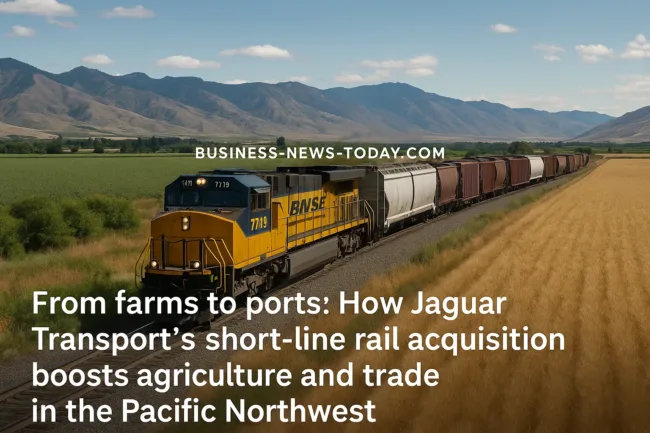
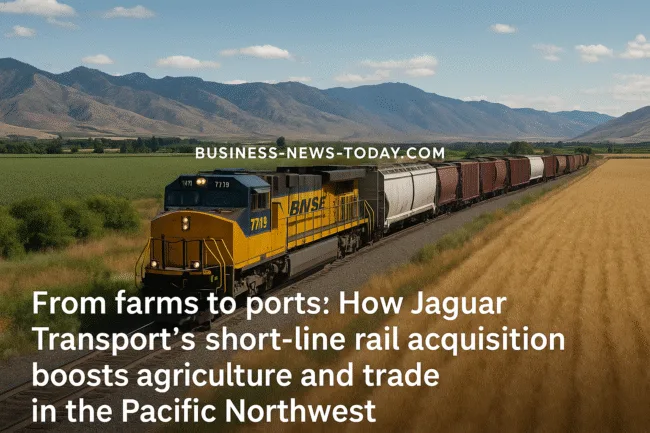
The deal strengthens Jaguar’s network in the Pacific Northwest, connecting rural and industrial hubs across central Washington to the national rail grid. Collectively, the two lines span 177 miles of track, providing crucial freight links between agricultural producers, industrial shippers, and manufacturers. By interchanging with BNSF Railway at Connell, Yakima, and Gibbon, the two railroads function as gateways to both domestic U.S. markets and Pacific Northwest export ports.
For Jaguar Transport Holdings, this transaction represents more than just asset growth. It reflects a broader strategy of acquiring railroads that serve as critical economic arteries for regional economies, particularly those reliant on agriculture and trade.
How does this acquisition fit into Jaguar Transport Holdings’ disciplined strategy of building a national short-line network?
Since its founding in 2018, Jaguar Transport Holdings has carved a niche by pursuing selective acquisitions of short-line railroads with strong existing infrastructure, steady freight bases, and community ties. This latest acquisition lifts Jaguar’s portfolio to 13 short-line railroads, 13 transload facilities, and six industrial parks spread across 12 states.
Stu Towner, chief executive officer of Jaguar Transport Holdings, explained that Columbia Basin and Central Washington have been transformed into strong businesses by focusing on reliability and community service. Jaguar’s plan, he indicated, is to carry that forward by investing in rail safety, customer engagement, and long-term infrastructure improvements.
Industry observers note that Jaguar’s model aligns with a wider U.S. logistics trend: short-line operators are increasingly seen as key enablers of regional trade, providing flexibility that larger Class I railroads cannot always deliver. Jaguar’s disciplined approach, emphasizing relationship-driven operations and sustainable growth, has been cited by analysts as a reason for its rising reputation in freight circles.
What is the historical and economic significance of Columbia Basin Railroad and Central Washington Railroad?
The Columbia Basin Railroad and Central Washington Railroad have been pivotal in supporting Washington’s agricultural exports for decades. Central Washington is home to one of the most productive farming regions in the United States, renowned for its apples, hops, cherries, and wine grapes. Rail links ensure that these crops can reach export terminals in Seattle, Tacoma, and Portland efficiently, helping Washington maintain its status as an agricultural export powerhouse.
Beyond agriculture, the lines also serve industrial clients in the Yakima Valley, where rail freight supports both inbound raw material transport and outbound product distribution. By providing affordable, reliable alternatives to trucking, the two railroads underpin the competitiveness of small and mid-sized businesses in the region.
Outgoing owner and president Brig Temple expressed confidence that Jaguar will protect and expand this legacy. He stressed that safety, dependability, and investment in local relationships have always been the backbone of the lines’ success, and that Jaguar’s approach closely mirrors those values.
How does Jaguar’s acquisition compare to other recent short-line railroad deals in the U.S.?
The short-line railroad sector has seen heightened acquisition activity over the past decade, with infrastructure funds and logistics companies targeting these resilient, community-anchored assets.
One of the most notable examples came in 2019, when Brookfield Infrastructure and GIC acquired Genesee & Wyoming, the largest short-line operator in North America, in a $8.4 billion transaction. That deal was driven by the same fundamentals Jaguar is now pursuing: stable cash flows from essential regional railroads, long-term shipper contracts, and embedded roles in local economies.
Similarly, Watco, another U.S. short-line operator, has expanded aggressively through acquisitions and partnerships, particularly in energy-rich and agricultural states. Analysts often highlight that operators like Jaguar, Watco, and Genesee & Wyoming are reshaping U.S. logistics by consolidating fragmented regional networks into scalable, customer-oriented platforms.
Compared with these giants, Jaguar is still smaller in scale but has adopted a similar playbook—focusing on disciplined, regionally significant deals rather than chasing high-risk growth. The Columbia Basin and Central Washington deal fits squarely into this strategy: both railroads offer established freight bases and predictable volumes, making them attractive for long-term investment.
What does institutional sentiment reveal about the resilience of short-line railroads as investment assets?
Institutional interest in U.S. railroads has surged in recent years, driven by their reputation as stable, cash-generating infrastructure. While Class I railroads attract significant regulatory and political attention, short-line operators often deliver steadier margins due to their local monopolies and closer shipper relationships.
Investors and analysts frequently describe short-lines as “sticky assets,” given that customers in rural regions often have few alternative logistics options. This dynamic reduces volume volatility and strengthens pricing power. In addition, as sustainability concerns push more freight from road to rail, demand for short-line capacity is expected to rise.
Jaguar’s deal comes at a time when institutional appetite for transportation assets remains robust. Though Jaguar is privately held, observers suggest that its growing portfolio could make it a candidate for future partnerships with infrastructure funds or private equity, mirroring what was seen in the Genesee & Wyoming transaction.
How does the Pacific Northwest position add future growth opportunities for Jaguar Transport Holdings?
The Pacific Northwest is a strategic prize for Jaguar Transport Holdings. Agricultural exports from Washington and Oregon are set to rise as global demand for food security increases. The ports of Seattle and Tacoma already rank among the busiest on the U.S. West Coast, and rail connectivity from inland regions like Yakima is critical to sustaining that growth.
By controlling Columbia Basin and Central Washington, Jaguar has secured a key position in this corridor. Analysts believe that the deal could open opportunities for Jaguar to sign long-term service agreements with agribusiness giants, exporters, and manufacturing clients. In addition, access to BNSF’s Class I system means that Jaguar can integrate these lines into broader national freight flows, increasing efficiency for its customer base.
The acquisition also provides Jaguar with a platform to expand ancillary services such as transloading and warehousing. Its existing industrial parks and transload facilities could be strategically aligned with the Washington lines to capture more value along the freight chain.
What is the long-term outlook for Jaguar Transport Holdings and the U.S. short-line rail sector?
Looking forward, Jaguar Transport Holdings is expected to continue its acquisition-led growth, with analysts pointing to agricultural regions in the Midwest and energy basins in the South as potential targets. Its current 13-railroad portfolio suggests a long-term ambition to compete with larger peers like Watco, while maintaining a focus on disciplined, community-first operations.
For the U.S. short-line sector as a whole, the outlook remains positive. Freight volumes from agriculture, manufacturing, and energy are projected to stay strong, while the shift to more sustainable transport modes is expected to benefit rail over trucking. Institutional observers also predict that more consolidation is likely, as smaller independent operators sell to larger groups like Jaguar seeking scale.
In that context, Jaguar’s move into Washington is not just a local story—it reflects broader shifts in U.S. logistics, where control of regional rail networks is becoming increasingly strategic. As global trade patterns evolve and supply chains demand greater resilience, operators like Jaguar are positioning themselves at the center of America’s freight future.
Discover more from Business-News-Today.com
Subscribe to get the latest posts sent to your email.