




A new offshore oil cycle is taking shape across Latin America and West Africa—and Floating Production, Storage and Offloading units, or FPSOs, are once again at the heart of the story. These giant, vessel-based production platforms are not new to the energy world. But as oil majors and national oil companies shift their attention back to long-life, low-cost reserves in ultra-deepwater fields, FPSOs are entering what many analysts now call their “second golden age.”
Driven by rising upstream investment, leasing economics, and the resurgence of long-cycle projects in remote basins, the FPSO model is now emerging as the preferred infrastructure for production flexibility and capital efficiency.
What makes the FPSO model attractive again for oil producers in 2025?
FPSOs offer a critical advantage in remote or deepwater regions where traditional pipeline or platform infrastructure is prohibitively expensive. Because they float, FPSOs can be moored over any depth, process hydrocarbons onboard, and store the product until it’s offloaded onto tankers. This makes them highly suitable for deepwater operations where subsea tiebacks and fixed installations are impractical or uneconomical.
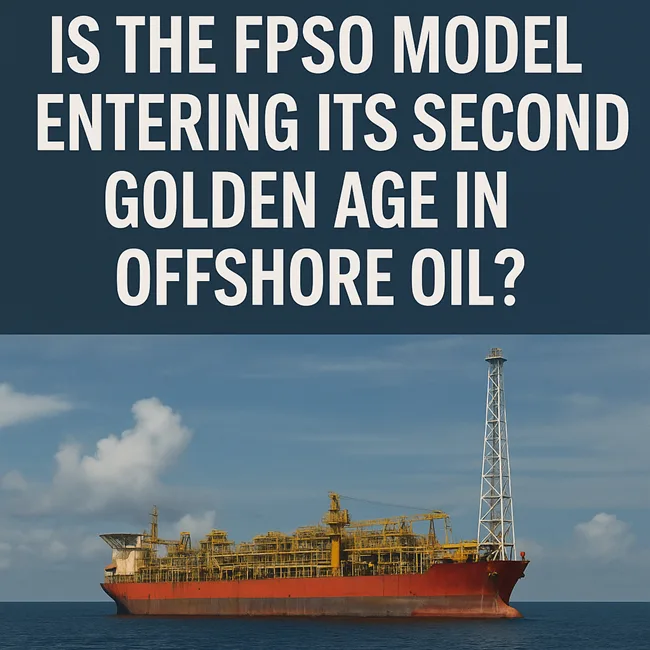
More importantly, today’s FPSO deployments are increasingly based on a leasing model. Rather than owning the infrastructure outright, oil companies contract FPSO providers like SBM Offshore, Modec, or BW Offshore to deliver and operate these units. This leasing model helps producers reduce upfront capital expenditure and mitigate execution risk—both crucial in volatile pricing environments and regions with challenging regulatory or political backdrops.
As a result, contractor-owned FPSOs have gained popularity among both international oil companies and national oil firms. The resurgence of this model reflects not only structural shifts in offshore development but also a generational pivot in capital discipline within the industry.
Why are Brazil, Guyana, Angola, and Côte d’Ivoire leading the FPSO revival?
Four countries—Brazil, Guyana, Angola, and Côte d’Ivoire—are currently driving the majority of new FPSO deployments and contract awards, thanks to high-quality reserves, favorable fiscal terms, and strong operator interest.
In Brazil, state-owned Petrobras continues to spearhead FPSO usage in the pre-salt Santos and Campos basins. These ultra-deepwater regions contain some of the world’s most prolific oil reservoirs, but also present complex geological and operational challenges. Petrobras plans to bring more than 15 FPSOs online by the end of this decade, under a mix of lease and build-operate-transfer models. FPSOs like Sepetiba, Almirante Barroso, and Anita Garibaldi have already been delivered, with others such as P-80 and P-83 in the pipeline.
Guyana, meanwhile, is quickly evolving into a production powerhouse, with ExxonMobil’s string of discoveries in the Stabroek Block underpinning one of the most aggressive FPSO rollouts in recent history. The Liza Destiny and Liza Unity FPSOs are already producing over 250,000 barrels per day each, and upcoming units—Payara, Yellowtail, Uaru, and Whiptail—are set to bring the country’s total FPSO count to seven by 2027. ExxonMobil, alongside partners Chevron and China National Offshore Oil Corporation, is implementing a phased strategy that relies exclusively on FPSOs for each development.
In Angola, the FPSO narrative is being reshaped by Azule Energy, a joint venture between Eni and BP. Azule has announced a USD 5 billion investment program over the next five years, with a portion earmarked for FPSO-backed projects. Deepwater fields like Agogo and PAJ are likely candidates for new floating production units, with additional redeployments expected from decommissioned vessels elsewhere in Africa.
Côte d’Ivoire, traditionally a mid-tier offshore player, is also gaining traction. Eni’s Baleine project has become the poster child for Africa’s first Scope 1 and 2 net-zero upstream development, and it is being anchored by the redeployed FPSO Firenze. A second, larger FPSO is being prepared for phase two, and recent licensing activity suggests further exploration is on the cards.
How are oil majors like ExxonMobil, Petrobras, Eni, and TotalEnergies approaching FPSOs?
The renewed focus on FPSOs is not limited to national oil companies. Supermajors are increasingly leaning into the floating production model as a hedge against risk and capital inefficiency.
ExxonMobil has embraced FPSOs as a modular strategy to sequentially unlock Guyana’s deepwater potential without overcommitting capital upfront. Each new FPSO is tailored to a specific development phase, with standardized topsides and rapid fabrication timelines enabling consistent output growth. The company now expects Guyana to become one of its top five producing countries by volume.
Petrobras, a veteran of the FPSO model, has scaled up its procurement and integration strategies in recent years. By working with shipyards in China, Singapore, and Brazil, Petrobras has created a supply chain that delivers large-capacity FPSOs capable of handling over 225,000 barrels per day each—critical for maximizing production from pre-salt clusters.
Eni, through Azule Energy and standalone projects, is betting on FPSOs not just for production, but also for meeting ESG milestones. Its integration of hybrid power systems, gas reinjection, and carbon monitoring into FPSO operations demonstrates a shift toward more sustainable offshore production.
TotalEnergies, with assets in Brazil, Angola, and Namibia, has adopted a balanced approach. It is participating in FPSO developments either directly or through joint ventures while exploring dual-fuel operations and offshore electrification to reduce emissions intensity.
Are FPSO market fundamentals strong enough to sustain this momentum?
Analysts tracking the offshore sector agree that the FPSO market is entering a structurally bullish phase. Global FPSO capex is projected to exceed USD 60 billion between 2024 and 2028, driven by large projects in Brazil, West Africa, and Southeast Asia. Lease rates have firmed across vessel classes, with high-spec units attracting day rates upwards of USD 400,000 depending on contract tenure and technical complexity.
Backlogs at FPSO fabricators like SBM Offshore, Modec, and Yinson are robust, with most 2025–2026 slots already committed. Redeployment opportunities are also improving, as fields mature and FPSO hulls reach end-of-contract stages. In this environment, investors see FPSOs as high-yielding infrastructure assets, often backed by 10- to 15-year charter agreements with investment-grade counterparties.
Private equity has also entered the fray. Carlyle’s recent acquisition of Altera Infrastructure’s FPSO fleet—announced in September 2025—is a clear sign that financial sponsors see value in long-duration cash flow from leased offshore assets. Brookfield, Warburg Pincus, and other asset managers have similarly backed FPSO operators or spinouts, betting on the sector’s resilience amid oil transition debates.
What are the challenges and risks for FPSOs in this next growth cycle?
Despite the optimism, the FPSO sector is not without its risks. Cost inflation, regulatory bottlenecks, local content obligations, and construction delays continue to challenge project economics. For instance, in Brazil, shipyard availability and environmental licensing remain friction points. In Guyana, political pressure to accelerate revenue generation could test ExxonMobil’s development timelines.
There are also questions about decarbonization. While some FPSOs now include gas reinjection, hybrid power, or carbon intensity tracking, most remain carbon-intensive. Critics argue that FPSOs must evolve toward lower-emission operations if they are to remain viable in a net-zero world.
Nevertheless, the sector is adapting. Next-gen FPSO designs increasingly feature electrification options, digital twins for predictive maintenance, and modular components that enable faster construction and redeployment.
Discover more from Business-News-Today.com
Subscribe to get the latest posts sent to your email.