



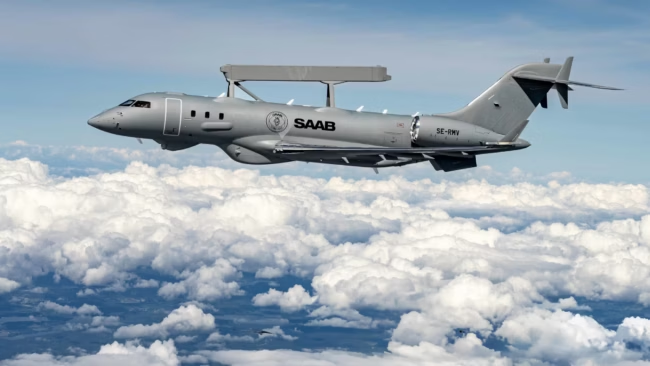
Saab AB (STO: SAAB B) has signed a SEK 12.3 billion (approximately EUR 1.05 billion) contract with the French General Directorate of Armaments (Direction générale de l’Armement, DGA) for two GlobalEye airborne early warning and control (AEW&C) aircraft, including ground systems, training, and support. The deal, which includes an option for two additional aircraft, positions Sweden’s flagship AEW&C platform as a cornerstone in France’s modernization of its airborne surveillance capabilities.
Deliveries are expected between 2029 and 2032, marking a long-term commitment to cross-European defense industrial collaboration and a notable deviation from France’s traditionally domestic defense procurement posture.

Why is France opting for GlobalEye over domestic or EU-integrated AEW&C platforms?
France’s decision to procure GlobalEye signals a strategic shift from its conventional preference for indigenous platforms or European consortium-built solutions such as the Airbus A330 MRTT-based AEW&C or NATO’s E-3A replacement program. While France has collaborated in European defense ventures such as FCAS and the SCAF fighter program, AEW&C capabilities have remained under-specified in France’s current airpower doctrine, relying largely on NATO assets and ground-based radar infrastructure.
GlobalEye’s multi-domain sensor integration—leveraging Saab’s Erieye ER radar on Bombardier Global 6000/6500 aircraft—likely tipped the scales. The system offers a comprehensive situational awareness package that extends across air, maritime, and land domains, with active and passive sensors fused in real time. For France, this represents not just a procurement of aircraft, but a sovereign capability in persistent, strategic ISR (intelligence, surveillance, and reconnaissance) at long range.
This decision also implicitly prioritizes delivery certainty, modular scalability, and geopolitical flexibility over industrial protectionism. France is unlikely to co-develop its own AEW&C platform in time to meet capability gaps emerging this decade. Saab’s GlobalEye, already operational with Sweden and the United Arab Emirates, offers a proven and fielded option within a relatively tight window.
How does this deal position Saab within the competitive landscape of airborne surveillance?
The GlobalEye program has steadily gained traction as a preferred AEW&C solution for mid-sized powers seeking strategic autonomy without the geopolitical encumbrances of U.S. or Chinese systems. With this deal, Saab becomes one of the few non-American players to successfully export a full-spectrum AEW&C platform into a Western European Tier 1 military.
This contrasts with the Boeing E-7 Wedgetail, which is increasingly dominant in U.S.-aligned procurement circles including the United Kingdom, Australia, and South Korea. While E-7 boasts battle-proven capabilities, its acquisition cost, integration complexity, and delivery backlog have prompted some nations to consider alternatives.
Saab’s ability to integrate its Erieye radar on commercial airframes like the Global 6000 also appeals to air forces seeking lifecycle affordability and maintenance accessibility. That France, a nuclear power and one of NATO’s largest militaries, has endorsed GlobalEye may push other European and Global South nations to reassess their AEW&C plans.
What does this imply for Europe’s defense industrial policy and surveillance architecture?
France’s procurement of GlobalEye raises structural questions about the European Union’s ability to coordinate and consolidate key surveillance capabilities across member states. While Brussels has pushed for interoperability and industrial synergy in defense programs under initiatives like PESCO and the European Defence Fund, AEW&C remains fragmented.
France and Sweden now join the United Arab Emirates and Brazil in operating GlobalEye variants, while NATO looks to the Boeing E-7 as a successor to its aging E-3 Sentry fleet. Germany and Italy, meanwhile, continue to evaluate future AEW&C needs as part of broader air force renewal efforts.
This growing diversification risks further fragmentation of sensor data standards, command and control doctrines, and long-range threat detection capabilities across Europe. In response, Saab may look to leverage this French deal as a platform for expanding common AEW&C interfaces across EU forces—something that could become particularly valuable if France exercises its option for two additional aircraft.
Are there industrial or political risks to Saab’s long-term AEW&C expansion in Europe?
While the DGA deal provides Saab with credibility and cash flow, several risks remain. First is the long delivery horizon. With aircraft not arriving until 2029–2032, changes in defense priorities, political leadership, or budgetary pressures could reshape France’s follow-on orders or alter the integration tempo.
Second is the risk of future EU-level AEW&C initiatives crowding out bilateral deals. If the European Commission accelerates joint surveillance projects, countries like Germany and Italy may push for homegrown or Airbus-led platforms over Saab’s GlobalEye.
Third is platform obsolescence. With AI-enhanced threat detection and edge computing being rapidly integrated into defense platforms, Saab will need to continuously upgrade GlobalEye’s onboard processing, data fusion algorithms, and ground-to-air interfaces to stay competitive against U.S. and Israeli systems.
Still, Saab’s track record of integrating advanced capabilities on export-friendly terms gives it a significant advantage in markets that value flexibility, industrial offset, and sovereignty over doctrinal alignment with U.S. systems.
What’s the broader strategic signal from Sweden–France defense collaboration?
This deal comes at a time when Sweden is finalizing its NATO accession and deepening defense ties with European partners beyond its historic Nordic and Baltic alignment. By anchoring its AEW&C roadmap in Saab’s GlobalEye, France not only supports Sweden’s defense industry but also aligns surveillance capabilities in a way that strengthens NATO’s northern and western flanks.
It also reflects an evolving European consensus on the importance of domain-spanning ISR platforms capable of operating independently of U.S. satellites or data feeds. With Russia’s ongoing threat posture and growing concerns about anti-access/area-denial (A2/AD) strategies, multi-domain awareness is becoming central to both deterrence and crisis response planning.
France’s bet on GlobalEye is thus not merely a tactical choice—it is a structural vote for a diversified European defense architecture capable of fielding sovereign, layered, and resilient surveillance networks.
Key takeaways: Saab secures French GlobalEye deal, reshaping European AEW&C dynamics
- Saab AB has secured a SEK 12.3 billion order from France for two GlobalEye AEW&C aircraft, with an option for two more, marking a major entry into Western Europe’s defense landscape.
- France’s selection of GlobalEye signals a shift from domestic or Airbus-based platforms in favor of operational readiness and sensor fusion capabilities.
- Saab’s GlobalEye now stands as a credible alternative to the Boeing E-7, especially for countries seeking affordable, scalable, and geopolitically flexible AEW&C solutions.
- The deal could complicate efforts to unify European AEW&C architecture and standards under joint procurement or NATO-integrated programs.
- Long delivery timelines and evolving EU defense industrial policy could affect future expansion or follow-on orders for Saab.
- Saab’s ability to continuously upgrade sensor packages and real-time analytics will determine its competitiveness in an AI-driven defense environment.
- Sweden–France defense alignment around GlobalEye strengthens regional surveillance capabilities and reflects a broader European shift toward sovereignty-driven ISR procurement.
- The order may influence other EU or Global South countries evaluating their next-generation AEW&C procurement paths.
Discover more from Business-News-Today.com
Subscribe to get the latest posts sent to your email.
