


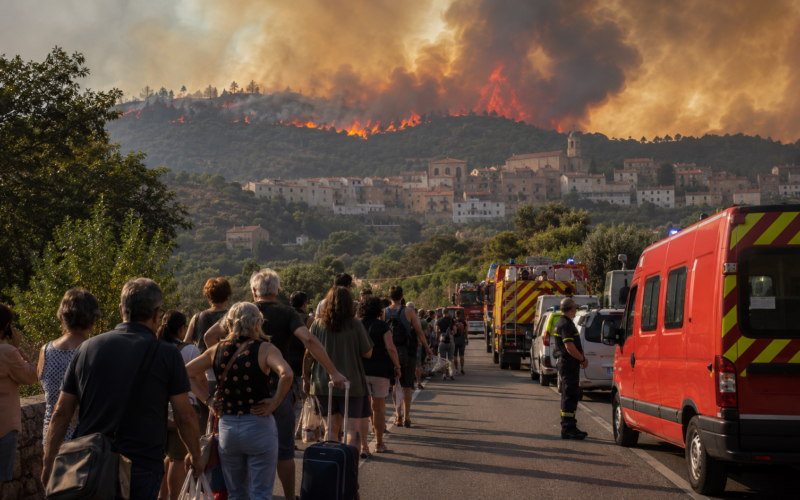
More than 250,000 people have been forced from their homes, vacation sites and communities as fast-moving wildfires spread across France and Spain, creating one of Europe’s largest evacuation emergencies in recent years. French authorities reported approximately 197,000 evacuations, principally around Bordeaux and southwestern coastal regions, while at least 70,000 people were evacuated in central Spain. The Spanish total rises to about 88,000 when residents ordered to remain indoors are included, demonstrating how rapidly official figures are changing as new communities enter the danger zone. At least one person has died in Spain, dozens of firefighters have been injured in France and both governments have mobilized military, aviation and civil-protection resources. The crisis is testing whether Europe’s emergency systems can keep pace with fires intensified by prolonged heat, drought, powerful winds and increasingly combustible landscapes.
The most dangerous French fires were advancing through the Gironde and Landes departments in the southwest, where authorities evacuated communities around the Arcachon Bay, the Cap Ferret peninsula and areas west of Bordeaux. In Spain, several fires west of Madrid expanded or merged while another blaze near Manises in Valencia caused the country’s first reported death in the current emergency. Spain declared a national wildfire emergency as smoke degraded air quality and strong winds repeatedly frustrated containment operations.
The scale of the evacuations has transformed what began as a series of regional fires into a cross-border European emergency. Fire crews have been reinforced by military personnel, aircraft and assistance from other European countries, yet officials continue to warn that changing winds could reverse recent progress. Cooler conditions and scattered rain may provide limited relief in some areas, but dry forests and unstable weather mean the immediate danger has not passed.
Southwestern France faces an evacuation emergency as wildfires advance toward Bordeaux
The largest French operation has centered on Gironde, where fire spread through pine forests near the Atlantic coast and threatened communities around Arcachon Bay. Residents and tourists were evacuated from Cap Ferret, a narrow peninsula with limited road access, forcing authorities to use boats as well as vehicles to move people away from the flames. Earlier evacuations involved campsites, children’s summer programs, care facilities and vacation communities, making the operation particularly difficult during the peak tourism season.
The fires have since expanded toward more heavily populated parts of the Bordeaux region. Emergency crews created firebreak trenches, dropped retardant and conducted door-to-door evacuations as authorities prepared temporary shelters for thousands of displaced residents. The French government also distributed large quantities of protective masks because smoke and ash were affecting communities beyond the immediate fire perimeter.

Fire behavior has made containment unusually difficult. Officials and firefighters described flames producing intense heat, rapidly shifting direction and, in some areas, generating their own local wind conditions. Such behavior can cause a wildfire to jump established control lines, overwhelm ground crews and threaten communities that appeared relatively safe only hours earlier.
More than 1,400 firefighters were deployed in France, supported by aircraft, soldiers and European assistance. The government authorized the use of an Airbus A400M military transport aircraft adapted to release fire retardant, a significant escalation that reflected the pressure on France’s conventional firefighting fleet. Security and emergency resources were also redirected from major national events, including the Tour de France, as authorities prioritized the wildfire response.
The crisis has created a substantial logistical challenge because many evacuees are tourists unfamiliar with local routes, emergency procedures or temporary shelters. Traffic congestion, blocked roads and the geography of coastal peninsulas can slow evacuation just as fire conditions deteriorate. Authorities must therefore balance the need for early evacuation against the risk of placing thousands of vehicles on limited roads simultaneously.
French weather officials indicated that storms and cooler conditions could slightly improve fire danger in parts of the country. However, rainfall was not expected to be widespread, and Gironde was forecast to receive little precipitation. Météo-France also warned that mistral and tramontane winds could strengthen again, raising fire danger in other regions even if southwestern conditions temporarily improve.
Spain’s first national wildfire emergency reflects the speed and reach of the crisis
Spain declared a national emergency as fires west of Madrid expanded across dry terrain and forced tens of thousands of people to leave their homes. Several blazes merged or threatened to combine, creating a larger fire front that stretched local response capacity and increased the possibility of flames reaching suburban communities. Approximately 2,600 emergency personnel and 19 aircraft were involved in the Spanish response as the country sought additional support from European partners.
The fires affected Madrid’s western surroundings and parts of Ávila, an area containing forested mountains, rural settlements and communities connected to the capital. Smoke reached densely populated areas, prompting officials to advise residents to reduce outdoor activity and protect vulnerable people from hazardous air. Even residents outside formal evacuation zones were affected by poor visibility, ash and particulate pollution.
The death of an elderly man in a wildfire near Manises in Valencia demonstrated that the danger was not confined to the largest fires near Madrid. Wildfire emergencies often develop simultaneously across several regions, forcing governments to distribute aircraft, specialist crews and medical resources over large distances. That fragmentation can weaken the response to each individual fire, particularly when strong winds produce sudden changes in direction.
Spain has already recorded more than 130,000 hectares burned during 2026, placing the year substantially above the recent seasonal average. The affected area includes forests, agricultural land, historic natural sites and communities located where developed areas meet flammable vegetation. This wildland-urban boundary has become one of the most difficult environments for emergency planners because evacuations, property protection and forest suppression must occur at the same time.
The national emergency declaration gives Spain’s central government greater authority to coordinate regional resources and deploy additional personnel. It also signals that the situation exceeds the capacity of individual autonomous communities to manage independently. The effectiveness of that coordination will depend on whether authorities can move aircraft and crews quickly enough as winds alter the geographic center of the crisis.
European assistance has become increasingly important. Firefighting aircraft and other resources were sent by countries including Italy, Germany, Greece, Portugal and Croatia, while the European Union’s civil-protection system coordinated requests for support. The European Union had prepared a 2026 reserve that included 22 firefighting airplanes and five helicopters, but multiple simultaneous emergencies can place even that expanded fleet under severe pressure.
Extreme heat, drought and shifting winds are creating more destructive wildfire conditions
The French and Spanish fires followed repeated heatwaves that dried vegetation and reduced moisture in forests and soil. Under those conditions, grass, shrubs and trees can ignite more easily and allow flames to travel quickly across large areas. Strong winds then carry embers ahead of the main fire front, creating new outbreaks that can bypass roads and firebreaks.
France recorded its hottest June since national measurements began in 1900, with the average temperature reaching 22.7 degrees Celsius, approximately 3.8 degrees above normal. The spring of 2026 was also France’s warmest on record. These unusually warm conditions do not directly ignite fires, but they accelerate the drying of vegetation and increase the probability that an ignition will become difficult to control.
Across the European Union, fires had affected approximately 254,388 hectares by July 22. The total was already above the average recorded during the previous two decades, even before the full impact of the French and Spanish emergency was incorporated. The figures demonstrate that the crisis is part of a broader continental fire season rather than an isolated disaster affecting two countries.
Scientists have consistently concluded that human-driven climate change is increasing the intensity and duration of heatwaves while raising the risk of severe drought and wildfire conditions in Europe. Climate change does not explain every individual ignition, many of which result from human activity, accidents or infrastructure failures. It instead creates a warmer and drier background environment in which fires can spread farther, burn hotter and become more difficult to suppress.
The western Mediterranean and southwestern Europe are particularly exposed because rising temperatures interact with seasonal drought, tourism pressure and development near forests. Emergency planning has historically focused on rural fires, but the current events demonstrate that flames can threaten airports, major cities, coastal resorts and transportation corridors. That shift could require governments to reconsider building standards, evacuation routes and vegetation management well beyond traditional high-risk zones.
There is also an operational limit to how much firefighting capacity governments can maintain. Aircraft, trained crews and heavy equipment are expensive, and simultaneous fires can overwhelm even well-funded systems. Continued expansion of suppression resources may be necessary, but prevention, controlled vegetation management and land-use planning will determine whether emergency services face manageable incidents or repeated national crises.
The evacuations expose growing economic, health and infrastructure risks across Europe
The immediate priority is protecting life, but the economic consequences will continue after the fires are controlled. Southwestern France depends heavily on summer tourism, including campsites, coastal resorts, restaurants and recreational businesses. Mass evacuations during the peak travel season can produce cancellations, lost revenue and long-term reputational damage even in communities that escape direct destruction.
Agriculture and forestry will also face losses. Fires can destroy timber, vineyards, livestock areas, equipment and productive land, while smoke and ash may affect crops beyond the burned perimeter. Insurance claims are likely to rise as authorities assess damage to homes, vehicles and commercial property.
Transportation disruption creates additional costs. Closed roads, interrupted rail services, restricted airspace and emergency maritime evacuations can affect regional supply chains and delay commercial activity. When fires approach a major economic center such as Bordeaux or Madrid, the potential impact extends far beyond the communities located directly beside the flames.
Public-health effects may be equally significant. Wildfire smoke contains fine particulate matter capable of entering the lungs and bloodstream, increasing risks for people with respiratory or cardiovascular conditions. Children, older adults, pregnant women and outdoor workers are particularly vulnerable, which explains why authorities issued mask distributions and advised residents to remain indoors.
The evacuation totals also reveal a difficult challenge for governments. Moving more than a quarter of a million people requires shelters, food, medical support, transportation and reliable public communication. Many displaced residents may return quickly, but others could remain away for days or discover that their homes are damaged or inaccessible.
France and Spain are among Europe’s most experienced wildfire responders, yet both have required international support. That dependence is not necessarily evidence of policy failure because the European Union’s civil-protection system is designed for shared emergencies. It does indicate that future wildfire planning must assume several countries may need the same aircraft and specialist crews at the same time.
The immediate battle will be determined by wind, humidity and whether firefighters can hold defensive lines around populated areas. The longer-term outcome will depend on whether European governments treat the 2026 fires as another exceptional summer or as evidence that wildfire preparation must become a central component of housing, public-health, tourism and infrastructure policy.
Key takeaways from the France and Spain wildfire evacuation emergency
- More than 250,000 people have been evacuated across France and Spain, making the crisis one of Europe’s largest recent wildfire displacement events. The scale shows that modern fire emergencies can quickly expand beyond rural communities and threaten major population centers.
- France has reported approximately 197,000 evacuations, particularly around Gironde, Landes, Cap Ferret and the Bordeaux region. Limited roads and coastal geography complicated efforts to move residents and tourists to safety.
- At least 70,000 people were evacuated in Spain, while the broader number affected rises to roughly 88,000 when shelter-in-place orders are included. Changing official totals reflect the speed with which new communities are entering and leaving emergency zones.
- Spain declared its first national wildfire emergency as several fires near Madrid expanded or merged. Centralized coordination may improve resource deployment, but powerful winds continue to make containment highly unpredictable.
- At least one person died in a wildfire near Manises in Valencia, while dozens of firefighters were injured in France. The human toll could rise because many areas remain inaccessible and damage assessments are incomplete.
- France deployed military personnel and an Airbus A400M aircraft equipped to drop fire retardant. The decision demonstrates that conventional firefighting resources were under severe pressure.
- European countries supplied aircraft, helicopters and specialist resources through the European Union’s civil-protection system. Cross-border assistance is essential, but simultaneous fires in multiple countries can strain the shared reserve.
- Prolonged heat and drought left forests exceptionally dry before strong winds accelerated the spread of flames. Climate change increases the likelihood of these dangerous background conditions even when the initial ignition has a human or accidental cause.
- Tourism, agriculture, forestry, transportation and insurance could face substantial losses after the immediate emergency ends. Communities spared from direct fire damage may still experience cancellations, smoke exposure and infrastructure disruption.
- The fires strengthen the case for longer-term investment in evacuation routes, vegetation management, resilient buildings and public-health planning. Suppression aircraft alone cannot offset growing development and climate exposure in high-risk landscapes.
Discover more from Business-News-Today.com
Subscribe to get the latest posts sent to your email.