




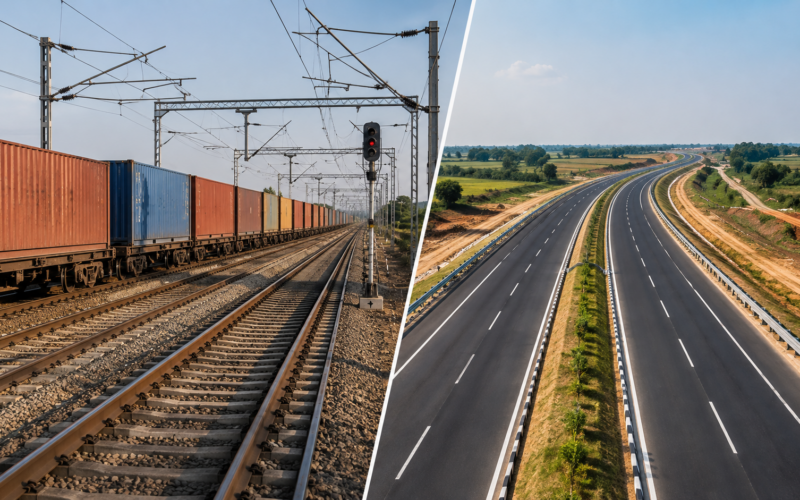
India has approved approximately ₹13,041 crore of railway and highway investment across five projects, combining four multitracking schemes on heavily used rail corridors with the four-laning of a strategic highway section in Bihar. The railway component carries an estimated cost of about ₹9,450 crore and will add roughly 410 route kilometres of additional track across West Bengal, Odisha, Andhra Pradesh and Tamil Nadu, while the Bihar road project is valued at about ₹3,591 crore.
The rail approvals cover a fourth line between Kharagpur and Bhadrak, a fourth line between Bhadrak and Haridaspur, third and fourth lines between Gummidipundi and Gudur, and third and fourth lines between Cuttack and Paradeep. The road component covers approximately 82.57 kilometres of the Muzaffarpur-Sitamarhi-Sonbarsa section of National Highway 22 and is planned under the Hybrid Annuity Model. Together, the approvals represent a capacity-expansion package focused heavily on eastern freight movement, port connectivity and the Bihar-Nepal border corridor.
Where will the ₹9,450 crore railway investment add new capacity?
The largest rail component is the roughly 173-kilometre Kharagpur-Bhadrak fourth-line project, estimated at about ₹3,352 crore. The corridor forms part of the wider Howrah-Chennai trunk route, where additional tracks can separate some competing freight and passenger movements and reduce the operational pressure created when multiple train categories share constrained sections.
A second fourth line of roughly 75 kilometres will be built between Bhadrak and Haridaspur at an estimated ₹1,583 crore. Further south, the Gummidipundi-Gudur project will add third and fourth lines across roughly 90 kilometres spanning Tamil Nadu and Andhra Pradesh, while the Cuttack-Paradeep scheme will add third and fourth lines over around 72 kilometres in Odisha. Collectively, the four projects add about 410 kilometres to the railway network and are targeted for completion by 2030-31.
The Gummidipundi-Gudur corridor illustrates the industrial logic behind the investment. Earlier government appraisal material identified traffic linked to containers, petroleum products, fertiliser, power plants and cement, with substantial freight moving through the corridor. The additional tracks therefore have implications for industrial logistics as well as passenger-train capacity.

How much additional freight could the four railway projects handle?
Government estimates indicate that the multitracking projects could support roughly 76 million tonnes of additional freight annually once completed, although realised traffic will depend on industrial demand, train planning and the performance of adjoining network sections. The projects collectively serve corridors connecting thousands of villages and a population of roughly six million people, giving them a passenger-connectivity dimension alongside their freight role.
The projects are particularly relevant to eastern India’s port and mineral logistics. Paradeep is a major gateway for coal, iron ore and industrial cargo, while the Kharagpur-Bhadrak axis sits on one of the country’s busiest eastern railway corridors. Adding lines does not automatically eliminate every bottleneck because yards, junctions, port interfaces and downstream sections can remain constrained, but multitracking materially increases the number of train paths available.
This explains why the investment should be viewed as network augmentation rather than four isolated civil works contracts. Capacity on a railway corridor has value when adjoining segments can absorb the traffic, and the concentration of several approvals along interconnected eastern routes suggests a broader effort to increase end-to-end freight throughput.
What will the ₹3,591 crore Muzaffarpur-Sitamarhi-Sonbarsa highway change?
The road component involves four-laning roughly 82.6 kilometres of the Muzaffarpur-Sitamarhi-Sonbarsa stretch of National Highway 22 in Bihar at a capital cost of approximately ₹3,590.73 crore. The project will be developed under the Hybrid Annuity Model and has an indicated construction period of about 30 months.
The corridor is strategically important because it links Muzaffarpur with Sitamarhi and extends toward Sonbarsa near the India-Nepal border. Current travel between Muzaffarpur and the Sitamarhi side of the corridor can take around two hours, while the improved highway is expected to reduce that significantly, potentially to around one hour under better operating conditions.
For freight operators, the economic value will come from more predictable journey times as much as higher road speeds. Four-laning can reduce delays caused by mixed local and long-distance traffic, but the realised benefit will depend on access management, junction design, construction quality and how effectively urban bottlenecks are handled.
Why does the ₹13,041 crore package matter beyond headline construction spending?
The combined package is notable because roughly 72% of the approved investment is directed toward railway capacity, with the remainder going to the Bihar highway. That composition points to freight decongestion as a major policy objective rather than the package being primarily a road-building programme.
The four railway schemes also extend a much larger pipeline of multitracking investment. For example, the government had already approved the Santragachi-Kharagpur fourth line earlier in 2026, while other projects are progressing around Paradeep and Odisha’s mineral and port corridors. The latest approvals therefore fill additional pieces of corridors where incremental sections can increase the utility of capacity already sanctioned elsewhere.
Execution will now become the key variable. Railway projects remain exposed to land availability, utility shifting, statutory approvals and site conditions, while the Bihar highway will have its own land and construction dependencies. Government disclosures themselves acknowledge that these factors can affect both completion schedules and costs.
The ₹13,041 crore approval therefore establishes investment authority and project scope, but it should not be confused with completed expenditure. The more consequential measure over the next several years will be whether the projects are tendered, mobilised and commissioned on schedule, allowing the additional rail paths and highway capacity to translate into lower logistics friction across the affected corridors.
Discover more from Business-News-Today.com
Subscribe to get the latest posts sent to your email.
