


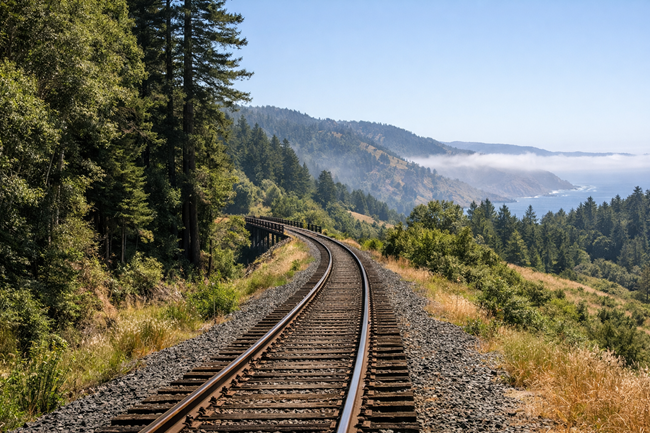
The Surface Transportation Board has issued a unanimous ruling that settles a prolonged regulatory dispute over the future of the Fort Bragg–Willits rail corridor in Northern California, confirming that the 40-mile line will remain part of the national rail network. By denying a petition that sought to remove the corridor from the interstate rail system, the federal regulator preserved the line’s legal status as a rail asset and retained federal jurisdiction over its future use.
The decision does not compel immediate operational changes or dictate specific development outcomes along the corridor. Instead, it establishes a clear institutional baseline that the Fort Bragg–Willits line remains eligible for freight and passenger rail service and cannot be permanently dismantled or converted through administrative removal. In regulatory terms, the ruling prioritizes preservation of rail optionality over irreversible corridor conversion.
For Mendocino County, the outcome reframes the policy discussion. The central question is no longer whether the corridor should continue to exist as a rail asset, but how it should be governed, funded, and integrated with competing land-use objectives under a federally defined rail framework.
Why the Surface Transportation Board rejected removal of the Fort Bragg–Willits rail corridor from the interstate rail system
The Surface Transportation Board’s decision confirms that the Fort Bragg–Willits corridor remains part of the national rail network and retains its classification within the interstate rail system. This designation reflects the Board’s assessment that the corridor continues to hold present and future value for rail service, regardless of fluctuations in current usage levels.
By denying the request for removal, the Board prevented an outcome that would have permanently severed the corridor from federal rail oversight. Such removal would have eliminated eligibility for future freight or passenger operations and foreclosed access to rail-specific regulatory protections and infrastructure programs.
The unanimous nature of the ruling underscores a shared institutional view that the corridor’s long-term transportation value cannot be discounted solely on the basis of near-term utilization patterns. The Board’s determination preserves regulatory continuity and ensures that decisions about the corridor’s future remain subject to federal rail policy rather than piecemeal land-use conversion.
What the ruling preserves for freight rail and logistics planning in Mendocino County
The Surface Transportation Board’s decision maintains the legal foundation for freight rail operations along the Fort Bragg–Willits corridor. For Mendocino County, this preserves a transportation option that remains relevant in a rural region with limited logistics alternatives and long distances between industrial, agricultural, and port-linked activity.
Freight rail access provides optionality for local businesses that may require bulk transport solutions over time. Even where current volumes are modest, the corridor’s continued classification allows future freight demand to be met without the need to reconstruct rail infrastructure from scratch.
From a policy standpoint, the ruling aligns with federal principles that treat freight rail corridors as strategic infrastructure assets whose utility may expand or contract across economic cycles, rather than as disposable rights-of-way.
How passenger rail and the Skunk Train service remain protected under federal rail status
Passenger rail service remains a central component of the Fort Bragg–Willits corridor’s identity and economic role. The line includes the historic Skunk Train operation, which has functioned as a tourism draw and a regional transportation feature in Northern California.
By preserving the corridor within the national rail network, the Surface Transportation Board ensured that passenger and excursion services retain their regulatory footing. This status allows such services to continue operating under federal rail standards and preserves the possibility of future enhancements or service modifications.
The decision also ensures that passenger rail operations remain compatible with broader infrastructure planning efforts, rather than being displaced by non-rail uses that would eliminate the corridor’s transportation function.
How Mendocino Railway is positioning itself as the federally recognized steward of the Fort Bragg–Willits rail corridor
Mendocino Railway, the federally regulated Class III common carrier railroad responsible for operating and maintaining the Fort Bragg–Willits line, characterized the ruling as recognition of the corridor’s public value and long-term relevance.
Robert Jason Pinoli, President and Chief Executive Officer of Mendocino Railway, indicated that the company’s priorities following the decision are to protect the corridor, continue infrastructure investment, and engage constructively with regional partners on sustainable long-term solutions. He emphasized that rail corridors, once removed from the national system, are rarely recovered, making preservation a critical consideration for future generations.
Mendocino Railway reiterated its commitment to maintaining the line in accordance with federal safety and regulatory requirements while pursuing projects that enhance operational resilience and community benefit.
How rail-with-trail development fits within the federal ruling
The Surface Transportation Board made clear that its decision does not prohibit recreational trail development along the Fort Bragg–Willits corridor. Instead, it affirms that trail use may coexist with rail service when planned and implemented in a manner that preserves rail integrity and safety.
This interpretation supports the rail-with-trail model, under which recreational infrastructure is developed alongside active or potential rail operations rather than replacing them. The ruling establishes that any such development must respect the corridor’s continued designation as a rail asset.
By preserving federal rail jurisdiction, the Board ensured that trail proposals remain subject to compatibility requirements rather than serving as a mechanism for de facto rail abandonment.
How Mendocino Railway is seeking a coordinated governance framework with the Great Redwood Trail Agency
Following the ruling, Mendocino Railway called for renewed collaboration with the Great Redwood Trail Agency to pursue a coordinated rail-and-trail approach. The company stated that it respects the agency’s vision for recreational connectivity and views shared-use planning as a viable pathway forward.
Mendocino Railway has emphasized that rail corridors are uniquely positioned to serve multiple public purposes when managed cooperatively. The company has expressed readiness to work with regional stakeholders to preserve freight access, maintain passenger service, and expand trail opportunities without undermining the corridor’s rail function.
This collaborative framing reflects a shift from binary rail-versus-trail debates toward negotiated governance models grounded in federal regulatory clarity.
What Mendocino Railway’s operational experience in California signals about the feasibility of rail-with-trail development
Mendocino Railway has stated that it brings prior experience in developing and maintaining rail-with-trail projects within California. The company owns specialized equipment designed to support trail construction and long-term stewardship alongside rail infrastructure.
By highlighting its operational capabilities, Mendocino Railway has sought to demonstrate that rail-with-trail implementation does not require abandonment of rail service. Instead, it has positioned shared-use development as a technically feasible outcome when supported by appropriate planning, engineering standards, and regulatory compliance.
This experience is presented as a foundation for future cooperation rather than as a unilateral development strategy.
How federally supported infrastructure funding underpins restoration of the Fort Bragg–Willits rail corridor
Mendocino Railway has indicated that it is advancing infrastructure improvements supported by federal programs aimed at restoring full functionality along the Fort Bragg–Willits corridor. These investments are intended to strengthen freight options, preserve passenger rail activity, and maintain long-term transportation flexibility.
The Surface Transportation Board’s decision ensures that such investments remain viable by preserving the corridor’s eligibility under federal rail programs. Without national rail network status, access to these funding mechanisms would be substantially constrained.
The restoration initiatives also reinforce the policy view that rail corridors should be evaluated based on future transportation potential rather than short-term utilization metrics.
Why rail corridor preservation remains a federal policy priority
The Fort Bragg–Willits ruling reflects broader federal policy principles governing rail corridor preservation. Rail infrastructure is treated as a strategic national asset, and removal from the interstate system is approached with caution due to the permanence of such actions.
Once rail corridors are eliminated, reestablishing rail service is typically cost-prohibitive and administratively complex. The Surface Transportation Board’s decision underscores an institutional preference for preserving optionality and preventing irreversible outcomes that could constrain future transportation planning.
This policy framework places long-term infrastructure resilience above near-term land-use pressures.
How the Surface Transportation Board ruling reshapes regional governance and planning in Mendocino County
For Mendocino County and regional planning bodies, the ruling establishes a definitive regulatory baseline. All future proposals involving the Fort Bragg–Willits corridor must operate within a framework that recognizes its continued rail status.
This clarity shifts the planning focus toward governance, coordination, and funding rather than corridor elimination. Freight transport, passenger rail, recreation, and environmental objectives must now be reconciled within a single federally regulated corridor rather than pursued through mutually exclusive outcomes.
The decision also reinforces the role of federally regulated rail operators in shaping corridor development where federal safety and operational standards apply.
What Mendocino Railway’s status as a federally regulated Class III common carrier means for corridor governance
Mendocino Railway operates as a federally regulated Class III common carrier public utility railroad providing freight and passenger service in Northern California. Since 2004, the company has operated and maintained the Fort Bragg–Willits line, including the Skunk Train passenger service.
As a regulated carrier, Mendocino Railway remains subject to federal oversight relating to safety, maintenance, and reporting. The Surface Transportation Board’s ruling confirms that these obligations and authorities remain intact.
The company has stated that it remains committed to safe operations, infrastructure investment, and community partnership as it moves forward under the clarified regulatory framework.
Why the Surface Transportation Board ruling carries national significance
Beyond its local impact, the Fort Bragg–Willits decision carries broader implications for rail policy across the United States. The ruling reinforces federal reluctance to permanently remove rail corridors and affirms that alternative uses must remain compatible with future rail service.
For other regions navigating rail corridor disputes, the outcome illustrates the regulatory weight placed on preserving national rail network integrity. It signals that rail corridors continue to be treated as nationally significant infrastructure even when competing land-use visions emerge.
What the Surface Transportation Board decision ultimately establishes for the Fort Bragg–Willits rail corridor
The Surface Transportation Board’s unanimous ruling preserves the Fort Bragg–Willits rail corridor as an active component of the national rail network and establishes a durable regulatory foundation for its future use. Freight rail, passenger service, and recreational trail development are now positioned within a shared framework defined by federal rail policy rather than corridor elimination.
By maintaining the corridor’s status, the decision protects transportation flexibility, preserves existing rail operations, and reinforces the principle that rail infrastructure, once lost, is rarely recovered. For Mendocino Railway, regional agencies, and Mendocino County, the ruling provides clarity, stability, and a basis for collaborative planning grounded in federal oversight.
The outcome confirms that the Fort Bragg–Willits line remains not only a historic rail route but a protected national rail asset with continuing public value.
Key takeaways from the Surface Transportation Board decision on the Fort Bragg–Willits rail corridor
- The Surface Transportation Board has unanimously denied a request to remove the Fort Bragg–Willits rail corridor from the national rail network, confirming that the 40-mile line remains part of the interstate rail system under federal jurisdiction.
- The ruling preserves the corridor’s legal eligibility for present and future freight and passenger rail service, preventing permanent conversion or dismantling through administrative removal.
- Recreational trail development along the corridor is not prohibited, but must be planned in a manner that is compatible with continued rail use, reinforcing the federal rail-with-trail framework.
- Mendocino Railway retains its role as the federally regulated Class III common carrier responsible for operating and maintaining the corridor, with ongoing obligations related to safety, maintenance, and regulatory compliance.
- The decision establishes a clear regulatory baseline for regional governance in Mendocino County, shifting future discussions toward coordinated planning, infrastructure investment, and shared-use management rather than rail abandonment.
Discover more from Business-News-Today.com
Subscribe to get the latest posts sent to your email.