



What New Emergency Measures Are in Place Across the Florida Keys?
With the 2025 Atlantic hurricane season approaching, Monroe County authorities have launched a wide-ranging upgrade of the Florida Keys’ disaster preparedness infrastructure. In what experts describe as the most hurricane-exposed region in the continental U.S., the county is addressing long-standing vulnerabilities with a reinforced Emergency Operations Center (EOC), a new seawater desalination facility, and an enhanced multi-platform alert system—all designed to mitigate the effects of wind damage, storm surge, and post-storm isolation.
The hardened EOC in Marathon has been built to withstand Category 5 storms. According to Monroe County Emergency Management officials, it will serve as the central command hub for regional coordination, replacing an older facility that sustained repeated storm damage in the past. The new building features advanced communications, emergency dormitories, and medical bays to support prolonged disaster response.
Meanwhile, the Florida Keys Aqueduct Authority (FKAA) has completed a high-output seawater desalination plant capable of supplying safe drinking water to thousands of residents if the mainland pipeline fails. Past hurricanes such as Georges in 1998 and Irma in 2017 severed the pipeline and left the Keys without access to fresh water for days. Officials say the facility will now act as a crucial buffer against that risk.
Why Are the Florida Keys So Vulnerable to Hurricanes?
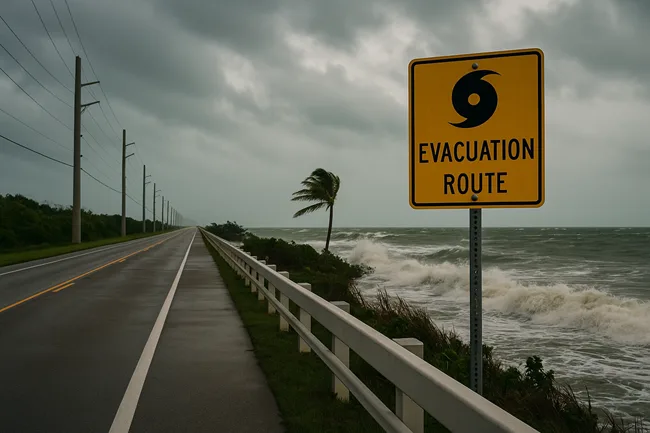
The geography of the Florida Keys makes it particularly susceptible to both immediate and lingering hurricane impacts. The archipelago stretches over 120 miles from the southern tip of Florida and lies at an average elevation of just 3 to 5 feet above sea level. The Keys are connected to the mainland only by the Overseas Highway—a narrow, elevated roadway that often floods or becomes impassable under high winds and storm surge.
Because of these structural limitations, the Keys have always adopted an “evacuation-first” emergency strategy. Emergency Management Director Shannon Weiner reaffirmed the importance of this doctrine during a recent preparedness briefing, stating that “hide from the wind, run from the water” remains the guiding principle for all hurricane-season actions. Officials say that while infrastructure is improving, the safest option will always be to evacuate well before landfall.
What Is Being Done to Secure Water and Energy Supplies During a Storm?
One of the standout upgrades in 2025 is the FKAA-operated desalination plant, a state-of-the-art system located on Stock Island. The plant can produce over one million gallons of fresh water per day using reverse osmosis, which officials say will be vital in case the main supply line from the mainland is disrupted.
To bolster energy resilience, Monroe County has also expanded its network of emergency generators and mobile fuel reserves. These are strategically placed at schools, shelters, and municipal buildings. Fuel contracts have been signed with private distributors to ensure priority delivery for emergency vehicles and generator refueling during an extended outage scenario.
How Will Public Alerts and Communication Be Handled?
Monroe County is implementing a comprehensive communication protocol through its new Emergency Alert System, which includes satellite backup. Officials say the system can broadcast alerts simultaneously via mobile devices, local FM/AM radio, social media, and physical signage along the Overseas Highway.
The county has also developed a color-coded evacuation map tailored to storm categories, which will be distributed both digitally and through local media. In case of network failure, printed advisories will be deployed via first responders and fire stations.
What Specific Plans Exist for Vulnerable Groups and Tourists?
One of the critical focus areas is the safe evacuation of elderly, disabled, and low-income residents. County emergency planners have partnered with nursing homes, assisted-living facilities, and home care agencies to create individualized evacuation protocols. Volunteer groups have been activated to assist with medical transportation and pre-storm sheltering for those unable to drive or afford private transit.
Tourists present an added logistical layer. On any given summer weekend, the Keys can host over 40,000 non-residents. To manage this, the Monroe County Tourist Development Council is now issuing preparedness briefings to hotels, vacation rentals, and Airbnb operators. Hotel guests will receive mandatory storm updates in multiple languages, and visitors will be encouraged to leave 48–72 hours before a storm’s arrival.
What Are the Predictions for the 2025 Hurricane Season?
According to the National Hurricane Center (NHC) and NOAA, the 2025 Atlantic hurricane season could be one of the most active in recent memory. Forecasters expect between 17 to 21 named storms, 8 to 11 of which may become hurricanes, and at least 4 of those reaching Category 3 or above. Climate scientists attribute the heightened activity to persistent warm ocean temperatures in the Atlantic basin and a potential return of La Niña conditions.
Given the rapid intensification trends observed in recent hurricanes, Monroe County officials are urging all residents to prepare early and stay updated through verified emergency channels. The warning is particularly urgent for the Keys, where evacuation can take more than 20 hours from end to end.
How Have Past Hurricanes Shaped Monroe County’s Approach?
Monroe County’s 2025 hurricane readiness reflects years of lessons learned from disasters like Hurricane Irma, which made landfall in Cudjoe Key in 2017 as a Category 4 storm. The storm caused widespread destruction—flattening homes, downing power lines, and severing communication. Post-Irma reports highlighted numerous failures in medical supply chains, fuel distribution, and special-needs evacuation.
In response, the county has tripled funding for emergency training exercises, conducted by FEMA and the U.S. Coast Guard. These drills include helicopter rescue simulations, emergency triage, and temporary shelter deployment. Authorities say these investments have significantly improved response time and inter-agency coordination.
What Does This Mean for Other Coastal Regions?
Experts suggest that Monroe County’s comprehensive strategy could serve as a blueprint for other vulnerable U.S. coastal communities. With similar issues facing barrier islands in North Carolina, Louisiana’s marshlands, and New Jersey’s shore communities, the Florida Keys’ layered approach—combining infrastructure hardening, public communication, and community-based evacuation plans—offers a replicable model.
Funding for many of these upgrades was secured through a combination of state resilience bonds, FEMA disaster mitigation grants, and federal infrastructure funds earmarked after Hurricane Ian in 2022. Monroe County’s aggressive use of public-private partnerships also drew praise from the National Association of Counties, which called it a “case study in targeted resiliency planning.”
Discover more from Business-News-Today.com
Subscribe to get the latest posts sent to your email.