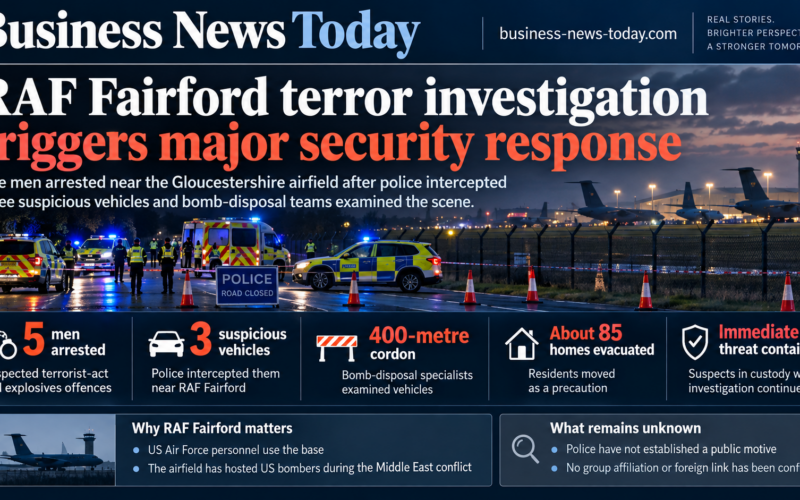
British counter-terrorism police are investigating five men arrested near RAF Fairford in Gloucestershire on suspicion of preparing a terrorist act and committing explosives offences after officers received a report that three suspicious vehicles appeared to be heading toward the military airfield. RAF Fairford hosts United States Air Force personnel and has been used by US bombers conducting operations against Iranian missile sites during the ongoing Middle East conflict. Police said the immediate incident had been contained, but bomb-disposal specialists continued examining vehicles while the suspects remained in custody.
The security response was substantial. Armed officers made the arrests, a roughly 400-metre cordon was established around part of the area and residents from around 85 homes in a nearby village were evacuated while explosive ordnance teams investigated. US President Donald Trump said the suspects had been under investigation by British and American authorities and alleged that they intended to cause significant damage, although British police have not publicly established a motive or identified the suspects’ affiliations.
What exactly happened near RAF Fairford in Gloucestershire on September 27?
British police received a call shortly after midnight concerning three suspicious vehicles apparently travelling toward RAF Fairford. Armed officers subsequently intercepted the vehicles in the Whelford area and detained five men under legislation covering explosives offences, before making further arrests on suspicion of preparing a terrorist act under Britain’s Terrorism Act. Counter Terrorism Policing took the lead in determining what the men were allegedly planning and whether any wider network was involved.
Authorities declared a major incident while specialist teams assessed the vehicles and surrounding area. Roughly 30 emergency vehicles were reported in the wider response, while nearby residents were temporarily moved to a leisure centre as a precaution. Police later said they believed the immediate threat had been contained, allowing investigators to shift from emergency response toward evidence collection and intelligence work.
No attack was reported to have occurred at the base itself. That distinction matters because the investigation concerns suspected preparation and explosives-related activity rather than a completed bombing or confirmed breach of the installation.

Why is RAF Fairford strategically important to the United States and Britain?
RAF Fairford is a Royal Air Force facility that regularly hosts US military aircraft and is designed to support large strategic bombers. The base has been associated with deployments of B-1B Lancer aircraft and other long-range US capabilities, making it one of the most strategically significant American-accessed aviation facilities in Britain.
Its role became more sensitive during the Iran conflict after the British government authorised the United States to use Fairford for strikes against Iranian missile sites linked to attacks on shipping around the Strait of Hormuz. That decision turned an established NATO and US-UK military asset into infrastructure directly connected with the ongoing war.
Iran’s Islamic Revolutionary Guard Corps had previously warned Britain against allowing its territory to be used for US military operations, saying bases supporting attacks on Iran could become legitimate targets. Britain responded that its armed forces were prepared to protect the country. Those earlier warnings do not establish any connection between Iran and the September 27 incident, but they explain why investigators are examining the case within a broader international-security context.
Do investigators know whether Iran, Russia or an Islamist group was involved?
No public attribution has been made by British police. Reuters reported, citing a source familiar with the investigation, that an Iranian-linked motive was being considered the most likely line of inquiry, while possible Russian sabotage or an Islamist plot were also being examined. Those possibilities remain investigative hypotheses rather than established findings.
Counter Terrorism Policing Senior National Coordinator Vicki Evans said the investigation remained at an early stage and that authorities were working with partner agencies to understand the circumstances. Police have not publicly identified the nationalities of the detained men, described any alleged organisation or disclosed the type or quantity of explosive material that may have been involved.
That uncertainty makes careful wording particularly important. The arrests establish that police suspected serious offences, but they do not establish guilt, motive or foreign sponsorship.
Why has security also increased at RAF Lakenheath and RAF Mildenhall?
Reuters witnesses reported additional security at RAF Lakenheath and RAF Mildenhall in eastern England following the Fairford arrests, including armoured vehicles and military personnel at entrances. Both bases have substantial connections to the United States military, making them obvious locations for precautionary measures while the Fairford investigation continues.
Increasing protection at multiple facilities does not necessarily mean authorities have identified a broader active plot. Governments frequently harden comparable sites after a serious security incident because investigators initially cannot know whether one location was the only intended target.
The precaution has particular significance during the Iran conflict because US military infrastructure in Europe supports operations well beyond the continent. Bases used for refuelling, logistics, bomber deployments and communications can become relevant to conflicts in the Middle East even when the host country is geographically distant from the battlefield.
What did Donald Trump say about the alleged Fairford plot?
Trump praised British and US security cooperation and said the men had been under observation for an extended period. He alleged that they were seeking to cause major damage to the base, describing the arrests as evidence that joint intelligence and policing had worked effectively.
Trump’s account adds political context but should not be treated as a substitute for the formal investigation. British police have deliberately released fewer details and have not independently confirmed his characterisation of the suspects’ intended level of damage.
The discrepancy is not unusual during active counter-terrorism investigations. Political leaders may receive classified briefings that cannot be made public, while police restrict disclosures to protect prosecutions and prevent other suspects from learning what investigators know.
Could the arrests affect Britain’s role in the Iran conflict?
The immediate military effect appears limited because RAF Fairford remains under security control and no operational damage has been reported. The more important consequence could be greater protection requirements around British facilities hosting US forces.
Additional perimeter security, intelligence monitoring and explosive detection all consume personnel and resources. If authorities conclude that military sites linked to Iran operations face an elevated threat, measures introduced after Fairford could remain in place for an extended period.
The political debate could also intensify over Britain’s decision to allow American strikes to be launched from UK territory. Supporters may argue the suspected plot demonstrates why Iran-linked security threats need to be confronted, while critics could question whether operational involvement increases risks to communities near military bases. Investigators have not established an Iranian connection, so such political arguments would remain separate from the evidentiary findings in this case.
What are the key takeaways from the RAF Fairford terrorism investigation?
Five men remain central to a counter-terrorism investigation after being arrested near RAF Fairford on suspected explosives and terrorism offences. Three suspicious vehicles, an extensive bomb-disposal response, the evacuation of nearby residents and the strategic role of the base explain why authorities treated the episode as a major incident.
The most consequential facts remain unknown. Police have not established a public motive, identified an organisation or stated whether the suspects possessed a viable device capable of attacking the base.
Until those questions are answered, the strongest factual framing is that British authorities believe they disrupted a potentially serious incident near a US-used military installation and are examining several possible motives. The investigation may ultimately reveal whether the episode was connected to the Iran war, another foreign actor or an entirely different form of extremist activity.
Discover more from Business-News-Today.com
Subscribe to get the latest posts sent to your email.