


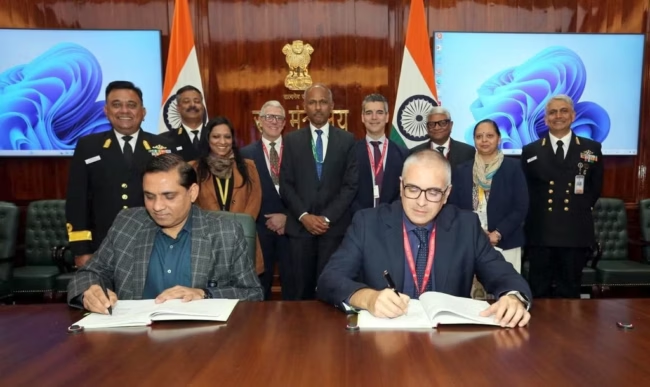
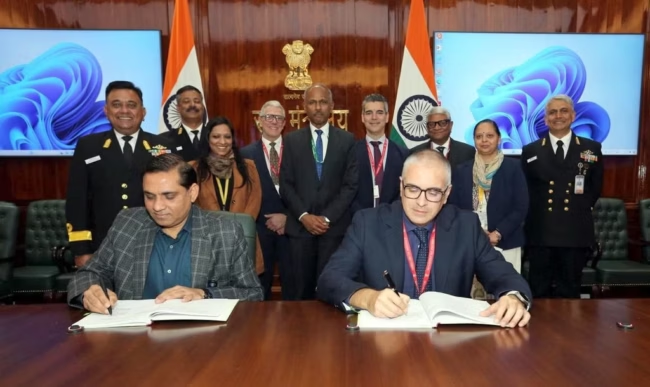
The Fincantieri Group has secured a strategically significant defence contract in India through its underwater warfare subsidiary WASS Submarine Systems, marking a decisive moment in the evolving naval partnership between Italy and India. The agreement, valued at more than €200 million, will see WASS supply Black Shark Advanced heavyweight torpedoes to the Indian Navy for deployment across its six Scorpène-class submarines. For WASS, this is not just another export order. It is the largest contract in the company’s 150-year history and a clear signal that India is moving with urgency to strengthen its underwater combat capability.
The contract spans deliveries from 2028 to 2030, with manufacturing concentrated at WASS’s Livorno facility in Italy. Beyond torpedoes, the scope includes launch systems tailored for Scorpène submarines, maintenance equipment, and spare parts, positioning the deal as a full-lifecycle capability package rather than a one-off procurement. That structure matters, because it embeds long-term operational and logistical dependence, not merely hardware supply.
Why the Indian Navy’s choice of Black Shark Advanced matters for submarine warfare balance in the Indo-Pacific
India’s decision to arm its Scorpène-class fleet with the Black Shark Advanced reflects more than a routine modernization cycle. Heavyweight torpedoes remain the decisive weapon in submarine warfare, especially in contested waters where detection ranges are shrinking and reaction times are measured in seconds rather than minutes. The Black Shark Advanced is already operational with the Italian Navy and several other fleets, giving India access to a combat-proven system rather than an experimental platform.
From a regional security standpoint, the timing is notable. The Indo-Pacific naval environment is seeing rapid submarine expansion, particularly in China’s People’s Liberation Army Navy and among regional middle powers. By equipping its Scorpène-class boats with a modern heavyweight torpedo optimized for high reliability and lower lifecycle costs, India is closing a critical capability gap while extending the effective relevance of its existing submarine fleet.
Just as important is interoperability. The Scorpène design originates from European naval architecture, and aligning weapons systems with that heritage reduces integration risk. The inclusion of customized launch networks underscores that this is not a plug-and-play purchase but a tightly engineered integration effort, minimizing operational friction once the systems enter service.
How WASS turned a torpedo contract into a strategic beachhead in India
For WASS Submarine Systems, the Indian contract is strategically transformative. India has long been a difficult defence market for foreign suppliers due to localization demands, political sensitivities, and shifting procurement rules. Securing a deal of this scale signals that WASS has crossed a trust threshold, positioning itself as a credible long-term partner rather than a transactional vendor.
The company’s leadership has been explicit about viewing India as a growth market, not a one-off opportunity. According to comments attributed to Pierroberto Folgiero, the agreement represents a strategic step in building enduring industrial and institutional partnerships in a region increasingly central to global maritime security. Read between the lines, and the message is clear: Fincantieri is aiming to embed itself deeper into India’s naval ecosystem, potentially paving the way for future cross-selling across shipbuilding, underwater systems, and support services.
This matters because India’s defence procurement philosophy is shifting from platform acquisition to ecosystem building. Suppliers that can demonstrate reliability, lifecycle support, and technology continuity stand to benefit disproportionately as India scales its naval ambitions.
What this deal signals about India’s Scorpène-class submarine roadmap and lifecycle planning
The six Scorpène-class submarines already in service form the backbone of India’s conventional submarine fleet. Arming them with a modern heavyweight torpedo extends their deterrence value well into the 2030s. By committing to deliveries through 2030, India is implicitly signaling confidence in the long-term operational relevance of these boats, even as discussions around next-generation submarines and nuclear-powered platforms continue.
Lifecycle planning is where this deal quietly becomes more strategic. The inclusion of maintenance equipment and spare parts ensures sustained readiness, a lesson hard-learned by navies worldwide that have struggled with availability due to fragmented supply chains. India’s approach here reflects a more mature procurement mindset, one focused on operational uptime rather than headline acquisition numbers.
This also aligns with India’s broader naval doctrine, which emphasizes sea denial and undersea persistence across chokepoints and critical sea lanes. In that context, torpedo effectiveness and reliability can matter as much as submarine stealth.
Why Fincantieri’s India focus is intensifying as global naval competition heats up
Fincantieri’s growing focus on India should be seen against a backdrop of intensifying global naval competition. European shipbuilders and systems integrators are under pressure to diversify beyond traditional NATO markets, where defence budgets are rising but competition is fierce. India, by contrast, offers scale, strategic urgency, and a willingness to engage in long-term partnerships if trust is established.
The WASS contract effectively positions Fincantieri as a trusted supplier in one of the world’s fastest-growing naval markets. That credibility can cascade into adjacent opportunities, from future submarine programs to surface combatant systems and underwater surveillance technologies. The emphasis on cross-selling synergies mentioned by Fincantieri is not incidental; it reflects a deliberate strategy to leverage one successful foothold into a broader portfolio presence.
From an industrial perspective, concentrating production in Livorno preserves high-value manufacturing in Italy while exporting advanced defence technology. That balance is politically and economically attractive, reinforcing Fincantieri’s standing at home while expanding its global footprint.
What the Indian Navy deal signals for Fincantieri Group’s defence earnings visibility and institutional sentiment
Although the contract value of just over €200 million is modest relative to Fincantieri Group’s overall revenue base, its strategic weight is disproportionate. Defence investors tend to value predictability, long-term contracts, and sovereign customers, and this deal checks all three boxes. The multi-year delivery schedule provides revenue visibility, while the Indian Navy’s stature enhances customer quality.
Industry sentiment is likely to interpret this as validation of Fincantieri’s underwater warfare portfolio, an area that often operates in the shadow of headline-grabbing shipbuilding programs. For WASS specifically, securing the largest contract in its history during its 150th anniversary year carries symbolic resonance, reinforcing its positioning as a core rather than peripheral asset within the group.
Over time, analysts will watch whether this Indian engagement translates into follow-on orders or localized industrial collaboration, which could materially alter Fincantieri’s growth trajectory in Asia.
How the WASS torpedo contract could influence India’s next wave of foreign naval partnerships and procurement strategy
Looking ahead, this agreement may serve as a template for how India structures future foreign defence collaborations. The emphasis on integrated systems, lifecycle support, and strategic alignment suggests a preference for depth over breadth. Suppliers that can commit to long-term engagement and technological continuity are likely to gain an edge.
For Fincantieri and WASS, execution will be critical. Deliveries between 2028 and 2030 leave little room for delays or integration setbacks in a market where scrutiny is intense. If executed smoothly, the Black Shark Advanced program could become a reference point that unlocks additional opportunities in India’s expanding maritime security landscape.
In a global environment where undersea warfare is regaining prominence, this deal quietly underscores a larger truth: control of the depths is back at the center of naval strategy, and partnerships that enable that control are becoming increasingly valuable.
Key takeaways: What the WASS torpedo contract means for Fincantieri, India, and global naval competition
- The €200 million-plus Indian Navy contract is the largest in the history of WASS Submarine Systems, materially strengthening Fincantieri Group’s credibility in the global underwater defence market and reinforcing its strategic pivot toward high-value naval systems.
- By selecting Black Shark Advanced heavyweight torpedoes for all six Scorpène-class submarines, the Indian Navy is prioritising proven, lifecycle-efficient undersea lethality over experimental or interim solutions, extending the operational relevance of its conventional submarine fleet well into the 2030s.
- The inclusion of launch systems, maintenance equipment, and spare parts shifts the deal from a one-time weapons sale to a long-term capability partnership, increasing switching costs and embedding WASS deeper into India’s submarine sustainment ecosystem.
- For Fincantieri Group, the contract establishes a durable foothold in India, one of the world’s fastest-growing naval markets, creating a platform for future cross-selling across underwater systems, naval platforms, and support services.
- Strategically, the deal reflects India’s evolving procurement philosophy, favouring trusted foreign partners that can deliver integrated solutions, execution certainty, and long-term support rather than standalone hardware.
- From an industry perspective, the agreement underscores the renewed centrality of heavyweight torpedoes in submarine warfare as Indo-Pacific naval competition intensifies and undersea deterrence regains prominence.
- If executed on schedule between 2028 and 2030, the WASS programme could become a reference case that shapes India’s future foreign naval partnerships, particularly in next-generation submarine and underwater warfare programmes.
Discover more from Business-News-Today.com
Subscribe to get the latest posts sent to your email.