



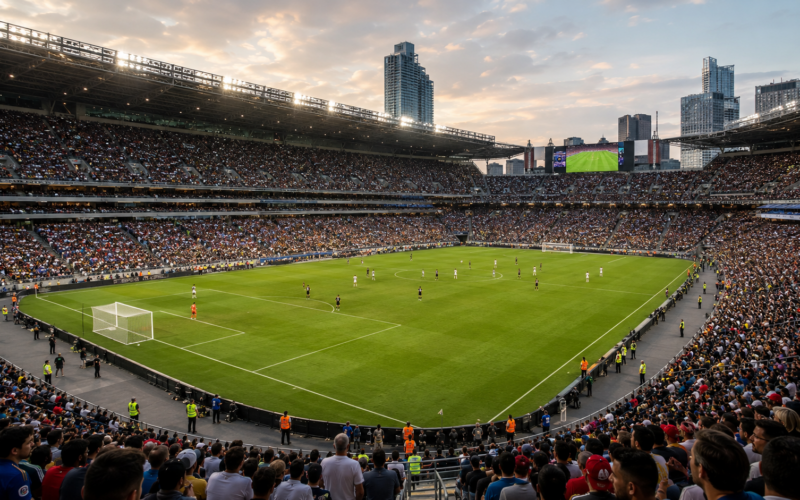
Switzerland beat Bosnia and Herzegovina 4-1 at Los Angeles Stadium in Inglewood, California, on June 18, 2026, June 19 in India, after substitute Johan Manzambi scored twice during a remarkable late transformation in their FIFA World Cup 2026 Group B match. The contest remained goalless until the 74th minute, but Switzerland scored four times during the closing stages after Murat Yakin’s substitutions changed the pace and structure of the game.
Manzambi opened the scoring only three minutes after entering, before Bosnia defender Tarik Muharemovic was sent off in the 80th minute for denying Breel Embolo a clear scoring opportunity. Rubén Vargas doubled Switzerland’s advantage, Manzambi added his second in the 90th minute and Granit Xhaka converted a stoppage-time penalty after Ermin Mahmic had scored Bosnia’s consolation goal with a powerful volley.
The result moved Switzerland to four Group B points and placed them in a strong qualification position. Canada’s subsequent 6-0 victory over Qatar moved the co-hosts above Switzerland on goal difference, leaving both teams level on four points before their decisive final-round meeting.
Bosnia and Herzegovina remain on one point and must beat Qatar in their final group match to strengthen their hopes of reaching the Round of 32. The size of the defeat also damaged Bosnia’s goal difference, which could become important when the tournament’s third-placed teams are compared.
Switzerland vs Bosnia and Herzegovina FIFA World Cup 2026 match scorecard
How did Johan Manzambi transform a goalless contest only minutes after entering?
Manzambi entered in the 71st minute as part of a carefully timed double substitution designed to attack a tiring Bosnian defence. Switzerland had controlled possession for most of the match but repeatedly failed to move the ball quickly enough around Bosnia’s compact defensive block.
The 20-year-old required only three minutes to break the deadlock. A loose defensive clearance fell into his path near the edge of the penalty area, and Manzambi struck a right-footed effort that goalkeeper Nikola Vasilj reached but could not prevent from entering the net.
The goal changed the emotional balance immediately. Bosnia had spent more than 70 minutes protecting their penalty area, blocking passing lanes and frustrating Switzerland’s established attackers. Once Manzambi scored, that defensive certainty disappeared.
His pace also forced Bosnia’s defenders to operate in larger spaces. Switzerland had previously attempted to break the opposition through slower positional attacks, allowing Bosnia time to regroup. Manzambi instead attacked directly, carried the ball forward and placed defenders under pressure before they could organise.
The young midfielder scored again in the 90th minute. Xhaka helped move the attack forward before Vargas reached the byline and delivered a controlled cutback. Manzambi opened his body and guided the ball beyond Vasilj to make it 3-0.
The second finish showed composure rather than only speed. Manzambi recognised the direction of Vargas’s pass, delayed his movement and positioned himself away from the remaining defenders.
His two goals transformed a potentially frustrating draw into a decisive Swiss victory and established him as one of the tournament’s most influential substitutes.
Why did Murat Yakin wait until the second hydration break before making changes?
Yakin’s decision to delay the introduction of Manzambi and Vargas was initially risky. Switzerland had dominated possession but remained unable to score, while Bosnia began creating occasional opportunities before the second-half hydration break.
The Swiss coach believed that Bosnia’s defensive work would eventually create fatigue. Sergej Barbarez’s players had spent long periods moving across the edge of their penalty area, closing spaces and tracking Swiss runners.
Yakin used the hydration break as a tactical window. Instead of introducing his quickest players earlier and allowing Bosnia to adjust, he waited until the defenders had already completed much of their physical work.
Manzambi and Vargas then entered against opponents who were beginning to lose compactness. Their acceleration immediately altered Switzerland’s attack, which became more direct and less predictable.
Vargas played a particularly important role. He scored the second goal by finishing into the bottom corner after Switzerland moved rapidly through Bosnia’s disorganised defence. He later created Manzambi’s second goal with a low cutback.
The decision demonstrated how hydration breaks can influence matches beyond player welfare. Coaches gain several minutes to discuss positioning, prepare substitutions and make structural adjustments without using a conventional stoppage.
Yakin’s patience was rewarded, but the match also raised a selection question before Switzerland face Canada. Manzambi and Vargas provided the urgency that the starting attack lacked, creating a strong argument for one or both players to begin the final group fixture.
How did Tarik Muharemovic’s red card turn a narrow deficit into a heavy defeat?
Bosnia were still only one goal behind when Muharemovic was dismissed in the 80th minute. The defender brought down Embolo just outside the penalty area as the Switzerland striker moved toward goal without another defender positioned to intervene.
The referee judged that Muharemovic had denied an obvious goalscoring opportunity and produced a straight red card.
The decision left Bosnia attempting to chase an equaliser with 10 players against a Swiss team whose substitutes had already increased the pace. Switzerland immediately exploited the additional space.
Vargas scored shortly afterward, making it 2-0 and forcing Bosnia to abandon the compact defensive plan that had worked for most of the match.
Manzambi’s second goal followed as Bosnia struggled to cover the width of the pitch. Switzerland moved possession from the centre toward Vargas on the left, and his cutback found Manzambi in space.
The red card did not cause every Bosnian problem, but it removed the structure that had kept the match goalless. Bosnia’s defenders were forced to make difficult decisions while Switzerland attacked with fresh players.
Goal difference is particularly important in the expanded World Cup format because eight third-placed teams qualify for the Round of 32. Conceding four goals may therefore have consequences beyond this individual defeat.
Bosnia must now beat Qatar and may need to improve their goal difference significantly to strengthen their third-place ranking.
Why did Bosnia and Herzegovina remain competitive for more than 70 minutes?
Bosnia’s defensive approach was disciplined for most of the contest. Barbarez organised his players close to their penalty area, reduced the space available to Embolo and prevented Switzerland’s midfielders from playing clear passes through the centre.
Switzerland circulated possession but struggled to generate high-quality chances. Bosnia’s defenders remained patient and refused to follow attackers into areas that would have opened central gaps.
Edin Dzeko also gave Bosnia an outlet during the first half. Although the veteran striker received limited service, his movement and ability to protect the ball allowed teammates to move forward occasionally.
Bosnia produced one of their strongest periods shortly before the decisive hydration break. They increased their pressing and created openings that could have changed the match had the final action been more accurate.
The failure to score during that period proved costly. Switzerland introduced fresh pace, Manzambi scored, and Muharemovic’s dismissal ended Bosnia’s ability to maintain the same structure.
Mahmic’s stoppage-time goal provided one positive moment. After Gregor Kobel punched a corner toward the edge of the area, the substitute controlled his position and struck a powerful volley into the net.
The goal showed that Bosnia retained attacking spirit despite the scoreline. However, Xhaka’s penalty shortly afterward restored Switzerland’s three-goal margin.
What did Granit Xhaka’s late penalty contribute to Switzerland’s qualification position?
Xhaka scored from the penalty spot in the seventh minute of stoppage time after Djibril Sow was fouled inside the area.
Manzambi was one goal away from a hat-trick, but Switzerland’s captain retained responsibility and placed his left-footed penalty into the bottom corner.
The goal generated discussion because Manzambi had already scored twice. However, Xhaka’s decision reflected the importance of goal difference during the group stage.
Switzerland and Canada are level on four points, but Canada’s 6-0 victory over Qatar created a three-goal advantage in overall goal difference. Switzerland therefore enter the final meeting in second place despite their convincing victory over Bosnia.
Xhaka’s penalty ensured the margin remained three goals rather than two after Mahmic’s consolation strike. That may prove useful if Switzerland lose narrowly to Canada and qualification positions are determined by goal difference.
The captain also played a central role in Switzerland’s control of possession. His passing helped move the ball across midfield and created the sequence that eventually produced Manzambi’s second goal.
The penalty was therefore not merely a statistical addition. It protected Switzerland’s advantage and improved their position within a group that could still produce a complicated final-round outcome.
What does the result mean for the FIFA World Cup 2026 Group B table?
Canada lead Group B on goal difference after following their opening draw with a 6-0 victory over Qatar. Switzerland are second after drawing with Qatar and defeating Bosnia and Herzegovina.
Bosnia sit third ahead of Qatar because their goal difference is less damaging. Both teams have one point and must win their final match to reach four.
FIFA World Cup 2026 Group B points table
| Team | P | W | D | L | GF | GA | GD | Pts |
|---|---|---|---|---|---|---|---|---|
| Canada | 2 | 1 | 1 | 0 | 7 | 1 | +6 | 4 |
| Switzerland | 2 | 1 | 1 | 0 | 5 | 2 | +3 | 4 |
| Bosnia and Herzegovina | 2 | 0 | 1 | 1 | 2 | 5 | -3 | 1 |
| Qatar | 2 | 0 | 1 | 1 | 1 | 7 | -6 | 1 |
Switzerland need one point against Canada to guarantee progress as one of Group B’s top two teams. A victory would send them through as group winners.
Canada are also in a powerful position because their six-goal victory over Qatar created the best goal difference in the group. A draw against Switzerland would secure qualification and first place.
Bosnia and Qatar face each other in a must-win contest. The winner would reach four points and could qualify as one of the eight best third-placed teams, although goal difference will remain a major consideration.
Bosnia currently hold the advantage over Qatar on goal difference, but the four goals conceded against Switzerland have reduced their protection. A narrow win may not be sufficient if several other groups produce third-placed teams with four points and stronger records.
Why does Switzerland’s late 4-1 victory matter beyond the three points?
The performance demonstrated Switzerland’s depth and Yakin’s ability to change a match tactically. The starting team struggled for more than an hour, but Manzambi and Vargas gave the attack a completely different profile.
Switzerland also showed patience. They did not abandon their structure when Bosnia remained organised, and they continued circulating the ball until physical fatigue created larger spaces.
However, the final score should not conceal the earlier problems. Switzerland were slow and predictable for long periods, and Canada’s attacking pace may punish a similar performance.
Bosnia’s collapse was severe, but their campaign remains alive. Beating Qatar would take them to four points and potentially into the knockout phase.
The editorial view is that Switzerland deserved the victory but should treat Manzambi’s impact as more than a one-match story. His pace, directness and composure could become essential as the opposition becomes stronger.
Bosnia must recover quickly. Their defensive plan worked for 70 minutes, but one mistake, one red card and several lost duels transformed a competitive performance into a damaging defeat.
Key takeaways from Switzerland vs Bosnia at FIFA World Cup 2026
- Switzerland beat Bosnia and Herzegovina 4-1 at Los Angeles Stadium on June 18, 2026, after all five goals were scored during the final 23 minutes.
- Johan Manzambi entered in the 71st minute and scored twice, breaking the deadlock three minutes after coming on and adding his second in the 90th minute.
- Rubén Vargas also came off the bench, scoring Switzerland’s second goal and assisting Manzambi’s second.
- Tarik Muharemovic was sent off in the 80th minute after denying Breel Embolo an obvious goalscoring opportunity.
- Ermin Mahmic scored Bosnia’s consolation goal with a powerful stoppage-time volley.
- Granit Xhaka completed the 4-1 victory with a penalty after Djibril Sow was fouled inside the area.
- Murat Yakin’s substitutions after the hydration break changed the match by introducing greater pace against a tiring Bosnian defence.
- Canada lead Group B on goal difference after beating Qatar 6-0, while Switzerland sit second with the same four-point total.
- Switzerland need a draw against Canada to guarantee a top-two place, while Bosnia must beat Qatar to strengthen their qualification prospects.
Discover more from Business-News-Today.com
Subscribe to get the latest posts sent to your email.