


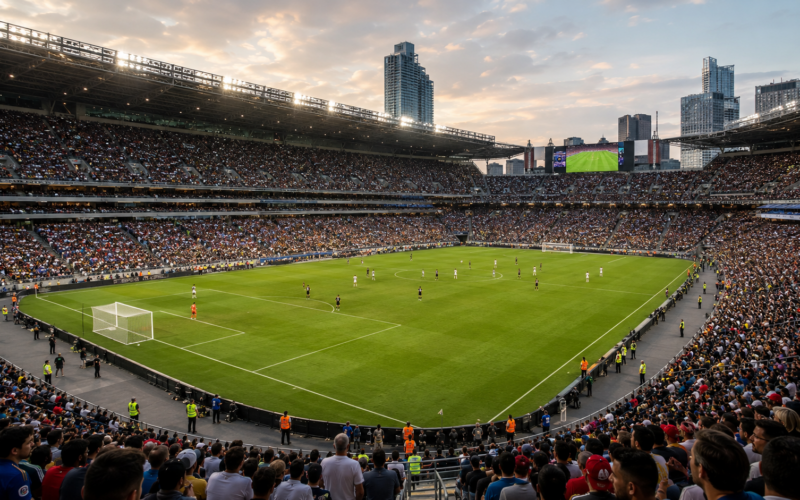
Spain reached the FIFA World Cup 2026 final with a 2-0 win over France at Dallas Stadium in Arlington, Texas, on Tuesday, July 14, 2026. Mikel Oyarzabal opened the scoring from the penalty spot in the 22nd minute after Lamine Yamal was fouled by Lucas Digne, before Pedro Porro doubled the lead in the 58th minute.
The semi-final was a statement win rather than a narrow escape. Spain controlled the tempo, protected central spaces and denied France’s attacking trio of Kylian Mbappé, Ousmane Dembélé and Michael Olise the rhythm that had powered Les Bleus through the tournament.
France had arrived as one of the most dangerous attacking teams at FIFA World Cup 2026, but Spain reduced them to frustration and limited them to only two shots on target. Yamal later had a goal ruled out for offside, while Desiré Doué and Mbappé produced France’s most notable late moments without changing the result.
Spain will now face the winner of England vs Argentina in the final at East Rutherford, New Jersey, on Sunday, July 19. France’s bid to reach a third consecutive World Cup final is over, and Didier Deschamps’ side will instead play the third-place match in Miami Gardens against the loser of the second semi-final.
FIFA World Cup 2026 France 0-2 Spain full match scorecard and decisive incidents
How did Spain turn France’s attacking strength into a tactical weakness from the opening phase?
Spain’s victory began with the way they denied France the kind of game France wanted. Deschamps started with Mbappé, Dembélé, Olise and Barcola in a forward-heavy structure, but Spain’s midfield control meant those attackers spent too much time waiting for service and too little time running at a broken defensive line.
Rodri, Fabián Ruiz and Dani Olmo gave Spain enough central security to control both the ball and the second ball. That made France’s front line look disconnected because Spain kept cutting off the pass before the danger could even begin. The French forwards were not simply quiet because they missed chances. They were quiet because Spain starved them of good situations.
The early minutes already showed the pattern. Spain pressed France’s first pass, kept Maignan under pressure and forced the French back line into rushed decisions. When Rabiot was booked early for a foul on Olmo, it also removed some of France’s ability to contest midfield aggressively.
The semi-final therefore became less about star power and more about structure. France had the bigger attacking names, but Spain had the cleaner distances, better spacing and sharper collective timing.
Why did Lamine Yamal’s penalty-winning moment expose France’s left-side problem?
The first goal came from a moment that captured France’s problem on their left flank. Digne tried to control and clear a deep ball in the penalty area, but Yamal read the situation quicker, stepped across him and forced the foul. Oyarzabal then converted from the spot in the 22nd minute.
That sequence mattered because it was not an isolated mistake. Yamal had already begun stretching Digne with his movement, and France never fully solved that matchup. Every time Yamal received on the right, France had to decide whether to double him, back off or risk being beaten in the first duel.
Oyarzabal’s penalty also changed the match state in a way France had not experienced during this tournament. It was the first time either team had trailed at FIFA World Cup 2026, and France’s response was strangely flat. The drinks break gave Deschamps a chance to reset the players, but Spain’s grip only tightened.
For Spain, the goal was more than a scoreboard advantage. It validated their plan. They had targeted the right-sided channel, trusted Yamal to provoke panic and gave Oyarzabal the platform to turn control into a lead.
How did Pedro Porro’s second goal show Spain’s superiority in movement and decision-making?
Porro’s goal in the 58th minute was Spain’s best attacking sequence of the night and the clearest proof that France were being pulled apart. The move began with Spain carrying the ball through midfield, then switching the angle before Porro combined with Olmo and broke into the box.
The finish was calm and precise. Porro side-footed low past Maignan, turning a tight semi-final into a match France suddenly looked incapable of rescuing. The goal was not just about the final strike. It was about the speed of Spain’s passing, the timing of the third-man run and France’s inability to track movement after the first defensive line had been bypassed.
Olmo’s role was crucial because he gave Spain the bounce pass that opened the box. By taking contact and still releasing the ball, he showed why Spain’s attacking midfield structure is so hard to defend. Even when the final scorer is a full-back, the move is created by collective timing.
For Porro, the moment carried added significance because he had also defended well against France’s left-sided attacks. He was later named player of the match, and the award made sense because his performance represented Spain’s wider balance: technical control, defensive discipline and decisive attacking contribution.
Why did France fail to create pressure even after Spain gave them more ball late on?
France’s second-half problem was not only that they were two goals down. It was that they never looked fully convinced about how to get back into the match. Spain were happy to hold their shape after the second goal, but France still struggled to turn territory into panic.
Mbappé had a tight-angle shot saved by Simón after driving past Porro, and Doué had one of France’s clearest late openings after Simón came far out of his goal. But the hesitation in that Doué chance was telling. France had the moment, but not the rhythm or clarity to punish it.
Dembélé tried to create from the right in stoppage time, while Mbappé sent a late free-kick chance well over. These were isolated flashes rather than sustained pressure. Spain’s defenders kept winning the timing battle, especially Cucurella, who repeatedly closed central lanes and celebrated defensive interventions as if they were goals.
The result was a rare sight: France chasing a semi-final without generating the emotional momentum of a comeback. Spain were not hanging on. They were managing the game.
What did Spain’s defensive record reveal about their evolution under Luis de la Fuente?
Spain are often described through possession and midfield control, but this tournament has also become a defensive story. The win over France gave Spain another clean sheet and underlined why their run has felt so controlled despite the pressure of the expanded FIFA World Cup 2026 format.
Their defensive success is not only about the back four. It begins with ball retention, counterpressing and the way Rodri blocks central access. France could not find clean first passes into Mbappé or Olise because Spain’s midfielders kept reading the direction of play before the ball arrived.
Cucurella and Porro also gave Spain important defensive width. Cucurella handled Olise and later helped cut off Mbappé-linked movements, while Porro balanced his attacking role with discipline against Barcola and later Doué. That full-back balance made France look narrower than they wanted.
The result suggests that Spain have moved beyond the old caricature of possession without punch. This team can defend, press, run, rotate and score through multiple channels. That is why they are now one match from a second World Cup title.
Why did Yamal’s disallowed goal still underline Spain’s confidence after the second goal?
Yamal’s 61st-minute finish did not count, but it still said plenty about the match. He received on the right, entered the box and curled a shot into the top corner, only for the offside flag to save France from a third concession.
Even though the goal was ruled out, the sequence showed how exposed France had become. They were chasing the game, but Spain were still the side finding cleaner attacking patterns. Yamal’s movement kept forcing France into reactive defending rather than controlled pressing.
The timing also mattered. Porro had just made it 2-0, and France needed a period of stability. Instead, within minutes, Spain had the ball in the net again. The offside decision prevented the score from becoming embarrassing, but it did not change the tactical message.
Yamal’s tournament has increasingly been about more than highlights. Against France, he won the penalty, stretched the defence, produced a disallowed finish and forced Deschamps to confront a flank France never controlled.
What does Spain 2-0 France mean for the FIFA World Cup 2026 final route?
Spain are into their second men’s World Cup final, 16 years after winning the 2010 title in South Africa. The next step is the final at East Rutherford, New Jersey, where they will face either England or Argentina.
That final route is loaded with meaning regardless of the opponent. England would bring a rematch feel after Spain beat England in the Euro 2024 final. Argentina would bring the reigning world champions, Lionel Messi’s final-stage aura and a chance for Spain to deny a historic title defence.
France now move into the third-place match rather than the final they had chased for most of the tournament. Their bid to become only the third team to reach three consecutive men’s World Cup finals ended in a match where their attacking identity was completely neutralised.
For Deschamps, the defeat is likely to be remembered as a brutal tactical ending. France had the names, the form and the scoring threat, but Spain had the plan. In a World Cup semi-final, that was the difference.
FIFA World Cup 2026 Spain and France knockout progression table after the semi-final
What must Spain improve before the FIFA World Cup 2026 final in East Rutherford?
Spain’s biggest challenge now is recovery and emotional reset. They produced a near-complete semi-final performance, but a final against England or Argentina will bring a different tactical problem and a different psychological weight.
If England qualify, Spain will face a side with Bellingham’s late-box threat, Kane’s link play and Saka’s direct running. If Argentina qualify, Spain will have to manage Messi’s rhythm, Álvarez’s pressing, Lautaro Martínez’s penalty-box movement and Argentina’s ability to survive chaotic knockout phases.
Spain also need to stay ruthless. At 2-0, they created enough positions to make the game even safer, including Yamal’s disallowed goal and Torres’ late header. A World Cup final may not offer as many clean chances, especially if the opponent sits deeper or attacks through transition.
The positive is that Spain are not relying on one route to goal. Oyarzabal, Porro, Yamal, Olmo, Merino, Ruiz and Torres have all given them different attacking shapes. That variety makes them hard to prepare for in a one-off final.
What must France address after their World Cup final streak ended in Dallas?
France’s immediate issue is not the third-place match. It is the deeper question of why such a talented attack was so completely neutralised in the biggest match of the tournament. Mbappé, Dembélé and Olise were supposed to stretch Spain. Instead, Spain compressed France.
Deschamps’ attacking selection created excitement on paper, but it left France short of midfield control against the strongest possession side in the competition. Once Rabiot was booked and Tchouaméni was forced to chase runners, France lost the battle that mattered most.
The left side will also be heavily scrutinised. Digne conceded the penalty, struggled with Yamal and was eventually replaced. Spain repeatedly found that zone, and France never built a convincing protection system around it.
This defeat does not erase France’s tournament strength, but it changes the tone of their exit. They did not lose a wild shootout or a narrow late scramble. They were methodically outplayed, and that is a more uncomfortable diagnosis for a side built to win the whole thing.
Key takeaways from France vs Spain at FIFA World Cup 2026
- Spain beat France 2-0 at Dallas Stadium on Tuesday, July 14, 2026, to reach the FIFA World Cup 2026 final.
- Mikel Oyarzabal opened the scoring from the penalty spot in the 22nd minute after Lucas Digne fouled Lamine Yamal.
- Pedro Porro made it 2-0 in the 58th minute after a sharp give-and-go with Dani Olmo and a composed low finish past Mike Maignan.
- Spain controlled midfield through Rodri, Fabián Ruiz and Dani Olmo, preventing France from feeding Mbappé, Dembélé and Olise in dangerous areas.
- France managed only two shots on target, a striking number for a team that had been one of the tournament’s most dangerous attacking sides.
- Yamal had a second-half goal ruled out for offside shortly after Spain’s second goal, showing how close the match came to becoming even more one-sided.
- Desiré Doué and Mbappé had France’s most notable late moments, but Spain’s defensive structure and game management held firm.
- Spain recorded another clean sheet and continued a tournament defensive record that has become as important as their possession game.
- France’s attempt to reach a third consecutive World Cup final ended, sending them into the third-place match in Miami Gardens.
- Spain will face England or Argentina in the final at East Rutherford, New Jersey, on Sunday, July 19.
Share this:
Discover more from Business-News-Today.com
Subscribe to get the latest posts sent to your email.