





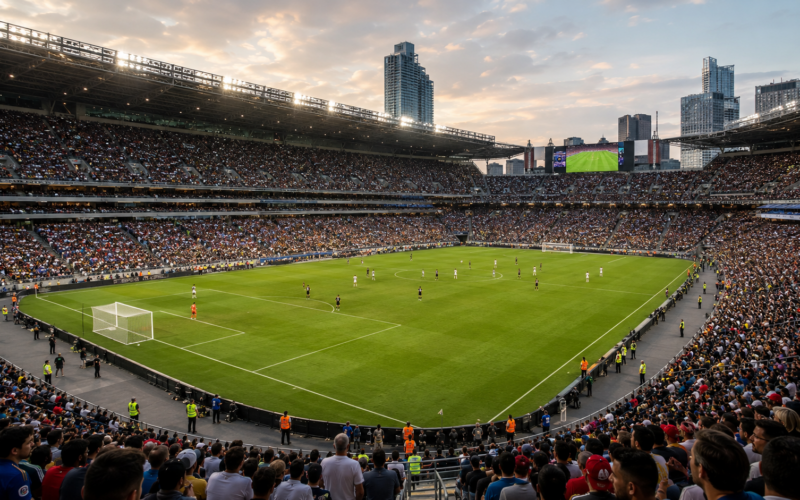
Kylian Mbappé scored twice as France overwhelmed Sweden 3-0 in their FIFA World Cup 2026 Round of 32 match at New York New Jersey Stadium in East Rutherford on Tuesday, June 30, 2026. Bradley Barcola added the second goal during a dominant performance in front of 80,663 spectators.
Mbappé broke the deadlock in the 45th minute after combining with Ousmane Dembélé following a short corner. France had already struck the post twice and seen another Mbappé finish disallowed for offside before the captain finally converted the pressure into a lead.
Barcola doubled the advantage eight minutes after half-time from Michael Olise’s defence-splitting pass. Olise then created Mbappé’s second goal in the 74th minute as France completed another controlled knockout victory.
France advanced with four victories from four matches and will face Paraguay in the Round of 16 in Philadelphia on July 4. Sweden were eliminated after producing only three shots on target and spending long periods attempting to contain France’s movement, passing speed and individual quality.
FIFA World Cup 2026 France 3-0 Sweden full match scorecard and key incidents
How did France turn Sweden’s encouraging opening into a one-sided knockout match?
Sweden began without immediate fear and created the first attempt after Isak found space outside the penalty area. The striker’s low effort was directed towards Maignan, who gathered without difficulty.
That early moment suggested Sweden might threaten through the combined movement of Isak, Gyökeres and Anthony Elanga. The attacking trio attempted to pull France’s centre-backs into wider areas and create room for midfield runners.
France quickly adjusted. Aurélien Tchouaméni remained close to William Saliba and Dayot Upamecano whenever Sweden regained possession, while Adrien Rabiot closed the passing routes towards Isak.
The defensive security allowed France’s four attackers to remain higher. Dembélé, Olise and Barcola rotated behind Mbappé, repeatedly forcing Sweden’s back three to defend different movements.
Sweden survived the first 30 minutes because of Zetterström’s saves and France’s inaccurate finishing. Once the physical effort of shifting across the field began taking effect, France found increasingly large gaps between the Swedish defenders and midfielders.
Why was Michael Olise the player who made France’s attacking structure function?
Olise did not score, but he became the central creative figure in France’s most productive attacks. His movement between Sweden’s midfield and defensive lines repeatedly created passing angles that were unavailable during simpler wide attacks.
He attempted six shots, more than any other France player, and came close to scoring with an overhead kick that struck the post. Zetterström later pushed one of his curling efforts wide and blocked another attempt after Olise broke through centrally.
His greater value came from the precision of his final passes. In the 53rd minute, Olise received possession near the right half-space and waited for Barcola’s diagonal movement.
The pass travelled between the legs of Gustaf Lagerbielke and reached Barcola inside the penalty area. Sweden’s goalkeeper had little time to adjust before the winger finished powerfully.
Olise created the third goal with another perfectly weighted through ball. His five assists at FIFA World Cup 2026 are the most by any player at one edition since Thomas Häßler produced five for Germany in 1994.
How did Kylian Mbappé’s disallowed goal signal the problems Sweden could not solve?
France first placed the ball in the net after approximately 20 minutes. Olise released Mbappé through the space between Sweden’s defenders, and the captain finished beyond Zetterström.
The assistant referee raised the flag for a narrow offside position. The decision protected Sweden temporarily but revealed that their defensive line was struggling to manage Mbappé’s timing.
Sweden attempted to remain compact without defending permanently inside its own penalty area. That required the back three to advance whenever France moved the ball away from goal.
Mbappé repeatedly positioned himself on the outside shoulder of the final defender. Olise and Dembélé then waited for Sweden’s line to move before attempting the pass behind.
The disallowed goal did not discourage France. It confirmed that the route through Sweden’s defence existed, and the same movement eventually contributed to the second and third goals.
Why did the two shots against the posts increase the pressure on Sweden before half-time?
Mbappé struck the first post after France switched possession towards the far side. The forward was left unmarked and directed a first-time effort across goal.
The ball hit the foot of the post before rebounding towards Zetterström. Victor Lindelöf’s position prevented France from converting the loose ball.
Olise then came close to producing one of the tournament’s most spectacular goals. He met a looping clearance with an overhead kick from inside the penalty area.
His effort struck the opposite post, and Dembélé curled the rebound wide. France had therefore hit both uprights within the same attacking period without scoring.
Those misses could have strengthened Sweden psychologically. Instead, they forced Graham Potter’s team to defend even deeper because the danger was arriving from several different players and areas.
France were no longer dependent on Mbappé alone. Olise, Dembélé and Barcola were all capable of becoming the decisive attacker during the next movement.
How did Ousmane Dembélé and Mbappé finally unlock Sweden before half-time?
France won a corner as the opening half approached stoppage time. Rather than delivering immediately into a crowded penalty area, the players used a short routine.
Olise and Dembélé combined before the ball reached Mbappé on the left side of the penalty area. Gyökeres attempted to close the forward but was wrong-footed by Mbappé’s change of direction.
The France captain moved inside and drove a right-footed finish beyond Zetterström. The strike travelled with too much power and precision for the goalkeeper to intervene.
The goal arrived at the worst possible moment for Sweden. Potter’s team had survived extensive pressure and appeared close to reaching half-time level.
Dembélé’s assist also continued an extraordinary partnership. He and Mbappé have now combined for six goals at FIFA World Cups, more than any other pair in the recorded history of the competition.
Why did Bradley Barcola’s goal remove any realistic chance of a Swedish comeback?
Sweden needed to survive the opening phase after half-time and regain attacking control. Instead, France scored their second goal after only eight minutes.
Olise received possession centrally and identified Barcola moving diagonally behind Sweden’s right side. His pass split the defence before the players could close the route.
Barcola controlled and drove a powerful finish beyond Zetterström into the upper part of the net. The goal was his second of the tournament.
The score changed the tactical requirements immediately. Sweden could no longer protect a compact shape and wait for a transition because two goals were required merely to reach extra time.
The wing-backs advanced and the midfield became more aggressive. Those changes created even greater spaces for France’s attacking players.
France continued controlling possession without reducing the speed of their forward movements. The second goal therefore became the point at which the match shifted from a competitive knockout contest towards a demonstration of France’s attacking depth.
Why could Alexander Isak and Viktor Gyökeres not trouble France consistently?
Sweden selected two elite centre-forwards but struggled to provide either with sustained service. Isak and Gyökeres frequently received with their backs to goal and several French defenders positioned nearby.
Tchouaméni protected the central space and reduced the number of direct passes available. Saliba and Upamecano could therefore engage the strikers without leaving large gaps behind them.
Elanga attempted to create transitions from the right, but France’s counter-press prevented Sweden from carrying possession forward after most recoveries. Sweden completed only one corner and seven attempts across the match.
Isak produced the early shot saved by Maignan but became increasingly isolated. Gyökeres worked aggressively without receiving enough passes inside the penalty area.
Sweden’s best first-half chance came from a different source. Elanga crossed towards the far post, where Jules Koundé’s touch redirected the ball towards Elliot Stroud, but the wing-back fired wide.
That miss prevented Sweden from entering half-time level. After France scored twice more, the attacking partnership faced an impossible task against opponents controlling both possession and territory.
How did Mbappé’s second goal add another record to his FIFA World Cup career?
Olise created the third goal in the 74th minute by releasing Mbappé behind Sweden’s tiring defence. The captain moved into the penalty area and lifted a controlled finish beyond Zetterström.
The goal was Mbappé’s sixth at FIFA World Cup 2026 and his 18th across 18 tournament appearances. He moved into second place on the competition’s all-time scoring list, one behind Lionel Messi’s total of 19.
Mbappé also reached ten goals in FIFA World Cup knockout matches. No other player has scored more during the elimination rounds.
The statistics are exceptional because Mbappé is still only 27. His tournament record includes goals in two finals, several multi-goal knockout performances and an average of one goal per appearance.
His wider influence was equally important against Sweden. He drew defenders towards him, created spaces for Barcola and Olise and continued attacking after France established a comfortable lead.
Deschamps removed him in the 85th minute to preserve energy for Paraguay. The captain left after producing one of the most complete attacking performances of the tournament.
Why did Sweden’s substitutions fail to change the direction of the match?
Potter introduced Taha Ali and Besfort Zeneli in the 66th minute. The intention was to add dribbling and creativity from wider positions while France were leading 2-0.
The replacements entered while Sweden’s defensive structure was already beginning to separate. France continued recovering possession quickly and created Mbappé’s second goal eight minutes later.
Benjamin Nygren and Svanberg were added in the 82nd minute, but the match had effectively been decided. Gustaf Nilsson replaced Isak shortly before the end.
Sweden produced two late shots on target. Gyökeres collected a loose ball and drove low towards goal, while Svanberg later tested Maignan from a difficult angle.
Maignan saved both attempts and preserved the clean sheet. The late pressure showed that Sweden retained effort, but the changes arrived too late to reverse France’s control.
Potter’s team had needed to alter the midfield balance before Barcola’s goal. Once France established a two-goal advantage, Sweden’s greater attacking ambition only increased the spaces available to Olise and Mbappé.
What did Didier Deschamps’ return mean during France’s most complete performance?
Deschamps returned to the technical area after travelling home following the death of his mother. The players surrounded and embraced him after Mbappé’s opening goal.
The emotional moment accompanied an important tactical performance. France remained aggressive without losing defensive balance and continued searching for goals after taking the lead.
Deschamps has now won nine FIFA World Cup knockout matches as a coach, more than any other manager. France have also reached at least the Round of 16 in every edition under him.
The attacking quality has changed the perception that France depend primarily on defensive control. Against Sweden, the team produced 25 attempts, 12 shots on target and 3.17 expected goals.
France have scored at least three goals in five consecutive FIFA World Cup matches, the longest such sequence in competition history.
The challenge for Deschamps is maintaining that standard as the opposition becomes stronger. France appear to possess both the individual talent and tactical flexibility required for another deep run.
Why will Paraguay present a different challenge from Sweden in the Round of 16?
Paraguay reached the Round of 16 by eliminating Germany on penalties after a 1-1 draw. Gustavo Alfaro’s team defended 120 minutes, survived 21 attempts and relied on Orlando Gill during the shootout.
France should expect a deeper and more compact defensive structure than the one used by Sweden. Paraguay will accept limited possession and concentrate players around their own penalty area.
That approach could reduce the space available behind the defensive line. Mbappé, Barcola and Dembélé may receive fewer opportunities to run directly towards goal.
Olise’s creativity will therefore become especially important. France may need to break Paraguay through precise passes, quick combinations and movement around the edge of the penalty area.
Paraguay also possess transition threats through Julio Enciso and Miguel Almirón. France must avoid committing both full-backs forward without protection from Tchouaméni and Rabiot.
The recovery advantage favours France. Paraguay completed extra time and a penalty shootout against Germany, while Deschamps was able to withdraw Mbappé, Olise and Dembélé during the closing stages against Sweden.
How does France’s victory shape the FIFA World Cup 2026 knockout bracket?
France will meet Paraguay at Philadelphia Stadium on Saturday, July 4. The winner will advance to a quarter-final against Canada or Morocco.
The result places France on a route containing two teams that have already produced significant knockout achievements. Paraguay eliminated Germany, while Morocco defeated the Netherlands on penalties.
Sweden’s elimination ends a campaign that included victory over Tunisia, a heavy defeat against the Netherlands and a draw with Japan. They reached the knockout phase as one of the best third-placed teams but encountered the tournament’s most productive attack.
Key takeaways from France vs Sweden at FIFA World Cup 2026
- France defeated Sweden 3-0 and advanced to face Paraguay in the Round of 16.
- Kylian Mbappé had a 20th-minute finish disallowed for offside.
- Mbappé and Michael Olise both struck the post during France’s first-half pressure.
- Ousmane Dembélé assisted Mbappé’s opening goal in the 45th minute.
- Bradley Barcola doubled France’s lead from Michael Olise’s pass in the 53rd minute.
- Olise assisted Mbappé again as the France captain completed his brace in the 74th minute.
- France registered 25 attempts, 12 shots on target and 3.17 expected goals.
- Mbappé reached 18 career FIFA World Cup goals and a record ten in knockout matches.
- Olise recorded his fifth assist of FIFA World Cup 2026.
- France will meet Paraguay in Philadelphia, while Sweden were eliminated.
Share this:
Discover more from Business-News-Today.com
Subscribe to get the latest posts sent to your email.