



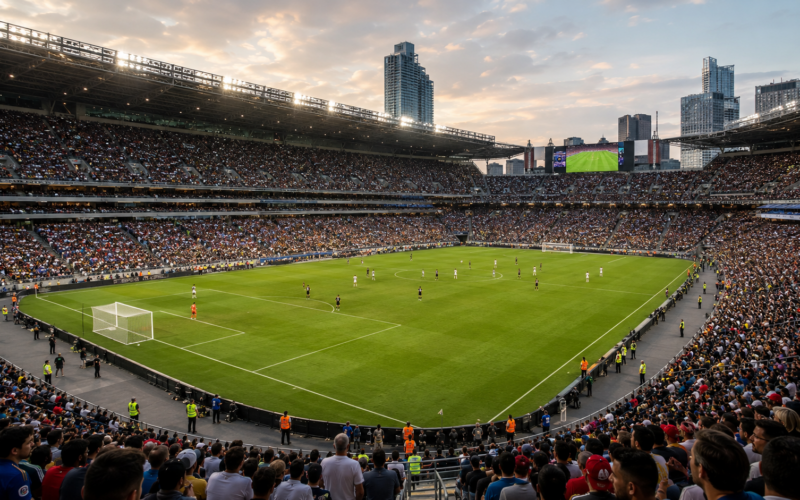
Mexico completed a perfect FIFA World Cup 2026 group-stage campaign by defeating Czechia 3-0 at Mexico City Stadium, also known as Estadio Azteca, on Wednesday, June 24, 2026. The match began at 7pm local time and was watched by an official attendance of 80,824.
Czechia resisted throughout a goalless first half, but Mateo Chávez broke the deadlock in the 55th minute after Luis Romo released the advancing left-back through the defensive line. Julián Quiñones doubled Mexico’s lead six minutes later after Jorge Sánchez’s forward run created a goalmouth scramble.
Substitute Álvaro Fidalgo completed the victory in the fourth minute of second-half stoppage time. Guillermo Ochoa’s long clearance began the move, Santiago Giménez’s shot was saved and Roberto Alvarado supplied Fidalgo, who curled the ball into the top-left corner for his first international goal.
The victory gave Mexico nine points from three matches, six goals scored and none conceded. South Africa finished second after beating Korea Republic 1-0, Korea Republic entered the best-third-place ranking with three points, and Czechia were eliminated after finishing bottom of Group A with one point.
FIFA World Cup 2026 Czechia 0-3 Mexico full match scorecard and key incidents
Why did Czechia’s cautious 3-4-2-1 delay Mexico without creating a genuine path to victory?
Czechia entered the match knowing that victory was necessary to preserve a realistic qualification chance. Miroslav Koubek nevertheless began with a conservative 3-4-2-1 and left senior figures Patrik Schick and Tomáš Souček on the bench.
The three centre-backs protected the penalty area, while the wing-backs dropped alongside them whenever Mexico established possession. This compressed the central space available to Guillermo Martínez and Quiñones and encouraged Mexico to circulate the ball slowly across the defensive and midfield lines.
Czechia’s structure succeeded in keeping the match goalless during the first half, but it did not generate the aggressive attacking response required by their group position. Višinský found an early shooting opportunity, yet Czechia rarely supported Adam Hložek with enough numbers to force Mexico’s defenders into sustained emergency defending.
Their 52% possession was therefore misleading. Much of it occurred outside Mexico’s defensive block, and the 13 attempts produced only one shot on target and an expected-goals total of 0.47.
Mexico, by contrast, were already guaranteed first place and had no need to force the game. Javier Aguirre’s team could remain patient, protect their defensive record and wait for Czechia’s need to attack to create larger spaces after half-time.
How did Mexico’s faster second-half circulation release Mateo Chávez for the opening goal?
Mexico’s first-half play was controlled but frequently too slow. Gilberto Mora and Luis Romo received the ball in midfield, but Czechia’s narrow shape prevented them from consistently finding Quiñones or Martínez between the lines.
The tempo changed after the interval. Mexico began moving possession forward with fewer touches, while Chávez and Sánchez advanced beyond Czechia’s midfield instead of waiting for the ball in deeper positions.
The breakthrough came in the 55th minute when Romo received possession with time to turn and released Chávez behind the Czech defensive line. The left-back accelerated away from the nearest challenge, opened his body and guided a composed left-footed finish beyond Kovář.
It was Chávez’s first senior international goal and demonstrated the importance of Mexico’s full-backs within Aguirre’s 4-3-3. Czechia had concentrated on protecting central areas, but their defensive distances widened as Mexico’s circulation became faster.
The goal also changed the psychological balance. Czechia could no longer protect a draw while waiting for a late opportunity, and their attempts to move forward created precisely the transition spaces Mexico had been seeking.
Why did Gilberto Mora’s movement help create Mexico’s decisive second goal?
Mora became the youngest player to start at the tournament since 2002, but his influence was not based only on age or novelty. The 17-year-old repeatedly received possession between Czechia’s midfield and defensive lines and showed the confidence to carry the ball towards retreating opponents.
His involvement was particularly important before Mexico’s second goal. Mora drove into Czech territory and released Sánchez on an overlapping run down the right, forcing Czechia’s back line to turn towards its own goal.
Sánchez’s initial attempt became part of a crowded goalmouth sequence, and Quiñones reacted more quickly than the defenders to finish from close range in the 61st minute. The goal was officially assisted by Sánchez, but Mora’s progressive carry and pass created the original defensive breakdown.
Quiñones’ finish was his second goal of the tournament. His movement across the front line offered Mexico a different threat from a conventional central striker because he could begin wide, attack the space behind a wing-back and then arrive inside the six-yard area.
The second goal effectively settled the result. Czechia introduced Schick and Souček in an attempt to add physical presence, but Mexico could now defend with greater security and attack the spaces left behind.
How did Mexico’s substitutions protect the result and produce the stoppage-time third goal?
Aguirre responded to the second goal by introducing Giménez and Vargas for Martínez and Romo in the 63rd minute. The changes refreshed Mexico’s pressing and ensured that Czechia could not establish sustained pressure through the centre.
Fidalgo replaced Mora in the 72nd minute and immediately offered controlled passing between the lines. Gallardo later replaced Chávez, while Ochoa entered for Rangel in the 78th minute to make his sixth FIFA World Cup appearance.
The third goal was built by several of those substitutes. Ochoa launched a long pass from his penalty area, Giménez drove forward and forced Kovář into a save, and Alvarado collected the loose ball before finding Fidalgo in the centre.
Fidalgo curled his finish into the top-left corner in the 90+4th minute. It was his first goal for Mexico and converted a comfortable victory into the country’s largest FIFA World Cup win since the 4-0 defeat of El Salvador in 1970.
The substitutions therefore served two purposes. They preserved Mexico’s energy ahead of the knockout stage and maintained the intensity necessary to punish Czechia after the game had already been decided.
What did Guillermo Ochoa’s sixth FIFA World Cup appearance add beyond the clean sheet?
Ochoa entered with Mexico leading 2-0 and received the loudest reaction of the night from the crowd at Mexico City Stadium. The 40-year-old was making his sixth FIFA World Cup appearance and earning his 154th international cap.
His role was largely ceremonial from a defensive perspective because Czechia did not register another shot on target. However, his long clearance initiated the move that led to Fidalgo’s third goal, giving his appearance a direct connection to the final result.
The moment also linked Mexico’s established generation with the younger players shaping the current campaign. Ochoa’s introduction followed Mora’s standing ovation, creating a symbolic transition between a veteran of six tournaments and one of the youngest starters in recent FIFA World Cup history.
Mexico’s clean sheet was shared between Rangel and Ochoa. More importantly, it completed a group stage in which Aguirre’s side did not concede a single goal.
That defensive record provides Mexico with a strong foundation for the Round of 32. The challenge will be retaining the same compactness when they face an opponent with greater pace and attacking quality than Czechia offered.
Why did Czechia finish bottom despite having enough possession and several experienced players?
Czechia’s campaign repeatedly demonstrated the difference between remaining competitive and controlling decisive moments. They scored first against Korea Republic before losing 2-1, surrendered a lead during the 1-1 draw with South Africa and then failed to score in a match they needed to win.
Against Mexico, the team completed enough passes and generated 13 attempts, but most efforts came from low-probability positions. Only Červ tested either Mexican goalkeeper, while Schick’s second-half introduction did not significantly change the quality of service entering the penalty area.
The defensive errors were equally damaging. Chávez was allowed to run through the line for the first goal, Sánchez attacked an exposed channel before the second, and Czechia’s stretched structure could not recover during the move that produced Fidalgo’s late finish.
Koubek later attributed the campaign partly to accumulated fatigue and the extensive travel required between group venues. Those factors may have reduced physical sharpness, but the broader issue was Czechia’s inability to match Mexico’s technical speed when the hosts raised their tempo.
Czechia returned to the FIFA World Cup after a 20-year absence but finished with one point, two goals scored and six conceded. Their next development cycle must improve progression under pressure, attacking support around the striker and defensive decision-making during transitions.
How did the Mexico victory and South Africa result reshape the final Group A standings?
Mexico finished first with three wins, nine points and a goal difference of plus six. They defeated South Africa 2-0, Korea Republic 1-0 and Czechia 3-0 without conceding.
South Africa’s simultaneous 1-0 victory over Korea Republic moved Hugo Broos’ team into second place with four points. That result secured South Africa’s first appearance in a FIFA World Cup knockout stage.
Korea Republic dropped to third with three points and a goal difference of minus one. Their possible progression depended on how that record compared with the third-placed teams from the remaining groups.
Czechia finished fourth with one point and a goal difference of minus four. Their elimination was confirmed regardless of the other group-stage results.
FIFA World Cup 2026 Group A final points table
What does Mexico’s perfect group stage mean for their Round of 32 route?
Mexico will return to Mexico City Stadium for their Round of 32 match on Tuesday, June 30. Their opponent will be one of the qualifying third-placed teams from Group C, E, F, H or I, with the exact allocation dependent on the final combination of eight third-place qualifiers.
The venue offers Mexico an obvious advantage. They have won all three tournament matches, remain unbeaten in nine FIFA World Cup games at the stadium and have conceded no goals during the current competition.
The knockout stage will nevertheless introduce a different level of risk. Mexico’s group opponents created relatively few clear chances, and Aguirre’s team may encounter a third-placed side with four points and stronger transition quality.
Mora’s emergence, Chávez’s attacking contribution and Fidalgo’s impact from the bench have expanded Mexico’s options. The combination of younger players and experienced figures such as Álvarez, Quiñones and Ochoa has also created significant momentum around the co-hosts.
Mexico must now convert that momentum into a controlled knockout performance. A perfect group stage creates national optimism, but it does not remove the pressure associated with the country’s long wait to move beyond the early knockout rounds.
Key takeaways from Czechia vs Mexico at FIFA World Cup 2026
- Mexico defeated Czechia 3-0 at Mexico City Stadium and completed Group A with three victories.
- Mateo Chávez opened the scoring in the 55th minute after a through ball from Luis Romo.
- Julián Quiñones doubled the advantage six minutes later following an attacking run by Jorge Sánchez.
- Álvaro Fidalgo scored his first international goal in the fourth minute of stoppage time.
- Roberto Alvarado supplied the final assist after Santiago Giménez’s initial effort was saved.
- Czechia recorded 52% possession and 13 attempts but produced only one shot on target.
- Gilberto Mora became the youngest player to start at the tournament since 2002.
- Guillermo Ochoa made his sixth FIFA World Cup appearance and earned his 154th Mexico cap.
- Mexico finished first with nine points, six goals scored and none conceded.
- Czechia finished bottom with one point and were eliminated from the FIFA World Cup 2026.
Discover more from Business-News-Today.com
Subscribe to get the latest posts sent to your email.