



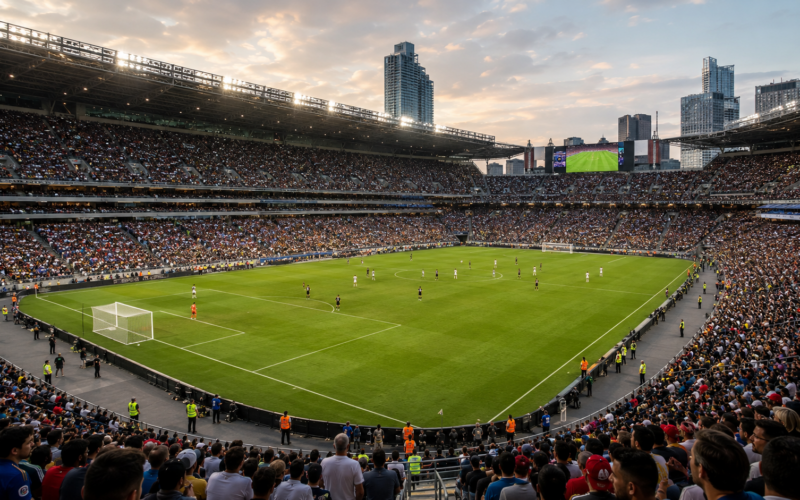
Argentina reached the FIFA World Cup 2026 semi-finals with a 3-1 extra-time win over Switzerland at Kansas City Stadium in Kansas City, Missouri, on Saturday, July 11, 2026. Alexis Mac Allister gave Argentina a 10th-minute lead, Dan Ndoye equalised in the 67th minute, and extra-time goals from Julián Álvarez and Lautaro Martínez finally broke Switzerland’s resistance.
The quarter-final finished 1-1 after 90 minutes, with Switzerland recovering from an early corner-kick concession and threatening to take the match toward penalties despite being reduced to ten men. Breel Embolo was sent off in the 72nd minute after a VAR review changed the original disciplinary decision, leaving Switzerland to defend the rest of normal time and all of extra time with one player fewer.
Álvarez restored Argentina’s lead in the 112th minute with a long-range finish after José López’s layoff, before Lautaro Martínez sealed the result in the 120+1st minute after Gregor Kobel saved Thiago Almada’s initial effort. Lionel Messi did not score, but his corner created Mac Allister’s opener and his influence remained central to Argentina’s attacking rhythm.
The result sets up a high-profile FIFA World Cup 2026 semi-final between Argentina and England in Atlanta on Wednesday, July 15. Switzerland are eliminated after their first World Cup quarter-final appearance since 1954, while Argentina remain on course to become the first team since Brazil in 1962 to retain the men’s World Cup.
FIFA World Cup 2026 Argentina 3-1 Switzerland full match scorecard and key incidents
How did Argentina’s early corner routine expose Switzerland before the match became difficult?
Argentina’s opening goal looked simple, but it came from a clear set-piece weakness. Messi’s corner delivery found Mac Allister at the near area, and the midfielder’s header gave Argentina a 1-0 lead after only 10 minutes. Switzerland had defended compactly from open play in the tournament, but the early lapse gave Argentina the one thing Switzerland could least afford: a lead.
The goal also gave Argentina emotional control in a stadium that felt heavily tilted toward their supporters. Lionel Scaloni’s side could slow the tempo, recycle possession and invite Switzerland to take more risks than Murat Yakin would have wanted so early in a quarter-final.
Yet the early goal did not create a comfortable Argentina performance. Switzerland had started positively, and they did not collapse after conceding. Their response showed why this was not merely a survival team hoping for penalties, but a disciplined side capable of applying pressure with Ndoye, Embolo, Xhaka and Rodríguez.
The first half therefore carried two truths at once. Argentina had the lead and the better tournament pedigree, but Switzerland had enough structure and belief to make the match increasingly uncomfortable.
Why did Switzerland’s second-half response expose Argentina’s defensive unease?
Switzerland’s best spell arrived after half-time, when they pushed higher and began testing Emiliano Martínez more consistently. Dan Ndoye’s movement from the left, Rodríguez’s passing and Xhaka’s control helped Switzerland turn possession into danger, something they had struggled to do during the opening half.
The warning signs arrived before the equaliser. Embolo threatened inside the box and was denied by a superb recovery block from Lisandro Martínez, while Ndoye and Xhaka both forced saves from Emiliano Martínez during a spell of sustained pressure.
The equaliser in the 67th minute was deserved on the pattern of that phase. Ndoye combined with Rodríguez, attacked the left channel and finished through Martínez from a difficult angle. It was not a lucky break. It was the result of Switzerland repeatedly finding Argentina’s defensive seams.
For Argentina, the goal continued a worrying trend from their knockout run. They had also conceded twice against Egypt in the previous round, and this match again showed that their back line can be stretched when opponents move the ball quickly into wide and half-space lanes.
Why did Embolo’s red card become the most controversial turning point of Argentina vs Switzerland?
The decisive disciplinary moment arrived only five minutes after Switzerland’s equaliser. Paredes was initially shown a yellow card after a challenge on Embolo, but the review changed the direction of the incident and resulted in Embolo receiving a second yellow card for simulation.
The decision immediately changed the match. Switzerland had just seized momentum and looked capable of asking Argentina more questions, but the red card forced them into a lower, more defensive posture for the rest of normal time and all of extra time.
Yakin and the Swiss players were visibly frustrated because the call did more than punish one incident. It altered the tactical balance of a quarter-final that had become finely poised. With Embolo gone, Switzerland lost their main forward outlet and had to depend more heavily on defensive compactness, set pieces and counterattacking restraint.
Argentina still had to make the extra man count, but from that point the match became a test of patience rather than a level tactical duel. Switzerland’s shape remained stubborn, but the burden of defending deeper for nearly 50 minutes eventually became too heavy.
How did Álvarez and Lautaro Martínez finally break Switzerland’s ten-man resistance?
For long stretches after the red card, Switzerland did exactly what a ten-man team must do. They narrowed the spaces, kept Kobel protected, delayed Argentina’s rhythm and took the contest into extra time. At the extra-time interval, penalties still looked possible because Argentina had not yet turned pressure into clean finishing.
The breakthrough came in the 112th minute, and it came from two substitutes shaping the decisive action. José López, introduced only two minutes earlier, laid the ball off to Álvarez, who bent a powerful long-range finish into the top corner. It was the kind of strike that breaks a low block not through elaborate structure, but through individual quality at the exact moment fatigue has narrowed defensive reactions.
Lautaro then ended the contest in the 120+1st minute. With Switzerland pushing desperately for a final chance, Álvarez helped regain control, Almada’s shot was saved by Kobel and Lautaro followed the rebound to finish calmly. The goal was a classic late knockout sequence: one team chasing, one team waiting to punish the loose second ball.
Argentina’s bench therefore decided the match as much as their stars did. López assisted the winner, Almada created the rebound for the third, and Lautaro delivered the closing goal after starting outside the first eleven.
What did Messi’s performance show even as his World Cup scoring streak ended?
Messi did not score, and that naturally became part of the post-match story because of his extraordinary scoring run at FIFA World Cup 2026. But reducing his match to the absence of a goal would miss his tactical influence.
His corner created Mac Allister’s opener, and his passing rhythm repeatedly pulled Switzerland’s midfield into awkward decisions. He also nearly settled the match in stoppage time when he cut inside and bent a shot narrowly wide, a reminder that Switzerland never fully removed him from the game.
What Switzerland did well was deny Messi the clean central shooting lanes that had defined some of Argentina’s earlier matches. They crowded him at the top of the area, forced him into traffic and made sure that when he did receive between the lines, support arrived quickly.
That defensive effort came at a cost. Switzerland’s focus on Messi opened pockets for others, and Argentina eventually used Álvarez, Lautaro, Almada and López to decide the game. That is the uncomfortable reality for opponents: stopping Messi from scoring no longer guarantees stopping Argentina.
Why did Argentina’s statistics reflect control even though the match felt tense?
The final statistics show why Argentina deserved to advance on volume, even if the emotional feel of the game was more dramatic than comfortable. Argentina had 59% possession, 23 total shots and seven shots on goal, while Switzerland finished with 13 shots and five on goal.
The expected goals difference also leaned clearly toward Argentina, 2.55 to 0.88. That gap reflected the pressure Argentina built after the red card, the rebound situations late in extra time and the quality of their final chances.
Yet statistics alone do not capture Switzerland’s danger during their best spell. Before Embolo’s dismissal, they had unsettled Argentina, forced saves from Martínez and shown enough attacking confidence to make the equaliser feel earned rather than surprising.
That is why Scaloni’s team will view the match with mixed emotions. The numbers validate Argentina’s superiority, but the performance also confirms that they are spending too much energy surviving difficult knockout phases before finally finding a solution.
What does Argentina 3-1 Switzerland mean for the FIFA World Cup 2026 semi-final route?
Argentina’s win completes the FIFA World Cup 2026 semi-final line-up. France will face Spain in one semi-final, while Argentina will face England in the other. It is a heavyweight final-four bracket made entirely of former World Cup winners.
For Argentina, the semi-final against England brings a historic emotional layer, but the tactical issue is more immediate. They have now been dragged into extra time twice in three knockout matches and conceded three goals across their last two games. England also needed extra time against Norway, so the physical toll may be broadly even, but Argentina cannot afford another slow defensive reset.
For Switzerland, the elimination is painful because the opportunity was real. They had not reached a World Cup quarter-final since 1954, they equalised against the reigning champions, and they were playing their best football when the red-card decision changed the game.
Still, Switzerland’s tournament should not be judged only by the ending. They reached the last eight, pushed Argentina deep into extra time and showed that their structure, midfield experience and attacking width can trouble elite opposition.
FIFA World Cup 2026 Argentina and Switzerland knockout progression table after the quarter-final
What must Argentina improve before facing England in the semi-final?
Argentina’s first concern is defensive control after taking the lead. They scored early against Switzerland but allowed the match to drift into a phase where the Swiss looked increasingly confident. Against England, that kind of control gap could be punished by Jude Bellingham, Harry Kane, Bukayo Saka or England’s late runners.
The second concern is physical load. Argentina have now had two extremely demanding knockout matches, and the Switzerland game required extra time after another emotionally intense contest against Egypt. England also played extra time against Norway, but Argentina’s repeated need to recover from pressure phases is still a warning sign.
Scaloni will also need to think carefully about his midfield balance. Paredes helped control early possession, Mac Allister scored and Messi created, but Switzerland found space after half-time. England’s midfield will likely press harder and run more directly through transition.
The positive is Argentina’s problem-solving depth. Álvarez scored the winner, Lautaro came off the bench to score, Almada helped create the third, and López made an instant impact. That gives Scaloni more options than a Messi-only narrative would suggest.
What must Switzerland address after a painful but impressive World Cup exit?
Switzerland’s immediate frustration will centre on the red card because they were in the match and had momentum when Embolo was dismissed. But the deeper lesson is that they came close because of their structure, not because Argentina were poor.
Yakin’s side defended well for long periods, recovered from conceding early and used the left side effectively through Rodríguez and Ndoye. Their equaliser showed composure, not panic, and their ability to hold Argentina until the 112th minute with ten men was a major statement of resilience.
The biggest area to improve is attacking redundancy. Johan Manzambi’s absence reduced their scoring options, Embolo’s dismissal removed their central outlet, and once Ndoye was substituted, Switzerland had fewer ways to stretch Argentina.
Still, Switzerland leave FIFA World Cup 2026 with their reputation strengthened. They reached the quarter-finals for the first time in more than seven decades, pushed the defending champions into extra time and showed that their next tournament cycle can be built around more than defensive discipline alone.
Key takeaways from Argentina vs Switzerland at FIFA World Cup 2026
- Argentina beat Switzerland 3-1 after extra time at Kansas City Stadium on Saturday, July 11, 2026, to reach the FIFA World Cup 2026 semi-finals.
- Alexis Mac Allister opened the scoring in the 10th minute with a header from Lionel Messi’s corner.
- Dan Ndoye equalised in the 67th minute after combining with Ricardo Rodríguez and finishing through Emiliano Martínez.
- Breel Embolo was sent off in the 72nd minute after a VAR review changed the original disciplinary decision and produced a second yellow card for simulation.
- Switzerland defended bravely with ten men and forced extra time, but Argentina’s pressure eventually broke through in the 112th minute.
- Julián Álvarez scored the decisive goal with a long-range finish after José López’s layoff.
- Lautaro Martínez sealed the result in the 120+1st minute after Gregor Kobel saved Thiago Almada’s shot.
- Argentina led the match statistics with 59% possession, 23 shots, seven shots on goal and 2.55 expected goals.
- Messi did not score, ending his scoring streak, but his assist for Mac Allister’s goal kept him influential.
- Argentina will face England in the semi-finals in Atlanta, while Switzerland are eliminated after their deepest World Cup run since 1954.
Discover more from Business-News-Today.com
Subscribe to get the latest posts sent to your email.