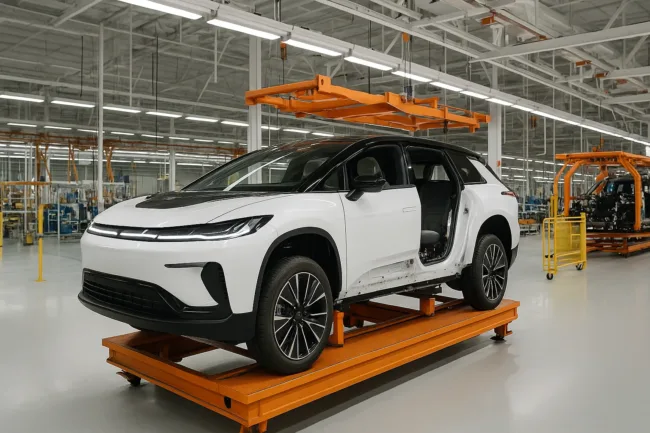
Faraday Future Intelligent Electric Inc. (NASDAQ: FFAI) announced this week that it has commenced the trial production phase of its newly unveiled FX Super One electric multipurpose vehicle (MPV) at its 1.1-million-square-foot facility in Hanford, California. This milestone marks a significant step in the long-delayed effort by the California-based electric vehicle manufacturer to bring its second model to market, following years of restructuring, fundraising hurdles, and volatile public trading performance.
Trial production at the Hanford site will be used to validate manufacturing workflows, train staff, and refine operational standards. The vehicle will then enter a critical engineering phase, including extensive safety testing and system validation, ahead of its commercial launch. The FX Super One was first unveiled on July 17 in Los Angeles, highlighting an AI-centric luxury experience the automaker claims could challenge legacy brands like General Motors’ Cadillac Escalade.
The FX Super One is being positioned by Faraday Future as a new category of “EAI-MPV”—an electric, AI-embedded multipurpose vehicle—which features the company’s proprietary Super EAI F.A.C.E. (Front AI Communication Ecosystem) and a 6×4 AI agent architecture designed to create a fully connected, semi-autonomous experience.
How is Faraday Future positioning the FX Super One as a luxury alternative to traditional MPVs?
The FX Super One marks a strategic pivot by Faraday Future toward a broader premium customer base. Unlike the flagship FF 91—a high-end sedan with limited volumes and a six-figure price tag—the FX series is intended to deliver a “First Class” AI-enabled experience in an MPV configuration that appeals to both families and executive transport markets.

The Super EAI F.A.C.E. system is a central part of this strategy. It enables interactive front-end AI communication between the vehicle and its environment, intended to provide a more intelligent in-cabin and external interface experience. Alongside it, the FF EAI Embodied AI Agent 6×4 architecture introduces multiple AI-driven subsystems tailored to driving, personalization, infotainment, safety, and predictive maintenance.
Faraday Future has described the FX Super One as “redefining traditional mobility” and challenging a segment long dominated by gasoline-powered offerings like the Cadillac Escalade. By layering proprietary AI-driven software features onto an all-electric platform, the company hopes to differentiate itself in a crowded but fast-evolving mobility landscape.
What is the significance of the Hanford facility and how much has been invested in its EV readiness?
The Hanford, California facility—branded as “FF ieFactory California”—represents the cornerstone of Faraday Future’s U.S. production ambitions. The company has invested approximately $300 million into the site to date, developing its capabilities to support multi-model EV production.
With appropriate permitting and future capital infusion, Faraday Future expects the Hanford plant could scale to manufacture over 30,000 vehicles annually. Currently, the site supports a flexible production line that could accommodate mixed assembly of FX units and future models.
As part of the trial production rollout, Faraday Future is also training its engineering and operations teams to support next-phase manufacturing. These readiness efforts are critical not just for FX Super One, but for any potential scaling of the FX platform across additional markets.
Analysts view the Hanford site as a key asset that could allow Faraday Future to pivot from ultra-low volume luxury sales to more sustained, production-driven revenue streams—provided the company can manage its supply chain, deliver timely certifications, and overcome investor skepticism built over years of delays.
What are the financial and strategic implications of the FX Super One production phase?
Faraday Future recently secured $105 million in new financing commitments, which it says will nearly cover the FX Super One’s production launch costs. This follows multiple rounds of capital raising since the company’s 2021 SPAC listing, many of which were used to fund FF 91 development, pay down liabilities, and keep operations afloat during a turbulent post-IPO period.
Despite these efforts, Faraday Future’s market capitalization remains compressed and its stock volatile. The company has struggled with investor confidence following executive turnover, delivery delays, and persistent questions over its go-to-market execution. Shares of Faraday Future Intelligent Electric Inc. (NASDAQ: FFAI) have traded under the $1 threshold for extended periods, raising concerns about long-term Nasdaq compliance.
Institutional sentiment toward the FX Super One project appears cautiously optimistic, especially given the targeted lower price point compared to the FF 91 and the promise of AI-integrated feature sets. Analysts note that the FX line could offer a more scalable path to volume production, and potentially improve Faraday Future’s revenue outlook—if the execution is on time and if buyer demand materializes.
The latest funding round, while modest relative to traditional OEM capital budgets, may help Faraday Future avoid further dilution or debt until initial units of the FX Super One reach customers. Whether the company can move beyond early-stage trial production and into commercial readiness in 2026 or earlier remains a central question for investors.
What challenges and future opportunities are emerging as Faraday Future transitions to a multiproduct EV portfolio?
Founded in 2014 with aspirations to disrupt the auto industry, Faraday Future has spent the better part of the last decade navigating financial instability, shifting leadership, and an extremely competitive EV landscape. The FF 91, while technologically ambitious, has seen limited commercial rollout and little traction in luxury segments dominated by Tesla, Mercedes-Benz, BMW, and Lucid Motors.
With the FX Super One and broader FX line, Faraday Future is attempting to reposition itself as a manufacturer capable of reaching mass-market and fleet segments without abandoning its AI-first vision. If successful, the company could begin to carve out a niche in the emerging AI mobility vertical—especially as AI-powered cabins, predictive safety systems, and intelligent infotainment platforms become standard across newer EV launches.
However, the road ahead remains steep. Faraday Future must not only complete production trials and validation for the FX Super One, but also secure crash test approvals, finalize certifications, navigate U.S. regulatory requirements, and establish sales channels. The MPV market, while less saturated than crossover EVs, is still governed by cost sensitivity and brand loyalty—two areas where new players often struggle to break in.
Analysts believe Faraday Future may look to partner with ride-sharing fleets, premium shuttle services, or corporate transport providers to seed early volumes of the FX Super One. Additionally, future FX models could serve as platforms for software-defined vehicle services and connected subscription features, building recurring revenue streams that are increasingly critical to EV economics.
Still, without a broader retail or fleet distribution partner in place, and with limited global footprint compared to incumbents, the FX Super One will need to succeed both as a product and a proof-of-capability to restore long-term confidence in Faraday Future’s business model.
Discover more from Business-News-Today.com
Subscribe to get the latest posts sent to your email.